
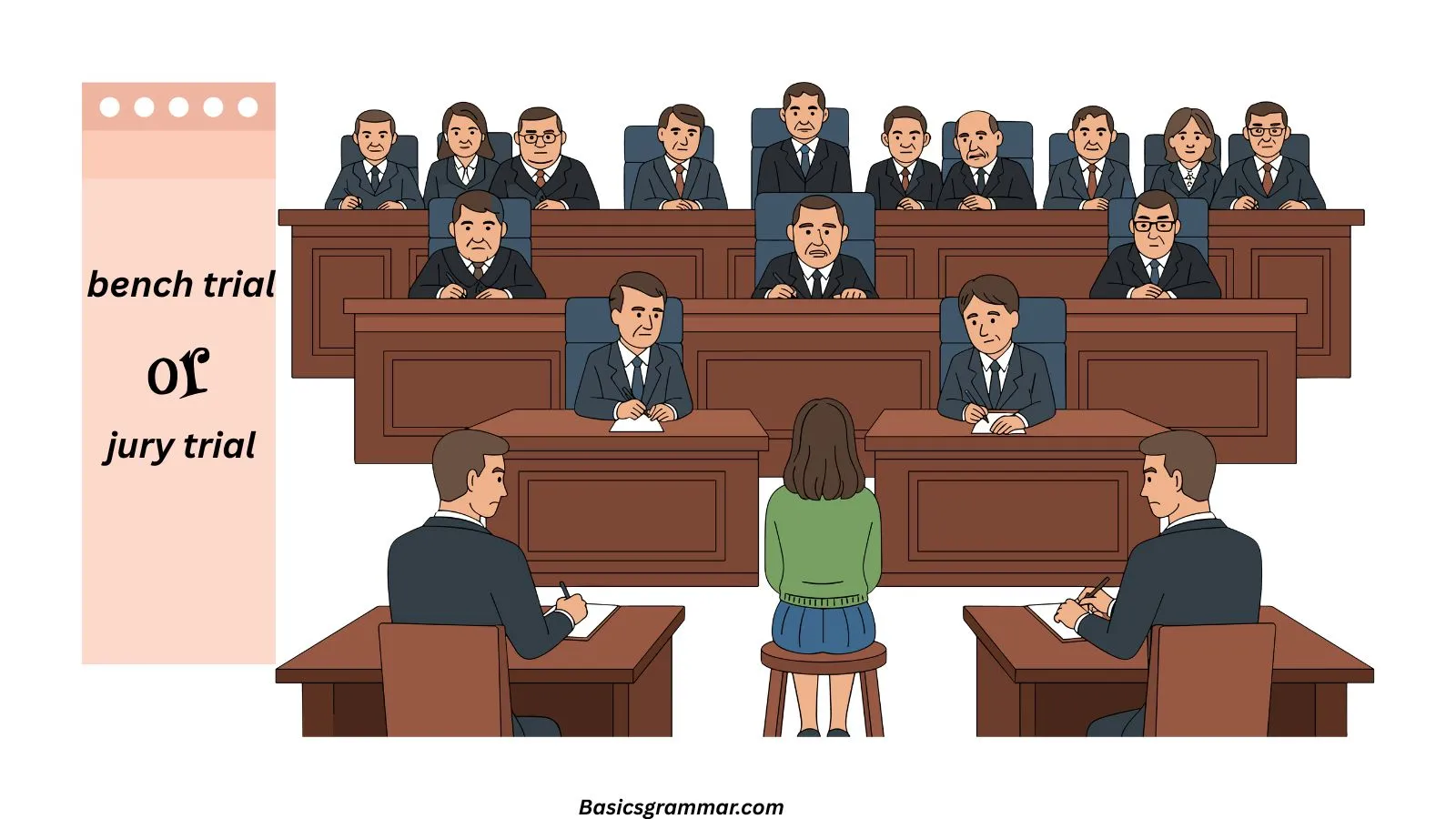
“Bench trial or jury trial” is an often asked question when confronted with a court case. Although the decision seems straightforward, it frequently leads to actual confusion. Many people don’t know what each option entails, how they differ, or which is best for their particular circumstance. Some believe that jury trials are always more equitable. Bench trials, according to others, are quicker and less expensive. Though not always, both theories may be accurate.
This keyword resolves a significant issue. Before making a choice that could impact a case’s outcome, it assists people in understanding their legal choices. Defendants, attorneys, legal students, and even inquisitive readers look for this term to find a concise, understandable definition. Legal jargon, TV shows, and misconceptions about how courts operate are typically the causes of the confusion.
It’s all explained simply in this essay. You will discover what bench trials and jury trials are, how they came to be, how they are employed in various nations, and which option can be best in various circumstances. By the time it’s all over, you’ll have a straightforward response and useful advice devoid of legal nuance.
Legal Definition of Bench Trial and Jury Trial
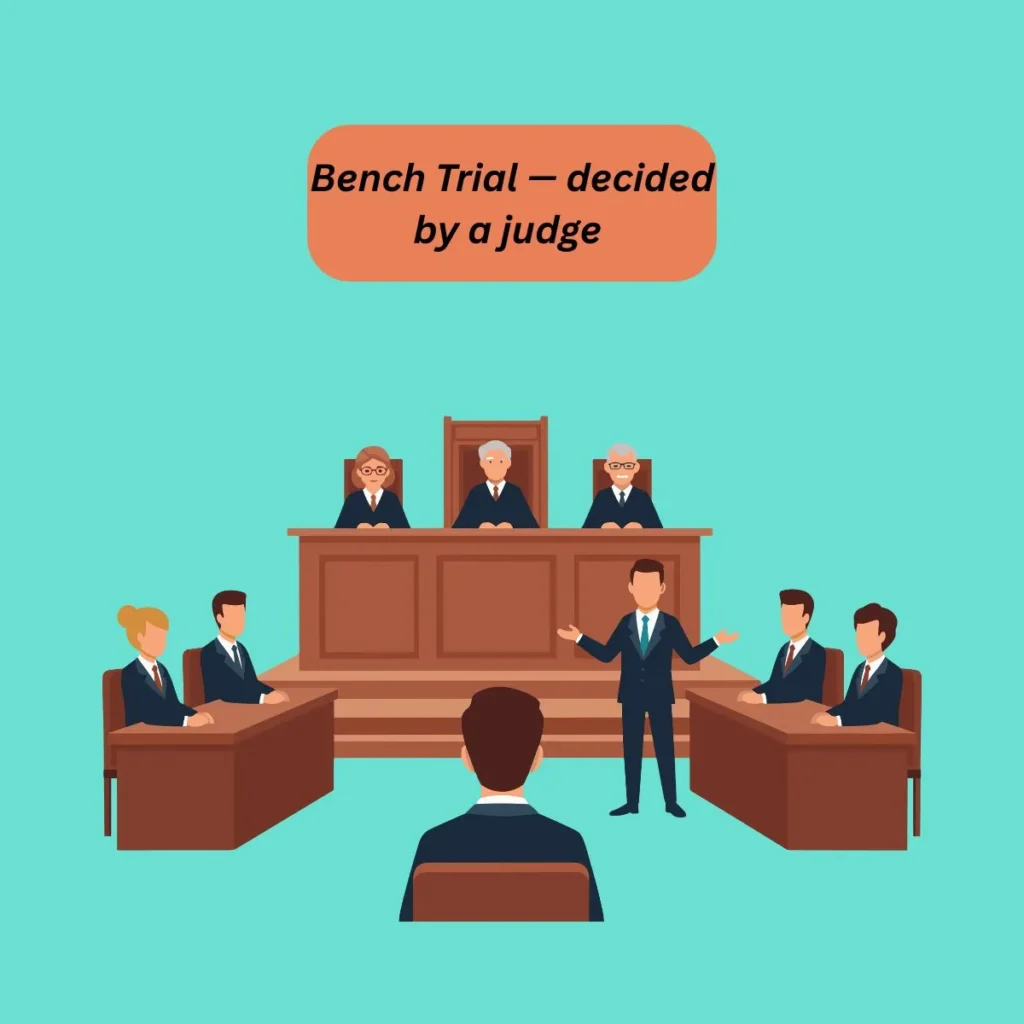
A bench trial is a legal proceeding in which a judge alone hears the case and makes the final decision. The judge reviews the evidence, listens to witnesses, applies the law, and delivers the verdict. There is no jury involved. Bench trials are commonly used in cases that involve technical legal issues, lower-value civil disputes, or when both parties agree to waive a jury.
A jury trial is a legal proceeding in which a group of citizens, called a jury, decides the facts of the case. The jury listens to testimony, examines evidence, and determines guilt or liability. The judge oversees the trial, explains the law, and ensures fair procedure, but does not decide the facts. Jury trials are often required in serious criminal cases and many civil lawsuits.
In simple terms, the key legal difference is who decides the outcome. A bench trial, the judge decides both the law and the facts. In a jury trial, the jury decides the facts, while the judge applies the law. This distinction is central to understanding how courts operate and why the choice between a bench trial or jury trial matters.
When Courts Prefer a Bench Trial Over a Jury Trial
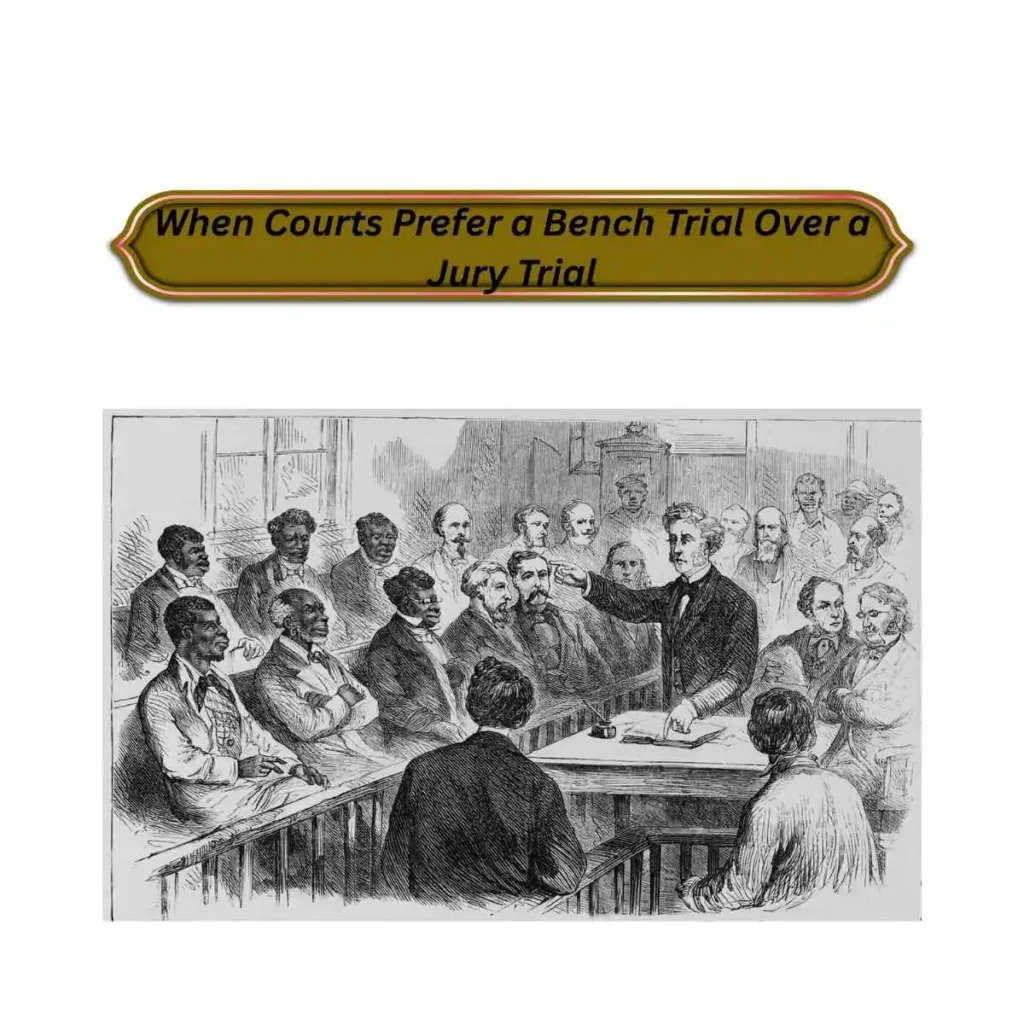
In general, courts prefer a bench trial over a jury trial when a case involves complex legal issues, technical evidence, or straightforward facts. In such situations, judges are better equipped to analyze detailed laws, contracts, and regulations without explaining them to a jury.
Moreover, bench trials are often favored in lower-value civil cases and minor criminal matters because they save time and reduce costs. As a result, courts frequently choose this option to avoid delays caused by jury selection and lengthy proceedings.
Additionally, another common reason arises when both parties waive their right to a jury trial. In these cases, the dispute usually relies more on documents than emotions, or a faster resolution is required.
In short, courts prefer bench trials when efficiency, legal expertise, and speed are more important than jury involvement.
Bench Trial or Jury Trial – Quick Answer
A bench trial is decided by a judge alone.
A jury trial is decided by a group of citizens (the jury).
Example:
- In a bench trial, the judge listens to evidence and gives the verdict.
- In a jury trial, the jury decides the facts, and the judge manages the law.
Bench trials are often faster and simpler. Jury trials are common in serious criminal and civil cases where community judgment matters.
The Origin of Bench Trial or Jury Trial
The term bench trial comes from the judge’s “bench,” the raised seat where judges sit in court. It highlights that the judge alone decides the case.
The word jury comes from the Old French jurée, meaning “sworn oath.” Jury trials began in medieval England, where local citizens swore to tell the truth about disputes.
Over time, common law systems—like those in the US, UK, and Commonwealth countries—kept jury trials as a symbol of public justice. Bench trials developed as a practical alternative for simpler or technical cases.
There are no spelling differences in this keyword. The variation comes from legal systems, not language.
British English vs American English Spelling
There is no spelling difference between British and American English for “bench trial or jury trial.” However, usage and importance differ.
| Aspect | American English | British English |
|---|---|---|
| Spelling | Same | Same |
| Jury trials | Very common | Less common |
| Bench trials | Common option | More standard |
| Legal focus | Constitutional right | Judicial efficiency |
In the US, jury trials are a legal right in many cases. In the UK, bench trials are more typical, especially in lower courts.
Which Spelling Should You Use?
Since there is no spelling difference, your choice depends on audience and legal context:
- US audience: Emphasize the right to a jury trial.
- UK/Commonwealth audience: Focus on judge-led trials.
- Global audience: Explain both clearly and neutrally.
Always match your explanation to the legal system you are discussing.
Common Mistakes with Bench Trial or Jury Trial
Here are frequent errors people make:
- Wrong Thinking jury trials are always better
Right Both have pros and cons - ❌ Believing bench trials mean no fairness
✅ Judges are trained and neutral - ❌ Using the terms as synonyms
✅ They are different trial types - ❌ Assuming you always get a choice
✅ Some cases do not allow it
Bench Trial or Jury Trial in Everyday Examples
Email:
“We opted for a bench trial to reduce costs and speed up the process.”
News:
“The defendant waived the jury trial and chose a bench trial instead.”
Social Media:
“Did you know you can choose a bench trial or jury trial in some cases?”
Formal Writing:
“The case proceeded as a bench trial under state law.”
Bench Trial or Jury Trial – Google Trends & Usage Data
Search interest for “bench trial or jury trial” is highest in countries with common law systems. The United States leads due to frequent jury involvement. Interest spikes during high-profile court cases, legal reforms, and celebrity trials.
The keyword is mostly used in:
- Legal education
- Criminal defense research
- Civil lawsuit preparation
This shows strong informational intent.
Comparison Table: Keyword Variations
| Term | Meaning | Who Decides |
|---|---|---|
| Bench trial | Judge-only trial | Judge |
| Jury trial | Trial with jury | Jury |
| Judge trial | Informal term | Judge |
| Trial by jury | Formal term | Jury |
FAQs
1. What is the main difference between a bench trial or jury trial?
A judge decides in a bench trial. A jury decides in a jury trial.
2. Is a bench trial faster than a jury trial?
Yes, it is usually faster and simpler.
3. Can I choose a bench trial instead of a jury trial?
Sometimes. It depends on the case and the law.
4. Are jury trials more fair?
Not always. Fairness depends on facts, evidence, and presentation.
5. Do all countries allow jury trials?
No. Many countries rely mainly on judges.
6. Are bench trials cheaper?
Often yes, because they take less time.
7. Which is better for technical cases?
Bench trials are often better for complex legal issues.
Conclusion
Selecting between a jury trial and a bench trial is a significant choice. Every choice has a distinct function and is appropriate for various circumstances. Bench trials are quicker, less expensive, and have a distinct legal focus. In many important instances, particularly in the United States, jury trials are essential because they convey communal judgment.
American and British English are identical in spelling, yet they differ significantly in legal practice. More important than the words themselves is knowing your audience and the legal system. People who believe that one type is always superior make a lot of mistakes. In actuality, the case, the evidence, and the strategy all influence the “correct” decision.
For a quick fix, keep in mind that jurors determine jury trials, while judges decide bench trials.
In addition, examining cost, time, and complexity provides a more in-depth understanding.
Therefore, whether you are writing, conducting research, or preparing for court, being aware of these distinctions helps you make confident and well-informed decisions.