Many English learners confuse “engrained” and “ingrained” because the two words sound almost the same. People often hear the words in conversation and assume both spellings work correctly. However, English grammar follows a different rule.
Writers commonly make this mistake in emails, essays, blogs, and social media posts. The confusion usually happens because “engrained” looks similar to the word “engrave.” Even native speakers sometimes type the wrong version without noticing.
If you want your writing to look clear and professional, you need to understand the difference between these words. In this guide, you will learn the correct spelling, meanings, examples, grammar rules, common mistakes, and easy memory tricks.
Quick Answer
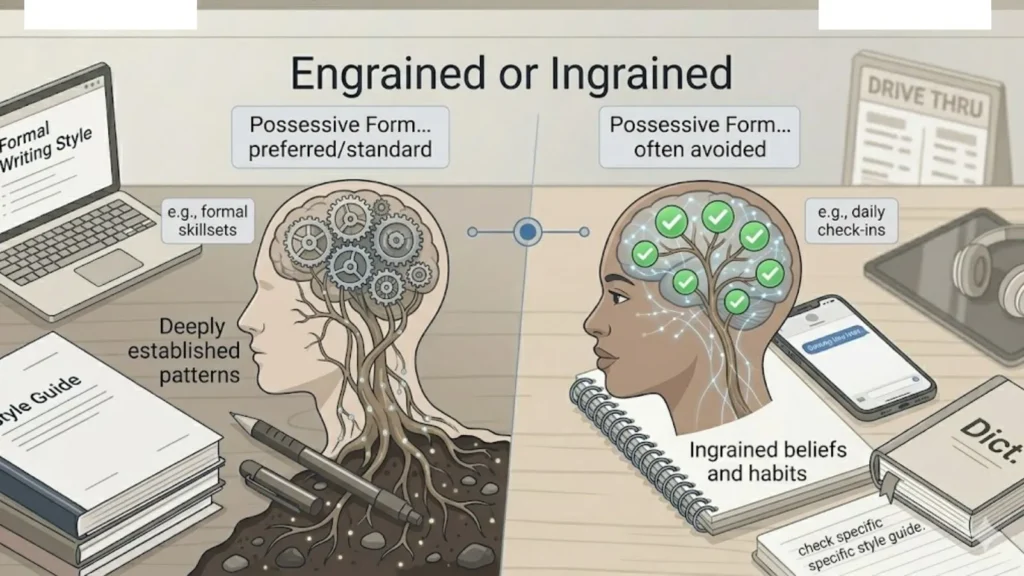
“Ingrained” is the correct word in modern English.
“Engrained” is usually incorrect and should not appear in formal writing.
People use “ingrained” to describe habits, beliefs, traditions, or behaviors that become deeply fixed over time.
Example:
- Hard work became ingrained in his personality.
Meaning and Definition of Engrained or Ingrained
1. Ingrained
Meaning
“Ingrained” means deeply rooted, strongly established, or difficult to change.
Explanation
The word originally described color that soaked deeply into cloth. Later, English speakers started using it for ideas and behaviors that stay fixed in the mind.
Examples
- Good manners become ingrained during childhood.
- Their culture has ingrained traditions.
- She developed ingrained study habits over the years.
2. Engrained
Meaning
“Engrained” usually counts as a misspelling of “ingrained.”
Explanation
Many people connect this spelling to the word “engrave,” which means to carve something into a surface. Because of that connection, writers sometimes believe “engrained” works correctly. However, modern dictionaries and grammar experts prefer “ingrained.”
You should avoid “engrained” in formal writing.
Incorrect Examples
❌ Respect is engrained in their culture.
❌ The habit became engrained over time.
❌ Fear remained engrained in his mind.
Correct Versions
✔ Respect is ingrained in their culture.
✔ The habit became ingrained over time.
✔ Fear remained ingrained in his mind.
Key Differences Between Engrained or Ingrained
Here are the main differences between these words:
- “Ingrained” works as the correct modern spelling.
- “Engrained” usually appears as a spelling mistake.
- “Ingrained” describes something deeply rooted or fixed.
- “Engrained” creates confusion in formal writing.
- Teachers, editors, and dictionaries recommend “ingrained.”
- Native English speakers rarely use “engrained.”
Another important point involves readability. Readers immediately recognize “ingrained,” while “engrained” may look strange or incorrect.
Examples in Sentences
Using “Ingrained” Correctly
- Discipline remains ingrained in military culture.
- She carries ingrained habits from childhood.
- Honesty became ingrained in his personality.
- The company promotes ingrained teamwork values.
- Fear of failure stayed ingrained in his mind.
- Parents should help children build ingrained healthy habits.
- Their traditions remain deeply ingrained in society.
Incorrect Usage (To Avoid)
❌ Team spirit is engrained in the school.
❌ Those beliefs became engrained over time.
❌ Respect for elders feels engrained in the culture.
❌ He developed engrained study habits.
Corrected Sentences
✔ Team spirit is ingrained in the school.
✔ Those beliefs became ingrained over time.
✔ Respect for elders feels ingrained in the culture.
✔ He developed ingrained study habits.
Common Mistakes
Many writers make similar mistakes with these words. Here are the most common ones.
1. Replacing “ingrained” with “engrained”
❌ Kindness became engrained in her behavior.
✔ Kindness became ingrained in her behavior.
2. Mixing Up “Engrave” and “Ingrained”
❌ Discipline was engraved into the students’ habits.
✔ Discipline became ingrained in the students’ habits.
3. Assuming Both Spellings Work
❌ Both “engrained” and “ingrained” work equally well.
✔ Most writers and dictionaries accept only “ingrained.”
4. Using the Wrong Word in Formal Writing
❌ Safety rules remain engrained in company policy.
✔ Safety rules remain ingrained in company policy.
Tips to Remember the Difference
You can remember the correct spelling with these simple tricks.
1. Think About “Inside”
The word “ingrained” starts with “in.” That can remind you of something deeply fixed inside your mind.
👉 Ingrained = inside your thinking
2. Avoid the “Engrave” Trap
People often choose “engrained” because they think about engraving words into stone or metal. However, habits and beliefs do not involve carving.
3. Look for the Common Spelling
Books, websites, dictionaries, and teachers almost always use “ingrained.”
4. Replace It with “Deeply Rooted”
Try replacing the word in a sentence.
Example:
- Her beliefs are ingrained.
- Her beliefs are deeply rooted.
If the sentence still sounds natural, “ingrained” works correctly.
When to Use Each Word
Use “Ingrained” When:
Use “ingrained” when you talk about:
- Deep habits
- Strong beliefs
- Cultural traditions
- Fixed behaviors
- Long-term attitudes
Examples
- Respect became ingrained in their family values.
- He has ingrained fears from childhood.
- Healthy routines should become ingrained early in life.
Do NOT Use “Engrained”
Avoid “engrained” because modern English rarely accepts it. Most grammar experts consider it incorrect.
Always choose “ingrained” instead.
Grammar Rules
Here are some useful grammar rules for “ingrained.”
1. “Ingrained” Usually Acts as an Adjective
The word commonly describes nouns like habits, beliefs, and traditions.
Examples:
- ingrained fear
- ingrained prejudice
- ingrained behavior
2. Writers Often Use It After Verbs
You will often see it after verbs like “become,” “remain,” or “stay.”
Examples:
- The habit became ingrained early.
- These values remain ingrained in society.
3. Use “In” After “Ingrained”
Many sentences use the preposition “in.”
Examples:
- Discipline remains ingrained in the culture.
- Those beliefs stay ingrained in his mind.
4. It Works in Formal and Informal Writing
You can use “ingrained” in essays, blogs, conversations, and business writing.
Synonyms or Related Words
Here are some similar words and phrases:
| Word | Meaning | Example |
|---|---|---|
| Deep-rooted | Strongly established | They follow deep-rooted traditions. |
| Embedded | Firmly fixed | The idea stayed embedded in her mind. |
| Established | Long accepted | It became an established habit. |
| Instilled | Gradually taught | Parents instilled discipline early. |
| Fixed | Hard to change | He has fixed opinions. |
| Rooted | Strongly connected | The fear remains rooted in childhood. |
| Permanent | Long-lasting | The event caused permanent changes. |
| Habitual | Regular behavior | Smoking became habitual. |
| Traditional | Connected to customs | Traditional values guide the family. |
| Conditioned | Learned through experience | He felt conditioned to obey rules. |
Frequently Asked Questions (FAQs)
1. Which spelling is correct: ingrained or engrained?
“Ingrained” is the correct spelling in modern English.
2. What does “ingrained” mean?
It means deeply rooted, strongly fixed, or difficult to change.
3. Why do people write “engrained”?
People confuse it with the word “engrave,” which has a similar spelling and sound.
4. Can I use “engrained” in professional writing?
You should avoid it because most editors and teachers consider it incorrect.
5. Is “ingrained” formal or informal?
The word works in both formal and informal English.
6. What are ingrained habits?
Ingrained habits are behaviors people repeat for a long time until they become natural.
Conclusion
The difference between “engrained” and “ingrained” becomes simple once you learn the main rule. Modern English accepts “ingrained” as the correct spelling, while “engrained” usually counts as a mistake.
People use “ingrained” to describe habits, beliefs, traditions, and attitudes that become deeply fixed over time. The word appears often in everyday conversation, academic writing, and professional communication.
Here is an easy reminder:
👉 “Ingrained” means deeply rooted inside your mind or behavior.

Hi, I’m Alex Reed, the voice behind Grammar Meaning! I simplify English grammar into easy lessons. I write for basicsgrammar.com to help you improve daily writing.