Have you ever stopped writing to consider whether to write “doughnut” or “donut”? You’re not by yourself. Every day, millions of English speakers are impacted by this spelling error. Spell checkers don’t seem to be certain, brands employ different versions, and some dictionaries list both. In actuality, both spellings are accurate, but context is important. Knowing which spelling to use will help you avoid self-doubt whether you’re placing an order at Dunkin Donuts, composing a business email, or posting on social media. This guide definitively resolves the doughnut vs. donut controversy. You’ll discover which form works best for your audience, comprehend regional preferences, and grasp the background of various English variant spellings. By the conclusion, you will be able to select between doughnut and donut spelling with confidence each and every time.
Quick Quiz: Test Your Donut Knowledge!
- Is Krispy Kreme a donut brand?
a) Yes
b) No - Which type of donut is generally considered the unhealthiest?
a) Plain glazed
b) Filled or heavily frosted - Does Shaquille O’Neal own Krispy Kreme?
a) Yes
b) No, but he’s invested in some franchises - What do you call a donut served with ice cream?
a) Donut sandwich
b) Donut ice cream sandwich or sundae - Which spelling is traditional: donut or doughnut?
a) Donut
b) Doughnut - Which spelling do Americans commonly use?
a) Donut
b) Doughnut - Which spelling is more common in the UK?
a) Donut
b) Doughnut - What does the 🍩 emoji represent?
a) A cake
b) A donut - When did the simplified spelling “donut” become popular?
a) 19th century
b) Mid-20th century
Answers: 1(a), 2(b), 3(b), 4(b), 5(b), 6(a), 7(b), 8(b), 9(b)
Donut or Doughnut – Quick Answer
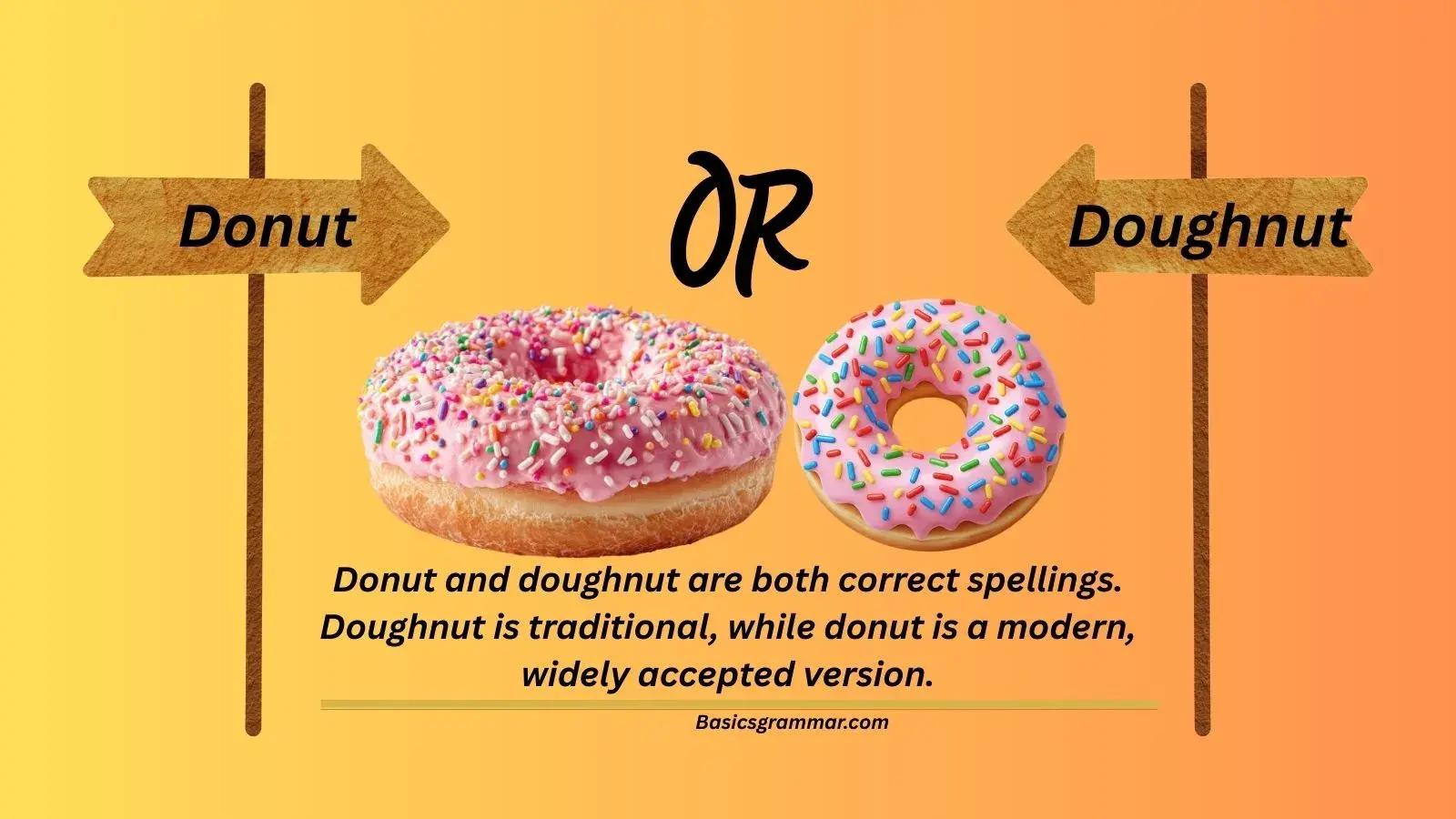
Both “donut” and “doughnut” are correct spellings for the same sweet, fried pastry. “Doughnut” is the traditional and more formal spelling, while “donut” is a simplified, phonetic-based spelling reform version that’s widely accepted in American English.
Examples:
- I bought a chocolate doughnut from the bakery. (Traditional)
- Let’s grab coffee and donuts this morning. (Simplified)
Both spellings appear in major dictionaries and are understood worldwide, though preferences vary by region and context.
The Origin of Donut or Doughnut
The word “doughnut” has been around since the early 19th century. It combines “dough” (the mixture used to make bread and pastries) and “nut” (referring to the small, rounded shape). The doughnut spelling emerged first and remained the standard for decades.
The simplified “donut” spelling appeared in the early 20th century as part of broader English spelling simplification efforts. Noah Webster spelling reform and other advocates of phonetic spelling examples pushed for easier, pronunciation-driven spelling variants. The donut spelling history shows it gained traction in the 1950s when Dunkin Donuts (now Dunkin’) adopted it for their brand name, making it mainstream.
This linguistic evolution of words reflects how marketing influence and common usage can shape language. The Associated Press donut spelling guidelines now accept both versions, showing how lexical acceptance criteria evolve with historical language adaptation.
British English vs American English Spelling
The donut or doughnut correct spelling debate often comes down to regional spelling differences and spelling preferences by organizations.
British English: Strongly prefers “doughnut” in formal writing, publications, and official documents. The UK views “donut” as too casual or Americanized.
American English: Accepts both spellings, but “donut” is increasingly common in informal contexts, advertising, and brand names. “Doughnut” remains preferred in formal or professional writing.
Spelling Comparison Table
| Aspect | Doughnut | Donut |
|---|---|---|
| Spelling Type | Traditional, formal | Simplified, phonetic |
| Origin | Early 1800s | Early 1900s |
| British English | Preferred ✓ | Rarely used |
| American English | Formal contexts ✓ | Casual/marketing ✓ |
| Dictionary Status | All major dictionaries | Most major dictionaries |
| Professional Writing | Recommended | Acceptable |
| Brand Usage | Traditional bakeries | Dunkin’, modern chains |
| Common Mistakes | Rare | Spelling confusion in UK |
This table shows the key English orthographic variations between these accepted English spellings.
Which Spelling Should You Use?
Your choice between donut spelling and doughnut spelling depends on your audience and purpose:
Use “doughnut” when:
- Writing for British, Australian, or Canadian audiences
- Creating formal documents, academic papers, or business reports
- Publishing in newspapers or magazines (unless style guide says otherwise)
- You want to appear more traditional or refined
- Writing recipes or culinary content
Use “donut” when:
- Writing for American audiences in casual contexts
- Creating social media content or informal emails
- Referring to donut brands like Dunkin Donuts
- You want a modern, relaxed tone
- Character/word count is limited (donut is shorter)
Global/International Writing: Stick with “doughnut” to avoid spelling confusion donut doughnut issues. It’s universally understood and accepted as the standard spelling worldwide.
Common Mistakes with Donut or Doughnut
Even experienced writers make these frequent errors:
1. Mixing spellings in the same document
- ❌ “I love donuts, especially chocolate doughnuts.”
- ✓ “I love donuts, especially chocolate donuts.” OR “I love doughnuts, especially chocolate doughnuts.”
2. Using “donut” in formal British writing
- ❌ “The study analyzed donut consumption in the UK.”
- ✓ “The study analyzed doughnut consumption in the UK.”
3. Misspelling as “doughnut” in brand names
- ❌ “Let’s meet at Dunkin Doughnuts.”
- ✓ “Let’s meet at Dunkin Donuts.” (brand name uses simplified spelling)
4. Assuming “donut” is incorrect Both are dictionary-approved. “Donut” isn’t a misspelling—it’s an alternative spelling recognized by evidence-based inclusion of words in major dictionaries.
5. Hyphenating as “dough-nut” This historical spelling is obsolete. Modern usage never includes a hyphen.
Donut or Doughnut in Everyday Examples
Here’s how both spellings appear across different contexts:
Social Media:
- “Sunday vibes ☕🍩 #donut #coffee” (Casual, phonetic spelling)
- “Homemade doughnuts coming out perfect today!” (Traditional baking context)
News Headlines:
- “National Donut Day celebrated nationwide” (Using simplified spelling for the holiday)
- “Gourmet doughnut shops see sales rise” (Formal journalism)
Professional Emails:
- “Our team enjoyed doughnuts at the morning meeting.” (Corporate, professional)
- “Thanks for bringing donuts today!” (Casual workplace email)
Advertising:
- “Dunkin Donuts spelling” uses the simplified form for brand recognition
- Traditional bakeries often use “fresh doughnuts” to convey artisan quality
Recipe Books:
- “Classic Glazed Doughnuts Recipe” (Formal culinary writing)
- “Quick Donut Recipe for Busy Mornings” (Casual food blogs)
The impact of branding on language shows clearly in donut usage in publishing and editorial spelling choices.
Donut or Doughnut – Google Trends & Usage Data
Search data reveals fascinating patterns about spelling preferences by organizations and regions:
United States: “Donut” searches are 60% higher than “doughnut,” especially after National Donut Day promotions and Dunkin Donuts advertising campaigns.
United Kingdom: “Doughnut” dominates with 85% of searches, reflecting British preference for traditional spelling.
Canada & Australia: “Doughnut” leads by 70%, following Commonwealth English conventions.
Global Trend: American English spelling variants like “donut” are growing internationally due to social media, but “doughnut” remains the worldwide standard.
Usage Comparison Table
| Region/Context | Preferred Spelling | Usage % |
|---|---|---|
| United States (Casual) | Donut | 60% |
| United States (Formal) | Doughnut | 70% |
| United Kingdom | Doughnut | 85% |
| Canada | Doughnut | 70% |
| Australia | Doughnut | 75% |
| Social Media Global | Donut | 55% |
| Academic Writing | Doughnut | 90% |
| News Publications | Both (style-dependent) | 50/50 |
| Food Industry Brands | Donut | 65% |
The donut dictionary entry in major publications like Merriam-Webster and Oxford lists both as acceptable, showing how spelling standardization debates evolve with historical spelling changes.
FAQs About Donut or Doughnut
Is Krispy Kreme a donut?
Yes, Krispy Kreme is a popular brand known for its glazed donuts.
What is the unhealthiest donut?
Typically, donuts with heavy frosting, fillings, and toppings (like cream-filled or chocolate-glazed) are considered unhealthiest.
Is Krispy Kreme owned by Shaq?
No, Krispy Kreme is not owned by Shaq, but Shaquille O’Neal has invested in some Krispy Kreme franchises.
What is a donut with ice cream called?
It’s often called a donut ice cream sandwich or donut sundae.
What is correct, donut or doughnut?
Both are correct; “doughnut” is traditional, and “donut” is an accepted variant.
Do Americans say donut or doughnut?
Americans commonly use “donut,” especially in casual contexts.
Is it donut or doughnut in the UK?
In the UK, “doughnut” is the more common spelling.
What does the 🍩 mean?
The 🍩 emoji represents a donut, often used to indicate sweet treats or breakfast.
When did donut spelling change?
The simplified spelling “donut” gained popularity in the mid-20th century, helped by brands like Dunkin’ Donuts.
final stage
The decision between a doughnut and a donut is based on context rather than morality. In contemporary English, both spellings are acceptable. The conventional form, doughnut, is most effective when used in academic, formal, or British English writing. Donut is a modern, simplified spelling that is frequently used in everyday writing, advertising, and American English.
You can write more confidently and clearly if you are aware of this distinction. Pay attention to your audience and tone rather than your blunders. Donuts are ideal whether you’re penning a menu, blog, or social media post. Doughnut is a preferable option if you’re writing a formal article or essay.
You may minimize misunderstanding and enhance the quality of your writing by making informed decisions and maintaining consistency. You now know exactly how to use both spellings, which are here to stay.