Quick answer:
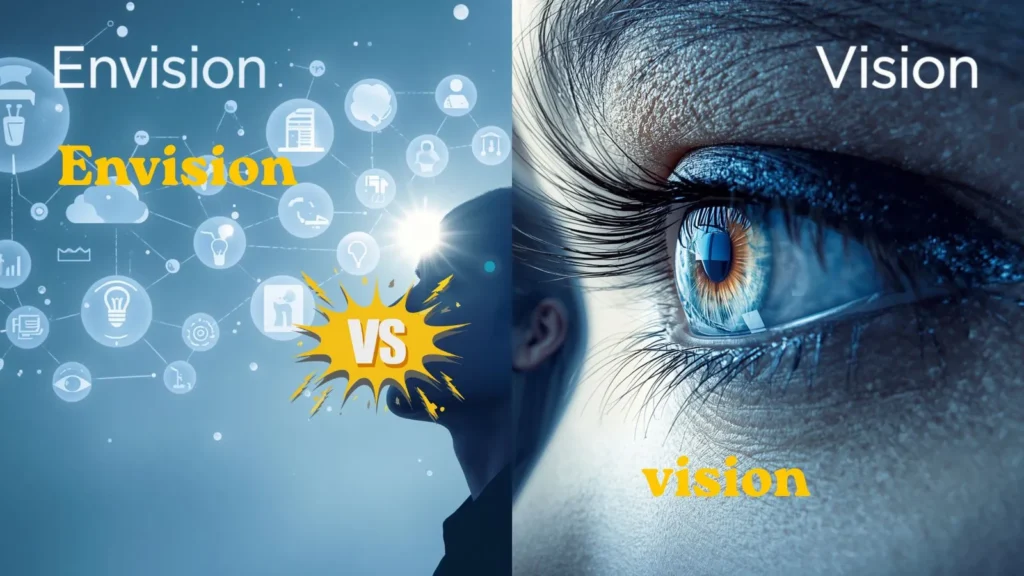
Vision is the picture or ability to see, while envision means to imagine that picture in your mind.
A student once said, “I have a vision for my future, but I cannot envision the steps.” That small sentence shows why many people search for Envision vs vision. The two words look alike. They also come from the same idea of seeing. Because of that, many learners mix them up.
|See more: Inpatient or Impatient
Vision is usually a noun. It can mean eyesight, a plan, or a dream for the future.
Envision is a verb. It means to imagine something clearly before it happens.
People search for Envision vs vision because they want to write better emails, school work, business plans, and social posts. They want to know which word fits the sentence. This guide solves that confusion in a simple way.
If you know when to use each word, your English sounds smarter and clearer. Let’s make it easy.
Pronunciation
Vision
- US: /ˈvɪʒ.ən/
- UK: /ˈvɪʒ.ən/
Envision
- US: /ɪnˈvɪʒ.ən/
- UK: /ɪnˈvɪʒ.ən/
Transition
Now let us break down the real difference between these two useful words.
Difference Between Envision vs Vision
1. Part of Speech
Vision is a noun.
Envision is a verb.
Examples:
- Her vision was clear.
- I envision success.
- The company shared its vision.
- We envision growth.
2. Main Meaning
Vision = sight or future idea.
Envision = imagine clearly.
Examples:
- My vision is weak.
- His vision for school is strong.
- I envision a better city.
- She envisioned peace.
3. Use in Planning
Vision is the goal.
Envision is the act of imagining it.
Examples:
- Our vision is global reach.
- Their vision is simple.
- We envision new markets.
- They envisioned change.
4. Grammar Role
Vision can be subject or object.
Envision needs a subject.
Examples:
- The vision inspired all.
- I love your vision.
- I envision a lake house.
- She envisions success.
5. Time Focus
Vision may be present or future.
Envision often points to future ideas.
Examples:
- His vision is poor today.
- Their vision is long term.
- I envision next year.
- We envision better roads.
6. Business Use
Vision is common in branding.
Envision is common in talks.
Examples:
- Read our company vision.
- The brand has a bold vision.
- Can you envision this plan?
- Leaders envision growth.
7. Emotional Tone
Vision sounds formal.
Envision sounds active.
Examples:
- The vision moved us.
- Their vision was clear.
- I envision hope.
- She envisioned joy.
8. Physical Meaning
Vision can mean eyesight.
Envision cannot.
Examples:
- My vision is blurry.
- Night vision helps soldiers.
- I envision success.
- We envision peace.
9. Common Pairings
Vision pairs with board, plan, goal.
Envision pairs with future, success, world.
Examples:
- Future vision matters.
- School vision statement.
- Envision your future.
- Envision a new world.
10. Simplicity
Vision is more common.
Envision is more specific.
Examples:
- I like your vision.
- Our vision is growth.
- Can you envision it?
- I envisioned this day.
Nature and Behaviour of Envision vs Vision
Vision
Vision is steady. It is often a goal, picture, or ability to see. It can be personal or business related.
Envision
Envision is action-based. It asks the mind to create a clear image. It often starts ideas and planning.
Why People Get Confused About Envision vs Vision
Both words share the root idea of seeing. Both connect to future plans. Their spellings also look close. But one is a noun, and one is a verb.
Comparison Table
| Point | Vision | Envision |
|---|---|---|
| Word Type | Noun | Verb |
| Meaning | Sight or goal | Imagine clearly |
| Physical Use | Yes | No |
| Business Use | Very common | Common |
| Action Word | No | Yes |
| Future Focus | Yes | Yes |
| Formality | Formal | Active |
| Example | Our vision is growth | We envision growth |
The Origin of Envision vs Vision
Vision comes from Latin visio, meaning sight.
Envision came later by adding “en-” to vision. It means to see in the mind.
British vs American English
Both the UK and US use vision and envision the same way. Spelling does not change.
Examples:
- UK: The charity has a clear vision.
- US: The startup has a clear vision.
- UK: Can you envision success?
- US: Can you envision success?
Which One Should You Use?
- US writing: Use both normally.
- UK writing: Use both normally.
- Global writing: Use vision for goals. Use envision for imagining ideas.
Common Mistakes
- Wrong: I vision a better life.
Correct: I envision a better life. - Wrong: Our envision is growth.
Correct: Our vision is growth. - Wrong: My envision is weak.
Correct: My vision is weak.
Everyday Usage Examples
Emails
- Our vision is customer trust.
- We envision faster service.
Social Media
- I envision a happy year ahead.
- Keep your vision alive.
News
- The mayor shared a city vision.
- Experts envision growth.
Formal Writing
- The firm’s vision guides policy.
- Leaders envision reform.
Usage Trends
Vision is used more often because it has many meanings. Envision is common in business, coaching, and motivation talks.
Metaphors and Similes
- Her vision was a lighthouse in dark times.
- I envisioned success like sunrise.
- His vision stood like a mountain.
Connotative Meaning
Positive
- Vision of peace
- Envision success
Neutral
- Vision statement
- Envision results
Negative
- Tunnel vision
- Envision failure
Idioms and Proverbs
- Tunnel vision = narrow thinking.
Example: He had tunnel vision. - Seeing is believing.
Example: Try it first. Seeing is believing.
Literature and Movies
Literature
- 1984 by George Orwell (1949) shows political vision and fear.
- The Alchemist by Paulo Coelho (1988) shows personal vision.
Movies
- The Secret Life of Walter Mitty (USA, 2013) shows imagined futures.
- Interstellar (USA, 2014) shows human vision for survival.
Why This Difference Matters
Using the right word helps clear writing. It avoids grammar mistakes. It also helps in school, jobs, and business talks.
Usefulness in Daily Life
You may write goals, plans, or posts each day. Knowing these words helps you sound clear and smart.
Situational Preference
Use vision when talking about a goal, mission, or eyesight. It in company plans, life goals, and health topics. Use envision when asking someone to imagine something new. It works well in speeches, coaching, and future planning. If you need a noun, choose vision. If you need an action verb, choose envision. In simple daily use, vision is more common. In creative talks, envision feels stronger and more lively.
FAQs
1. Is envision the same as vision?
No. Vision is a noun. Envision is a verb.
2. Can vision mean eyesight?
Yes. It often means the ability to see.
3. Can I say I vision success?
No. Say I envision success.
4. Which word is common in business?
Vision is more common.
5. Is envision formal?
It is common in formal and motivational speech.
6. Do UK and US spell them differently?
No. The spelling is the same.
7. Which is easier for learners?
Vision is easier because it is more common.
Conclusion
The debate of Envision vs vision is simple once you know the grammar role. Vision is mainly a noun. It means eyesight, a goal, or a future plan. Envision is a verb. It means to imagine something clearly in your mind.
Use vision when talking about plans, mission statements, or seeing. Use envision when talking about creating a mental picture of the future. That is the key difference.
Many learners confuse these words because both come from the idea of seeing. Their spellings also look alike. Still, their jobs in a sentence are different.
If you remember one rule, remember this: vision is the picture, envision is the act of picturing it. With that simple tip, your writing becomes clearer and more natural. Whether you write emails, business plans, or school work, choosing the right word will help you communicate better every day.