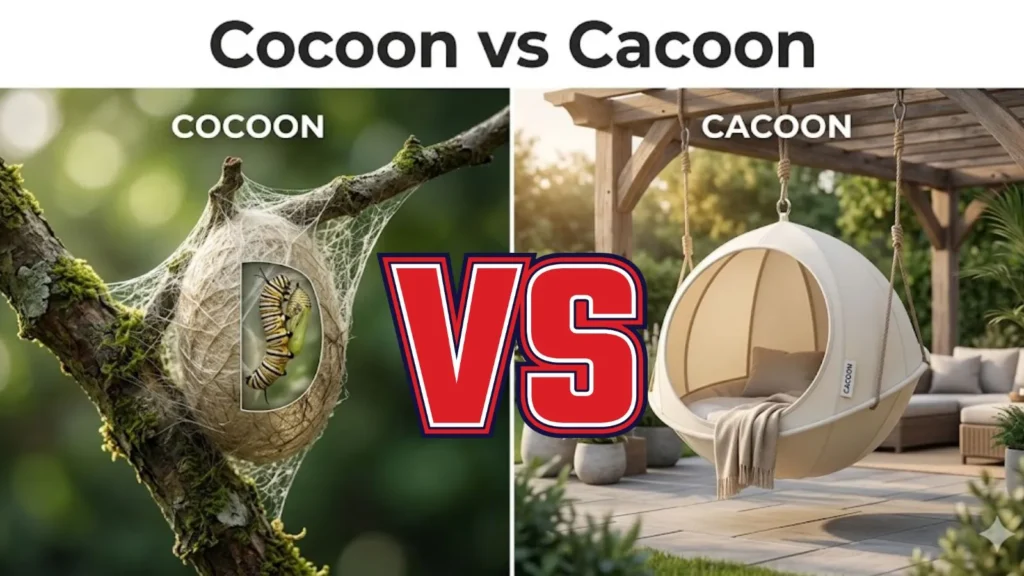
Many people search for “Cocoon vs Cacoon” because the words look almost the same, but they create confusion. Some think they are two different things. Others are unsure which spelling is correct. This confusion is very common in English writing, product searches, and design topics.
A “cocoon” is a natural protective case made by insects like silkworms. But “Cacoon” is often seen in product names, especially hanging chairs or hammock pods used for relaxation. Because both words sound similar, people often mix them up in Google searches, shopping sites, and social media.
|See also: Inpatient or Impatient
Cocoon vs Cacoon – Quick Answer
Cocoon
A cocoon is a natural covering made by insects during transformation.
Example:
A caterpillar turns into a butterfly inside a cocoon.
Cacoon
- A cacoon is usually a brand name or product term, often used for hanging chairs or pod-style seats.
- Example: A “Cacoon hammock chair” used for outdoor relaxation.
👉 Simple rule:
- Cocoon = nature (biology)
- Cacoon = product/brand name
The Origin of Cocoon vs Cacoon
The word “cocoon” comes from the French word cocon, which means a silky protective case. It entered English in the 1600s.
It is used in biology to describe the stage where insects protect themselves while changing form.
The word “cacoon” is not a scientific term.
It is mainly used in modern branding. Companies often change spelling slightly to create unique product names. That is why “Cacoon” appears in furniture, travel pods, and hammock designs.
So, the origin difference is simple:
- Cocoon = natural science word
- Cacoon = modern brand spelling variation
British English vs American English Spelling
For this keyword, there is no real UK vs US spelling difference. The correct spelling in both is “cocoon.”
However, “cacoon” appears only in branding or product naming, not in grammar rules.
Comparison Table
| Term | Meaning Type | Correct Usage | Example |
|---|---|---|---|
| Cocoon | Biology / Nature | Standard English | A butterfly forms in a cocoon |
| Cacoon | Brand/Product | Not standard grammar | Cacoon hanging chair |
| Cocoon | US & UK English | Correct spelling | Same in both regions |
| Cacoon | Marketing name | Product identity | Outdoor Cacoon pod |
Which Spelling Should You Use?
It depends on your purpose:
For science or education: Use cocoon
In writing or blogging: Always use cocoon
For product names: Use cacoon only if it is a brand name
👉 In simple terms:
Use cocoon in all formal writing unless you are referring to a product brand.
Common Mistakes with Cocoon vs Cacoon
Many writers make simple mistakes:
❌ Writing “cacoon” when talking about butterflies
✔ Correct: cocoon
Thinking both words mean the same thing in science❌
Correct: only cocoon is scientific✔
❌ Using cocoon as a product name
✔ Correct: product brands may use “cacoon”
❌ Mixing spellings in the same article
✔ Keep consistent usage based on meaning
Cocoon vs Cacoon in Everyday Examples
Emails
- Correct: “The caterpillar forms a cocoon before becoming a butterfly.”
- Incorrect: “The caterpillar forms a cacoon.”
Social Media
- “Relaxing in my new Cacoon hanging chair!” (product use)
- “Nature is amazing—watching a cocoon transform is magical.” (biology)
News Writing
- Scientists studied how larvae build a cocoon structure.
Formal Writing
- The insect develops inside a protective cocoon stage.
Cocoon vs Cacoon – Google Trends & Usage Data
Search behavior shows a clear difference between “cocoon” and “cacoon,” with “cocoon” widely used in science, education, fashion, and lifestyle content.
In contrast, “cacoon” is mostly a misspelling or niche brand term and is not considered a standard English word.
Global Search Trend Overview
- Cocoon → Very high global search volume
- Cacoon → Low search volume, mostly typo-based queries
- Most users searching “cacoon” actually intend to find “cocoon” content
Country-Based Usage Pattern
- United States: High usage of “cocoon” in science and wellness topics
- United Kingdom & Commonwealth countries: Strong academic and writing usage
- Asia (India, Pakistan, Philippines): High search volume due to learning English and SEO content creation
- “Cacoon” searches: Appear globally but mostly corrected by search engines
Context of Usage
- Cocoon: Biology, transformation, comfort, metaphor, writing
- Cacoon: Product branding (hanging chairs), typing errors, informal mentions
Why “Cacoon” Still Appears in Searches
- Typing mistakes (fast writing)
- Sound-based spelling confusion
- Auto-suggestions in search engines
- Brand influence in outdoor furniture markets
Search Intent Insight
Most users searching “Cocoon vs Cacoon” want:
- Correct spelling
- Meaning difference
- Whether “cacoon” is a real word
- Usage in writing or SEO
👉 Conclusion from usage data:
“Cocoon” dominates all formal and educational searches, while “cacoon” survives mainly as a mistaken or branded variation.
Quick Summary Insight
- “Cocoon” = standard English, high authority usage
- “Cacoon” = rare, mostly incorrect or branding-related
- Search engines strongly favor “cocoon” in all languages and regions
This makes “cocoon” the correct and globally accepted spelling in all professional writing contexts.
Comparison Table: Cocoon vs Cacoon
| Feature | Cocoon | Cacoon |
|---|---|---|
| Meaning | Insect protective case | Product/brand name |
| Category | Biology | Marketing / Furniture |
| Correct spelling | Yes | Not standard |
| Usage | Science, nature writing | Hanging chairs, pods |
| Global usage | Very high | Limited |
FAQs – Cocoon vs Cacoon
1. What is the correct spelling: cocoon or cacoon?
The correct spelling is cocoon in English grammar.
2. Is cacoon a real word?
Yes, but only as a brand or product name, not in science.
3. What does cocoon mean?
It means a protective case made by insects during development.
4. Why is cacoon used in products?
It is used for branding and unique product identity.
5. Can I use cacoon in writing?
Only if referring to a product name. Otherwise, avoid it.
6. Are cocoon and cacoon the same?
No, they are completely different in meaning and usage.
7. Which word should I use in SEO content?
Use cocoon for general content and include cacoon only for product-related searches.
Conclusion
Understanding Cocoon vs Cacoon is simple once you know the difference in meaning and usage. The word “cocoon” is the correct and standard English term used in science and nature. It describes how insects protect themselves during transformation. This spelling is accepted worldwide in both British and American English.
On the other hand, “cacoon” is not a grammar rule word. It is mainly used in branding and product names, especially in hanging chairs, hammocks, and outdoor pods. It exists for marketing uniqueness, not linguistic correctness.
Many people get confused because both words sound the same and look similar. However, their purpose is completely different. If you are writing essays, articles, or formal content, always choose cocoon. If you are talking about a branded product, then “cacoon” may appear as part of the name.

Hi, I’m Mark Cole, the voice behind Grammar Meaning! I explain tricky grammar rules in simple ways. I write useful guides on basicsgrammar.com.