
You’ve probably seen or written the phrase “time flies” many times—but have you ever stopped to wonder if “time flys” could also be correct? You’re not alone. This small spelling difference confuses many English learners, writers, and even native speakers. Because flies and flys sound the same when spoken, people often rely on how it sounds rather than how English grammar works. That’s where mistakes happen.
People search for “time flies or flys” because they want a quick, clear answer. They may be writing an email, a social media post, an essay, or professional content and want to avoid common English spelling mistakes. This confusion is also linked to broader grammar rules, such as plural nouns ending in -ies, verb conjugation patterns, and words ending in Y.
This article solves that confusion step by step. You’ll get a fast answer, grammar rules explained in simple words, real-life examples, common mistakes to avoid, and usage advice for all types of writing. By the end, you’ll confidently know which spelling is correct—and why.
Quick Quiz
1. Which sentence is correct?
A) Time flys when you’re busy
B) Time flies when you’re busy ✅
2. “Time flies” is best described as:
A) A grammar mistake
B) An English idiom ✅
3. Why is “flies” correct?
A) It follows verb rules for words ending in Y ✅
B) It is just a slang spelling
4. Fill in the blank:
Time ___ when you’re having fun.
✅ flies
5. True or False:
“Time flys” is acceptable in modern English.
❌ False
Correct Usage of “Time Flies” in Formal Writing
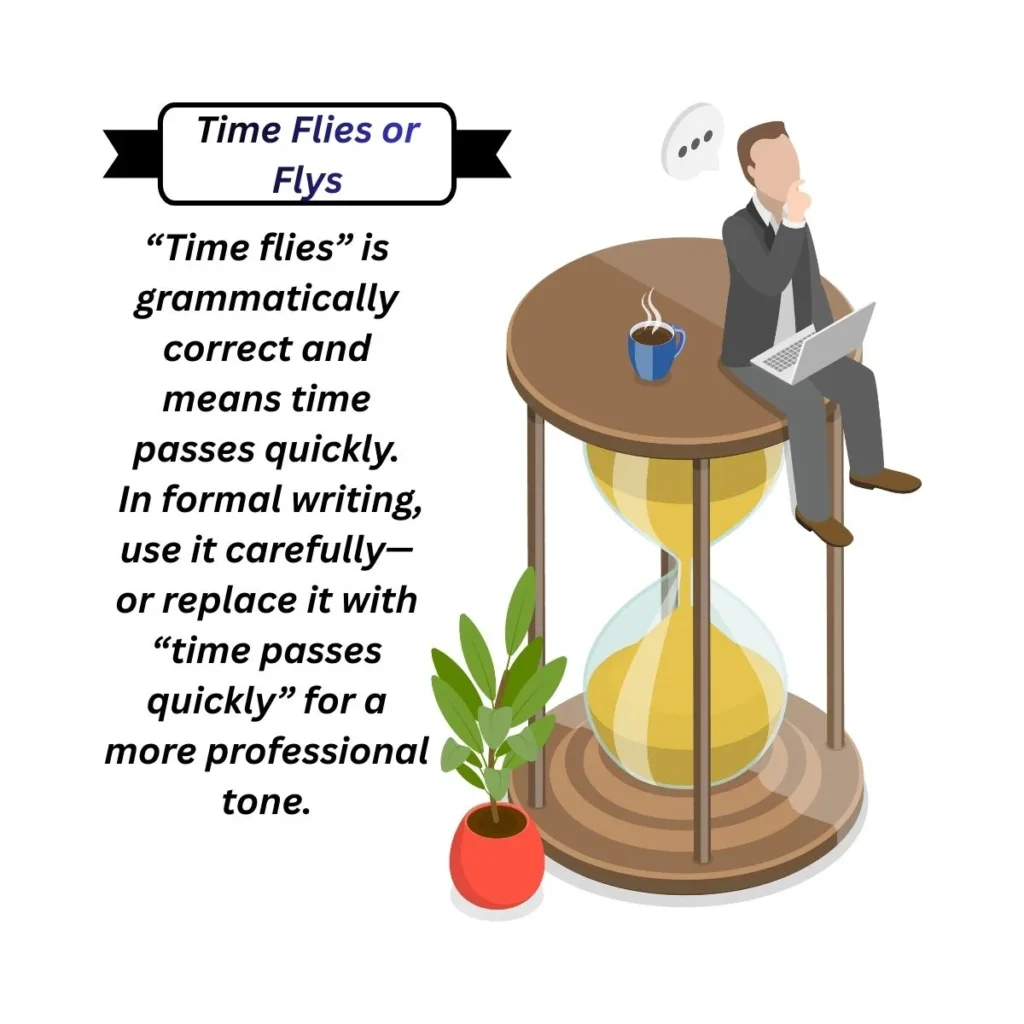
In formal writing, “time flies” is used to express that time seems to pass quickly, especially during meaningful, productive, or engaging periods. It is grammatically correct because “time” is a singular noun and “flies” is the third-person singular verb. The phrase should always be spelled “flies,” not “flys.”
Although “time flies” is an idiomatic expression, it is acceptable in professional emails, academic essays, reports, and speeches when used thoughtfully. In very formal or technical documents, it is often better to use alternatives such as “time passes quickly” or “the period elapsed rapidly.” However, in introductions, conclusions, or reflective statements, “time flies” adds clarity and a natural, professional tone without sounding casual.
Time Flies or Flys – Quick Answer
The correct phrase is “time flies.”
“Flys” is not correct in modern English.
Examples:
- ✅ Time flies when you’re having fun.
- ❌ Time flys when you’re busy.
Here, flies is the third-person singular form of the verb fly.
The Origin of “Time Flies or Flys”
The phrase “time flies” comes from the idea that time moves quickly, like something flying through the air. The verb fly has been used this way for centuries to describe speed and passing moments.
In English grammar, verbs that end in Y change to -ies in the third-person singular form (he, she, it). That’s why fly → flies. While flys did exist historically, it was used for old meanings of fly (like a type of carriage). Today, flys is considered a spelling error in everyday English.
British English vs American English Spelling
There is no difference between British and American English for this phrase.
| English Variant | Correct Form |
|---|---|
| American English | Time flies |
| British English | Time flies |
| Australian English | Time flies |
| Canadian English | Time flies |
“Time flys” is incorrect in all versions of English.
Which Spelling Should You Use?
Always use “time flies”, no matter your audience.
- US audience: Time flies
- UK/Commonwealth audience: Time flies
- Global or ESL readers: Time flies
This spelling ensures grammatical correctness and clear communication.
Common Mistakes with “Time Flies or Flys”
Here are frequent errors people make:
- ❌ Writing flys instead of flies
- Error Thinking flys is a plural form
- ❌ Using spoken English sounds instead of grammar rules
Correction tip:
If the subject is time (it), the verb must be flies.
Time Flies or Flys in Everyday Examples
Emails:
- Time flies, so I wanted to follow up on this project.
News & Blogs:
- Time flies faster in the digital age.
Social Media:
- Wow, time flies! Already Friday.
Formal Writing:
- Time flies when productivity is high.
Time Flies or Flys – Google Trends & Usage Data
Search trends show that “time flies” is used worldwide, especially in English-speaking countries. Searches for “time flys” often come from people checking spelling or correcting grammar mistakes. The correct phrase dominates books, news articles, academic writing, and professional content.
Comparison Table: Flies vs Flys
| Word | Correct? | Usage |
|---|---|---|
| Flies | ✅ Yes | Verb form and plural noun |
| Flys | ❌ No | Common misspelling (modern English) |
FAQs
- Is it okay to say time flies?
Yes, it’s a correct and common English idiom meaning time passes quickly. - Which is correct, flies or flys?
Flies is correct; flys is a spelling mistake in modern English. - Is it correct to say time flies by so fast?
Yes, this sentence is grammatically correct and commonly used in spoken English. - Why do they say time flies?
Because time feels like it moves quickly, especially during busy or enjoyable moments. - Who said time flies?
The idea comes from Latin (Tempus fugit), often linked to the poet Virgil. - How to use time flies?
Use it to express how quickly time passes, e.g., Time flies when you’re happy. - Do you say time flys or time flies?
Always say time flies—time flys is incorrect. - How time flies idiom?
It’s an idiom meaning time passes faster than expected. - How time flies with kids?
It means children grow up very quickly, making time feel like it’s moving fast.
Conclusion
The confusion between “time flies or flys” is common, but the rule is simple. “Time flies” is the only correct form in modern English. The word flies follows standard English grammar rules for verbs ending in Y, and it works the same way in American, British, and global English.
Understanding this small rule helps improve clarity in communication and avoids common English misspellings. Whether you’re writing an email, social post, article, or academic paper, using the correct phrase builds credibility and professionalism. Language mistakes like flys often come from spoken language habits, but writing requires accuracy.
If you remember just one thing, remember this: If it’s “he,” “she,” or “it,” the verb ends in -ies. Time flies—and now, your grammar does too.