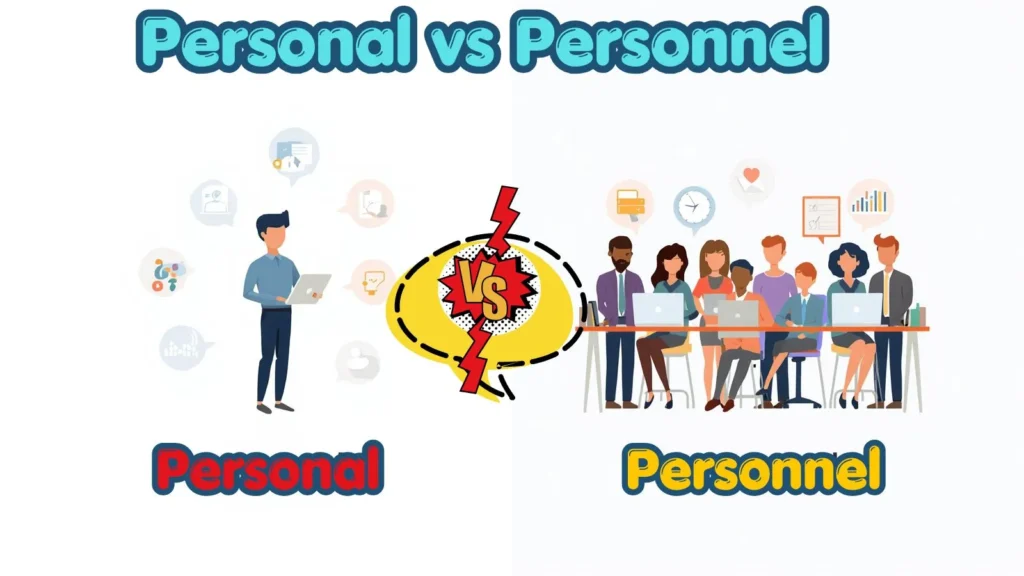
Have you ever typed personal when you actually meant personnel?
These two words look and sound similar, which makes them easy to confuse. However, they have completely different meanings and are used in different situations. Using the wrong one can change the meaning of a sentence and make your writing appear less professional.
The word personal relates to a person, their private life, feelings, or belongings. In contrast, personnel refers to the employees or staff who work for an organization, business, or government agency. Although only a few letters separate them, choosing the correct word is essential for clear communication in emails, resumes, business documents, and everyday conversations.
You’ll learn the key differences between Personal vs Personnel, discover their meanings and origins, see real-life examples, and explore simple tips to remember which word to use. By the end, you’ll be able to use both words confidently and avoid one of the most common English vocabulary mistakes.
Origin of Personal vs Personnel
The roots of personal vs personnel come from Latin. Personal comes from “personalis,” meaning “of a person.” It entered English in the late Middle Ages.
Personnel comes from French, derived from “personnel,” meaning “staff” or “employees.” It became popular in English during the 19th century, especially in business and military contexts.
Both words share the root “person,” but evolved into different meanings over time.
Quick Answer
The difference between personal vs personnel is simple: personal relates to something private or individual, while personnel refers to people working in an organization. For example, personal goals belong to you, but company personnel are employees. Remember: personal = private, personnel = people at work.
See also: Rhythm or Rythm – Which Spelling is Correct?
What Does “Personal” Mean?
“Personal” relates to a person’s private life, feelings, or individual use.
It describes something that belongs to or affects one specific person.
Example:
- This is my personal phone.
What Does “Personnel” Mean?
“Personnel” refers to the people who work in an organization or company.
It is often used in business, military, or office contexts.
Example:
- The company hired new personnel this month.
Key Difference Between Personal and Personnel
“Personal” is about one individual, while “personnel” is about a group of employees.
The meaning changes based on context, not just spelling.
Mixing them can make your sentence incorrect.
Personal vs Personnel in Simple Words
“Personal” = private or individual things.
“Personnel” = staff or workers in a company.
When to Use “Personal” Correctly
Use “personal” when talking about private matters or belongings.
It fits in casual and formal writing.
Example:
- She shared her personal story.
When to Use “Personnel” Correctly
Use “personnel” when referring to employees or staff members.
It is common in offices, HR, and official writing.
Example:
- All personnel must attend the meeting.
Personal vs Personnel in One Sentence Each
Personal: I keep my personal notes in a diary.
Personnel: The manager spoke to all personnel today.
Easy Trick to Remember
“Personal” has “person” inside it, meaning one individual.
“Personnel” sounds like “people,” meaning a group.
This simple trick helps you avoid confusion.
Why People Misspell
Many confuse personals vs personnels due to similar pronunciation and spelling. English often uses double letters, like in “address” and “success,” which can be tricky.
Writers may type quickly and forget the double “n” in personnel, or mix the meanings entirely. For example, writing “personal department” instead of “personnel department.”
To avoid mistakes, remember: personnel has double “n” and relates to many people.
British vs American English
The spelling of personal vs personnel remains the same in both British and American English.
| Word | British English | American English | Meaning |
|---|---|---|---|
| Personal | Personal | Personal | Private, individual |
| Personnel | Personnel | Personnel | Employees, staff |
There is no spelling difference, making it easier to learn compared to words like colour/color.
When to Use Personal vs Personnel
Use personal vs personnel correctly depending on context.
- Essays & Assignments: Use personal for opinions; personnel for staff discussions
- Emails: Personal email vs contact personnel
- Work Reports: Refer to employees as personnel
- Legal Documents: Personal property vs authorized personnel
- Casual Writing: Personal life vs company personnel
Always check if you mean an individual thing or a group of people.
Common Mistakes
Writers often confuse personal vs personnel due to spelling errors.
| Incorrect Sentence | Correct Sentence |
|---|---|
| Personal staff attended the meeting | Personnel attended the meeting |
| Contact the personal department | Contact the personnel department |
| My personnel opinion is strong | My personal opinion is strong |
Common issues include using a single “n” or mixing meanings. Always double-check context.
Everyday Examples
Here’s how personals vs personnels appear in daily life:
- Email: This is a personal message vs HR personnel will respond
- Social Media: Sharing personal thoughts
- Professional Writing: All personnel must attend training
- School Assignments: Write a personal essay
Using the right word improves clarity and professionalism.
Usage Comparison Table
| Context | Personal Example | Personnel Example |
|---|---|---|
| Objects | Personal laptop | Company personnel |
| Skills | Personal skills | Skilled personnel |
| Legal Terms | Personal property | Authorized personnel |
| Daily Speech | Personal choice | Office personnel |
This table helps quickly identify correct usage.
FAQs
1. What is the main difference in personal vs personnel?
Personal refers to private or individual matters, while personnel means employees or staff.
2. How can I remember the spelling?
Think: personnel = many people = extra “n.”
3. Is personnel always plural?
Yes, it usually refers to a group of employees, even though it looks singular.
4. Can personal refer to people?
No, it describes qualities or belongings, not groups of workers.
5. Why do people confuse these words?
Because they sound similar and share the root word “person.”
6. Is there a spelling difference in UK vs US English?
No, both use the same spelling for personal vs personnel.
7. Which is used in business writing?
Personnel is commonly used in business contexts.
Conclusion
Understanding personal vs personnel is easier than it seems. Remember: personal relates to you, while personnel refers to employees. Watch out for spelling—especially the double “n” in personnel.
Use these words correctly in writing, emails, and professional documents to avoid confusion. A simple trick: if it’s about people at work, use personnel; if it’s about you, use personal.

Hi, I’m John Miles, the voice behind Grammar Meaning! I share clear and practical grammar tips. You’ll find my work on basicsgrammar.com.