Have you ever stopped while writing and wondered whether to use wack or whack?
One word is widely accepted in standard English, while the other is mostly slang or informal. However, both are used in real life, which makes things even more confusing. Therefore, knowing the difference helps you write clearly and avoid mistakes.
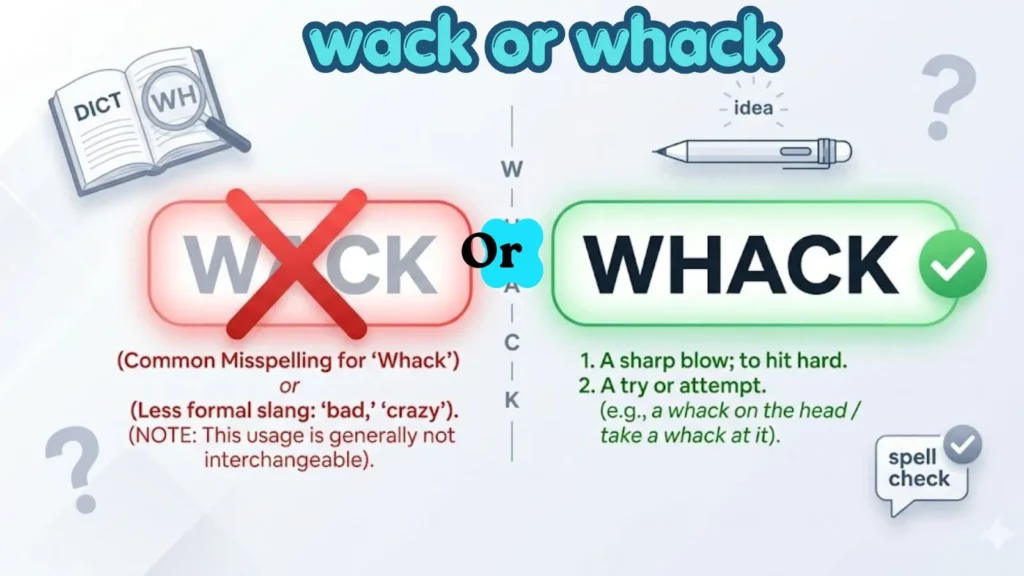
Whack vs Wack — Quick Answer
- ✅ Whack = correct spelling
- ⚠️ Wack = informal slang
Examples:
- ✔️ He gave the ball a strong whack.
- ✔️ That movie was whack (slang: bad or weird).
- ⚠️ That movie was wack (acceptable only in casual texting).
Simple Rule:
Use “whack” in almost all situations—especially in school, business, or SEO writing.
Use “wack” only in very informal conversations or social media.
👉 Final Tip: If you’re unsure, always choose whack.
|RELATED: Spicey or Spicy – Which Spelling Is Correct?
What Does Wack or Whack Mean?
Meanings of wack or whack in simple words.
Whack
“Whack” is a proper English word with several meanings:
- To hit something hard
- To strike suddenly
- Informally, to criticize or defeat
Examples:
- He tried to whack the ball across the field.
- She gave the table a quick whack.
- That movie was totally whack (slang meaning: bad or weird).
Wack
“Wack” is a slang spelling of “whack.” It is often used in informal writing, especially online.
Examples:
- That song is wack.
- His idea sounds wack to me.
However, “wack” is not considered standard English in formal writing.
Core Difference Between Wack or Whack
The difference between wack or whack is mainly about correctness and context.
- Whack → Correct spelling in standard English
- Wack → Informal slang version
Therefore, if you are writing professionally, academically, or formally, you should always use whack.
On the other hand, “wack” may appear in casual conversations, text messages, or social media. However, it is not recommended in serious writing.
Why One Form Is Correct and the Other Is Incorrect
The reason behind the difference is simple: dictionary recognition and grammar rules.
Whack Is Correct Because:
- It appears in English dictionaries
- It has clear meanings (verb, noun, slang)
- It follows standard spelling rules
Wack Is Considered Incorrect Because:
- It is not widely accepted in formal dictionaries
- It developed from slang and pop culture
- It lacks grammatical authority
However, language evolves over time. So, while “wack” is not technically correct, it is still used informally. Even so, you should avoid it in professional settings.
Comparison Table: Wack vs Whack
| Feature | Whack | Wack |
|---|---|---|
| Spelling Status | Correct | Informal / Slang |
| Usage Type | Formal + Informal | Informal only |
| Dictionary Entry | Yes | Rare / Limited |
| Meaning | Hit, strike, bad (slang) | Bad or unimpressive |
| Recommended Use | Always safe | Only casual writing |
Usage in Real Life
Understanding wack or whack becomes easier when you see how they are used in daily life.
1. Blogging Examples
- Correct: This design looks whack and needs improvement.
- Avoid: This design looks wack (not professional).
2. Education Examples
- Teachers and students should always use “whack” in assignments.
- Example: The player gave the ball a strong whack.
3. Marketing Examples
- Professional content should use “whack” for credibility.
- Informal brand voice (like youth marketing) may use “wack.”
4. Social Media Examples
- Casual: That outfit is wack.
- More correct: That outfit is whack.
Therefore, context matters a lot when choosing between wack or whack.
Common Mistakes to Avoid
Here are some frequent errors people make:
1. Using “Wack” in Formal Writing
Avoid writing “wack” in essays, emails, or business content.
2. Thinking Both Are Equal
Although they sound the same, they are not equal in correctness.
3. Ignoring Context
Using slang in professional settings can reduce credibility.
4. Spelling Confusion
Many people assume “wack” is just a shorter form—but it’s not standard.
5. Overusing Slang
Even in casual writing, too much slang can confuse readers.
FAQs About Wack or Whack
1. Is “wack” a real word?
“Wack” exists as slang, but it is not considered standard English.
2. Which is correct: wack or whack?
“Whack” is the correct spelling in proper English.
3. Can I use “wack” in essays?
No, you should always use “whack” in academic writing.
4. Why do people use “wack”?
People use it in casual speech, especially online or in pop culture.
5. Does “whack” only mean hitting?
No, it can also mean something bad or strange in slang.
6. Is “whack” formal or informal?
It can be both, depending on how it’s used.
7. Can “wack” become correct in the future?
Language changes over time, so it’s possible—but not yet standard.
Conclusion
In the debate of wack or whack, the answer is clear: “whack” is the correct and reliable choice. While “wack” may appear in casual conversations or social media, it is not suitable for formal or professional writing. Therefore, if you want your content to be clear, credible, and grammatically correct, always choose “whack.”
Moreover, understanding this difference helps improve your writing skills and avoids confusion for readers. Whether you’re writing a blog, an essay, or marketing content, using the correct form makes a strong impression. In short, stick with “whack” for accuracy—and only use “wack” when you intentionally want a casual tone.

Hi, I’m John Miles, the voice behind Grammar Meaning! I share clear and practical grammar tips. You’ll find my work on basicsgrammar.com.