“Cite,” “site,” and “sight” sound the same, but they have completely different meanings and uses.
Homophones are words that sound alike yet carry different spellings and meanings.
A student writes, “Please site your sources.” The teacher immediately notices the mistake because the correct word should be “cite.”
The difference between cite vs site vs sight improves communication in everyday life. Whether you are writing professionally, studying for exams, creating content online, or sending work emails, choosing the correct word builds confidence and clarity. Thankfully, once you understand the meaning behind each term, the confusion becomes much easier to avoid.
|RELATED: Shiney or Shiny: Which Spelling Is Correct?
Core Meaning and Spelling Clarity
The easiest way to understand these words is to learn their core purpose.
| Word | Part of Speech | Meaning | Example |
|---|---|---|---|
| Cite | Verb | To quote or mention a source | “Please cite the article.” |
| Site | Noun | A place or location | “The construction site is busy.” |
| Sight | Noun/Verb | Vision or something seen | “The sunset was a beautiful sight.” |
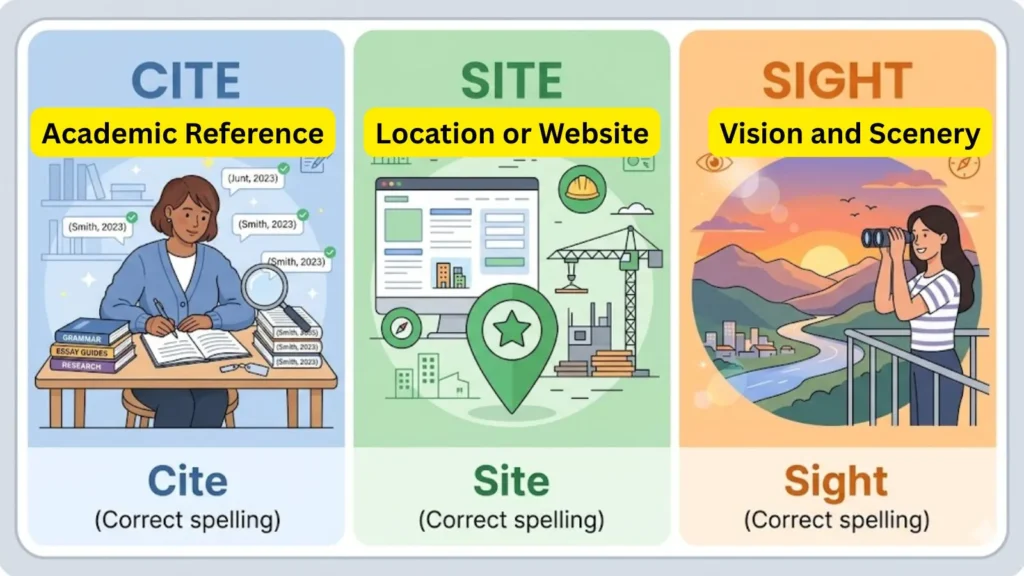
- Cite: “Relates to writing, research, and references.”
- Site: “Relates to locations, places, and websites.”
- Sight: “Relates to vision and seeing.”
That single spelling change completely shifts the meaning.
Understanding “Cite”
What Does “Cite” Mean?
The word cite means to mention, quote, or refer to a source of information.
use:
- School essays
- Research papers
- Journalism
- Legal documents
- Academic writing
When you cite something, you give credit to the original source.
Examples of “Cite”
- “Please cite your references.”
- “The lawyer cited a previous court decision.”
- “Students must cite sources correctly.”
Real-Life Example
Imagine you are writing a school report about climate change. Your teacher asks you to include facts from books and websites. At the end of your report, you cite the sources to show where the information came from.
Here’s how each word works in real life:
Sight = something you see or view visually
Cite = mention a source or reference
Site = a place or website
Incorrect vs Correct
| Incorrect | Correct |
|---|---|
| “Please site your book sources.” | “Please cite your book sources.” |
| “She sighted a research article.” | “She cited a research article.” |
Understanding “Site”
What Does “Site” Mean?
The word site refers to a place, location, or area.
It may describe:
- Construction areas
- Historical locations
- Websites
- Event locations
Today, people also use “site” heavily in the digital world because websites are often called “sites.”
Examples of “Site”
- “The building site closed early.”
- “This site loads quickly.”
- “The wedding site looked beautiful.”
Website Meaning
When someone says:
- “Visit our site”
they usually mean a website.
Real-Life Example
A company manager might say:
- “Upload the file to the company site.”
In this case, “site” means a website or online platform.
Incorrect vs Correct
| Incorrect | Correct |
|---|---|
| “Please cite the construction area.” | “Please visit the construction site.” |
| “I love this sight for shopping online.” | “I love this site for shopping online.” |
Understanding “Sight”
What Does “Sight” Mean?
The word sight relates to vision or something seen.
It can describe:
- Eyesight
- A visual experience
- Something beautiful to look at
- The act of seeing
Examples of “Sight”
- “The mountains were an amazing sight.”
- “His sight improved after surgery.”
- “We finally caught sight of the train.”
Real-Life Example
Suppose you travel to a beach during sunset. The colorful sky becomes a memorable sight because it creates a strong visual impression.
Incorrect vs Correct
| Incorrect | Correct |
|---|---|
| “The waterfall was a lovely site.” | “The waterfall was a lovely sight.” |
| “I lost my cite after the accident.” | “I lost my sight after the accident.” |
Why People Get Confused Between Cite vs Site vs Sight
The confusion happens because these words are pronounced exactly the same.
This phenomenon is called a homophone.
Main Reasons for the Confusion
1. They Sound Identical
When spoken aloud:
- cite
- site
- sight
all sound like “syt.”
Without context, listeners cannot know which spelling is correct.
2. Autocorrect Causes Problems
Phones and computers may replace one word with another accidentally.
Example:
- typing “cite” may become “site.”
3. Fast Typing Habits
People often type quickly during emails or texting. Small spelling checks get skipped.
4. English Has Many Similar Words
English contains countless confusing word groups like:
- their / there / they’re
- affect / effect
- lose / loose
So learners naturally struggle with cite vs site vs sight too.
Side-by-Side Comparison Table
Here is a quick visual guide.
| Feature | Cite | Site | Sight |
|---|---|---|---|
| Main Meaning | Reference a source | A location/place | Vision or something seen |
| Common Use | Academic writing | Websites or areas | Eyesight or scenery |
| Part of Speech | Verb | Noun | Noun/Verb |
| Related Topic | Research | Location | Seeing |
| Example | “Cite your source.” | “Visit the site.” | “Beautiful sight.” |
Real-Life Meaning Explained
In School
Teachers ask students to:
- cite books
- cite articles
- cite research
They never mean:
- site books
- sight articles
In Technology
People say:
- “This shopping site is secure.”
Here, “site” refers to a website.
In Travel
Tourists may say:
- “The waterfall was a breathtaking sight.”
This refers to something visually beautiful.
Common Mistakes People Make
Mistake 1: Using “Site” Instead of “Cite”
Wrong:
- “Please site your sources.”
Correct:
- “Please cite your sources.”
This is one of the most common academic spelling mistakes.
Mistake 2: Using “Sight” for Websites
Wrong:
- “I found the recipe on a cooking sight.”
Correct:
- “I found the recipe on a cooking site.”
Mistake 3: Using “Cite” for Visual Experiences
Wrong:
- “The Grand Canyon was an incredible cite.”
Correct:
- “The Grand Canyon was an incredible sight.”
Memory Tricks to Remember the Difference
Simple memory tricks make these words easier to remember forever.
Memory Trick for “Cite”
Think:
- Cite = Citation
Both start with “cit.”
If you are talking about references or sources, use “cite.”
Memory Trick for “Site”
Think:
- Site = Website
Both words relate to locations or online spaces.
Memory Trick for “Sight”
Think:
- Sight = Seeing
Both relate to vision.
The word even contains “igh,” similar to “eye” sounds connected to seeing.
Professional Writing Importance
Using the wrong homophone may hurt your credibility.
Why It Matters
In School
Wrong spelling may lower grades.
In Business
Clients may notice mistakes in emails or reports.
In Blogging
Readers trust writers who use proper English.
In Job Applications
Grammar errors may appear unprofessional.
Even tiny spelling slips can shape first impressions.
Practical Writing Examples
Example 1: Academic Writing
Incorrect
- “The student failed to site the article.”
Correct
- “The student failed to cite the article.”
Example 2: Website Discussion
Incorrect
- “This cite sells electronics.”
Correct
- “This site sells electronics.”
Example 3: Describing Beauty
Incorrect
- “The northern lights were a beautiful site.”
Correct
- “The northern lights were a beautiful sight.”
Mini Case Study: One Word Changed the Meaning
A college student once submitted an essay containing this sentence:
“Researchers must properly site all evidence.”
The teacher marked it incorrect immediately.
Why?
Because “site” means a location, not a reference. The correct word was “cite.”
This example shows why understanding cite vs site vs sight matters in real communication.
Quick Fix Guide
When unsure which word to use, ask yourself one simple question.
| Question | Correct Word |
|---|---|
| Am I talking about a source or reference? | Cite |
| Am I talking about a place or website? | Site |
| Am I talking about vision or seeing? | Sight |
This fast method works almost every time.
Common Phrases Using Each Word
“Cite” Phrases
- Cite a source
- Cite evidence
- Cite an article
- Cite references
“Site” Phrases
- Construction site
- Website
- Historic site
- Job site
Common “Sight” Phrases
- At first sight
- Catch sight of
- Beautiful sight
- Lose sight of
How Context Changes Everything
Context acts like a clue.
Read these sentences carefully:
- “Please cite the research paper.”
- “Please visit the site tomorrow.”
- “The waterfall was a stunning sight.”
Even though the pronunciation stays identical, the surrounding words reveal the meaning instantly.
That is why context matters greatly in English.
Easy Practice Sentences
Try filling in the blanks.
- Please _____ your textbook sources.
- The museum _____ opened last year.
- The sunset was a wonderful _____.
Answers
- cite
- site
- sight
FAQs About Cite vs Site vs Sight
1. What is the main difference between cite vs site vs sight?
“Cite” means to reference a source, “site” means a place or location, and “sight” relates to vision or something seen.
|See also: US or U.S.: Simple Guide to Correct Usage
2. Why do cite, site, and sight sound the same?
They are homophones. Homophones are words that share pronunciation but have different meanings and spellings.
3. Is a website spelled “site” or “sight”?
The correct spelling is “site.” A website is an online location or platform.
4. When should I use “cite”?
Use “cite” when referring to references, sources, evidence, or quotations in writing or speech.
5. What does “sight” mean in English?
“Sight” refers to vision, eyesight, or something visible and noticeable.
6. Why is “please site your sources” incorrect?
It is incorrect because “site” means location. The correct phrase is “please cite your sources.”
7. How can I remember cite vs site vs sight easily?
Use simple memory links:
- Cite = Citation
- Site = Website
- Sight = Seeing
These associations make the differences easier to recall.
Final Thoughts on Cite vs Site vs Sight
Understanding the difference between cite vs site vs sight may seem small, but it greatly improves writing accuracy and communication confidence.
Remember the basics:
- Cite relates to references and sources.
- Site refers to places and websites.
- Sight connects to vision and things you see.
Because these words sound identical, confusion is common. However, once you focus on context and meaning, choosing the correct spelling becomes much easier.
Clear writing leaves a stronger impression in school, business, blogging, and daily conversations. Small language improvements often create big results over time.