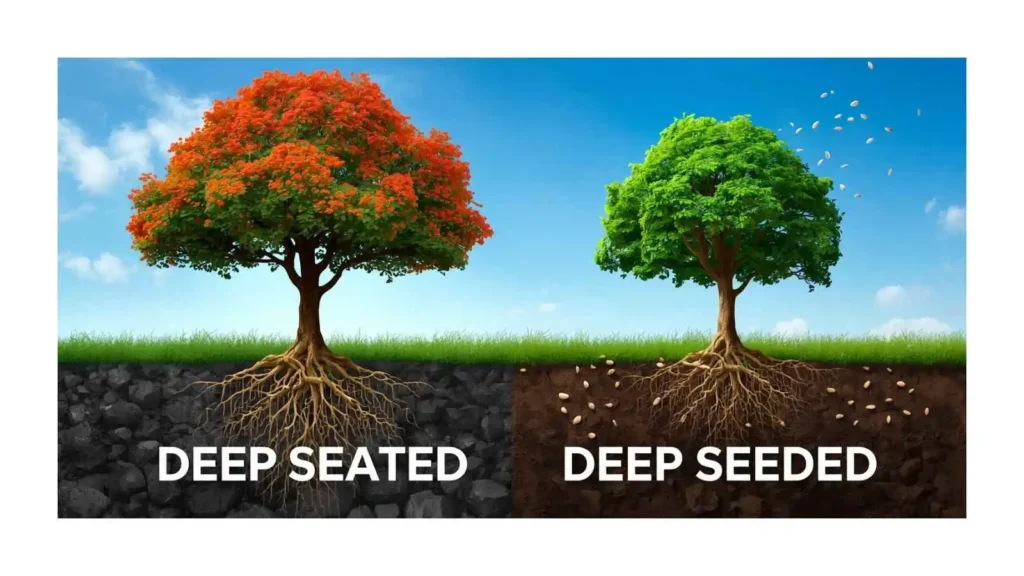
Many writers confuse deep-seated and deep-seeded because the phrases sound alike. This common spelling confusion often affects English grammar, word usage, writing accuracy, and language clarity. While deep-seated is the correct expression, deep-seeded is usually considered a mistaken variation.
Understanding the difference helps improve communication and ensures professional writing. Learning the origin and correct usage of these terms can prevent errors and strengthen your overall command of English.
|SEE ALSO: Sence or sense
What Does Deep-Seated Mean?
Deep-seated means firmly established, strongly rooted, or difficult to change.
The phrase is commonly used to describe:
- Beliefs
- Feelings
- Habits
- Attitudes
- Fears
- Prejudices
Examples
- She has a deep-seated fear of heights.
- The company faced deep-seated management problems.
- His success came from deep-seated determination.
In each example, the idea is firmly established and not easily changed.
Is Deep-Seeded Correct?
In standard English, deep-seeded is generally considered incorrect.
Although many people use it, dictionaries and style guides typically recognize deep-seated as the proper expression.
Why the Mistake Happens
People often assume the phrase relates to a seed growing deep in the ground. Since beliefs and emotions can seem to “grow,” the spelling deep-seeded feels logical.
However, the phrase has a different historical origin.
The Origin of Deep-Seated
The expression deep-seated comes from the word seat, meaning a location, position, or place where something rests.
Historically, something described as deep-seated was positioned deep within something else.
|SEE LEARN MORE: Spicey or spicy
Over time, the phrase developed a figurative meaning describing ideas, emotions, or conditions that are firmly established within a person or organization.
Example
- A deep-seated belief is one that is firmly fixed in a person’s mind.
This historical origin explains why deep-seated is correct and deep-seeded is not.
British English vs American English Differences
Unlike many spelling debates, deep-seated is accepted in both British and American English.
There is no regional spelling variation.
Comparison Table
| British English | American English |
|---|---|
| Deep-seated | Deep-seated |
| Deep-seeded (incorrect) | Deep-seeded (incorrect) |
This differs from other spelling variations commonly seen between English dialects.
Understanding the -ise vs -ize Rule
Many spelling discussions involve the famous -ise vs -ize difference.
Example:
| British Variant | American Variant |
|---|---|
| Organise | Organize |
| Realise | Realize |
| Recognise | Recognize |
| Apologise | Apologize |
Many writers mistakenly believe one form is always right and the other is always wrong. In reality, usage often depends on regional preferences and style guides.
However, the Deep-Seated vs Deep-Seeded issue is different.
This is not a British-versus-American spelling difference. Instead, it is a question of correct versus incorrect usage.
How Spell Checkers Affect Spelling Choices
Modern spell checkers influence how people write.
Most spelling software depends on language settings such as:
- English (US)
- English (UK)
- English (Australia)
- English (Canada)
These settings affect suggestions for words like:
- Organise/Organize
- Realise/Realize
- Apologise/Apologize
However, most spell checkers identify deep-seated as correct regardless of region.
Some programs may not immediately flag deep-seeded because it consists of correctly spelled individual words. As a result, writers may overlook the mistake.
This is why proofreading remains important.
Common Mistakes Writers Make
Mistake 1: Using Deep-Seeded
❌ He has deep-seeded beliefs.
✅ He has deep-seated beliefs.
Mistake 2: Assuming Both Forms Are Correct
❌ Deep-seated and deep-seeded are interchangeable.
✅ Deep-seated is the standard expression.
Mistake 3: Trusting Spell Check Alone
Even advanced software can miss contextual mistakes.
Always verify unfamiliar expressions using reliable dictionaries.
Why Correct Spelling Matters
Using the correct expression demonstrates professionalism and attention to detail.
Benefits of Correct Usage
- Improves credibility
- Enhances clarity
- Reduces confusion
- Strengthens professional communication
- Creates a better impression on readers
In academic, business, and professional writing, small errors can affect how readers perceive your expertise.
Example:
- A job application containing “deep-seeded experience” may appear less polished.
- A business report using “deep-seated issues” appears more professional.
Accurate language helps establish trust with your audience.
Practical Examples of Deep-Seated
Personal Feelings
- She has a deep-seated love of music.
Social Issues
- The country faces deep-seated economic challenges.
Workplace Culture
- Deep-seated communication problems affected productivity.
Education
- Students often develop deep-seated study habits over time.
Deep-Seated vs Deep-Seeded: Quick Comparison
| Feature | Deep-Seated | Deep-Seeded |
|---|---|---|
| Standard English | Yes | No |
| Dictionary Approved | Yes | Generally No |
| Professional Writing | Recommended | Not Recommended |
| Historical Origin | Correct | Incorrect Interpretation |
| British English | Accepted | Not Accepted |
| American English | Accepted | Not Accepted |
Conclusion
Understanding the difference between deep-seated, spelling, English grammar, word meaning, and language usage helps writers avoid a common mistake.
The correct phrase is deep-seated, meaning firmly established or deeply rooted. By using the proper form consistently, you can improve writing accuracy, enhance credibility, and communicate more clearly in both professional and everyday contexts.