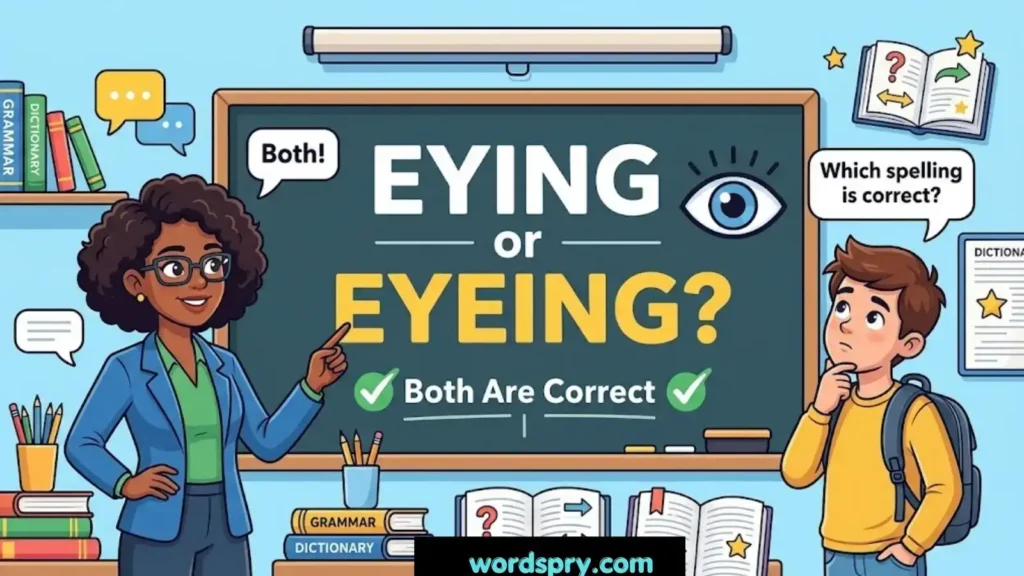
When you want to say that someone is looking at something closely, you may wonder whether eying or eyeing is the correct spelling. This is a common spelling question because both forms appear online and in different types of writing.
The confusion comes from the word eye. When we add the ending -ing, it may seem natural to simply write eying. However, English spelling does not always work that way. The standard spelling used in modern English is eyeing.
For example, you can say, “She was eyeing the new phone.” This means she was looking at it with interest or attention.
But why does eyeing keep the letter e? Does British English use a different spelling? Is eying ever acceptable? In this guide, we will answer these questions in simple terms.
You will also learn the origin of the word, common mistakes, everyday examples, spelling rules, and which form you should use in professional writing.
Eying or Eyeing – Quick Answer
Eyeing is the standard and preferred spelling in modern English.
Eying is sometimes seen, but it is much less common and is generally not the best choice for standard writing.
The word eyeing comes from the noun eye and means looking at someone or something closely, often with interest, attention, or suspicion.
Examples
✓ She was eyeing the cake on the table.
He kept eyeing the new car.✓
✓ The manager was eyeing a promotion.
✗ She was eying the cake on the table.
For school, business, academic, and professional writing, choose eyeing.
Quick Comparison
| Spelling | Status | Recommended? | Example |
|---|---|---|---|
| Eyeing | Standard | Yes | He was eyeing the new laptop. |
| Eying | Rare/variant | Usually no | He was eying the new laptop. |
Therefore, if you are unsure, use eyeing.
The Origin of Eyeing
The word eyeing comes from the English noun eye. The noun refers to the organ used for sight. Over time, the word also developed a figurative meaning related to watching, examining, or showing interest.
The verb eye means to look at someone or something carefully. When the -ing ending is added, it becomes eyeing.
For example:
- eye → He began to eye the door.
- eyeing → He was eyeing the door.
The spelling can look unusual because the word already ends with the letter e. Many English learners expect the final e to disappear before -ing.
For example:
- make → making
- take → taking
- write → writing
This rule can make eying seem logical. However, eyeing has become the established spelling in standard modern English.
The reason is that eye is treated as a special word in this spelling pattern. Keeping the e also makes the connection with the noun eye clear.
So, while eying may look like a logical spelling, eyeing is the form most readers expect.
British English vs American English Spelling
Unlike many spelling differences between British and American English, eyeing does not have a major US-versus-UK spelling split.
Both British English and American English commonly use eyeing.
This is important because some learners assume that eying might be the British form while eyeing is the American form. That is not the normal distinction.
Comparison Table
| English Variety | Preferred Spelling | Example |
|---|---|---|
| American English | eyeing | She was eyeing the dress. |
| British English | eyeing | She was eyeing the dress. |
| Canadian English | eyeing | He was eyeing the restaurant. |
| Australian English | eyeing | They were eyeing the property. |
| General international English | eyeing | We were eyeing a new opportunity. |
The main spelling difference is not between American and British English. Instead, it is between the standard form, eyeing, and the less common form, eying.
Why Does Eyeing Keep the E?
Many verbs lose their final e before -ing. However, spelling patterns can vary when a word has a special structure or when removing the letter could make the word less clear.
The spelling eyeing has been widely established in dictionaries and edited English. As a result, writers should normally use it.
Which Spelling Should You Use?
The simple advice is:
Use “eyeing” in almost all standard writing.
If you write for an American audience, use eyeing.
If your readers are in the United Kingdom, Ireland, Australia, or other Commonwealth countries, eyeing is also the safe choice.
For international websites, blogs, business documents, emails, and educational content, eyeing is the better option.
For Students
Use eyeing in essays, homework, exams, and assignments.
Example:
The students were eyeing the clock because they wanted the class to end.
For Business Writing
Use eyeing in reports, emails, and professional documents.
Example:
The company is eyeing expansion into new markets.
For Websites and Blogs
Use eyeing because it is the more familiar standard form.
Example:
Investors are eyeing the technology sector for future growth.
Using the standard spelling helps your writing look polished and professional.
Common Mistakes with Eyeing
Several mistakes appear when people use this word. Here are the most common ones.
1. Using Eying Instead of Eyeing
Incorrect or less preferred:
She was eying the expensive necklace.
Preferred:
She was eyeing the expensive necklace.
The second version follows the standard spelling most readers expect.
2. Thinking British English Uses Eying
Some people believe eying is British English and eyeing is American English.
This is misleading.
Eyeing is the standard form in both major varieties of English.
3. Confusing Eyeing with Seeing
Eyeing does not simply mean seeing something.
Seeing means noticing something with your eyes.
Eyeing suggests looking at something with attention, interest, desire, suspicion, or a particular purpose.
Compare:
I saw a new phone in the shop.
This simply means you noticed it.
I was eyeing a new phone in the shop.
This suggests that you were looking at it with interest, perhaps because you wanted to buy it.
4. Using Eyeing When Watching Is Better
Sometimes watching is more natural.
For example:
The police were watching the suspect.
This sounds more natural when describing continued observation.
However:
The man was eyeing the suspect.
This can suggest that the man was looking at the suspect with suspicion or interest.
Eyeing in Everyday Examples
The word eyeing is common in everyday English. It can appear in casual conversations, emails, news reports, social media posts, and formal writing.
In Everyday Conversation
“I’m eyeing that chocolate cake.”
This means the speaker wants the cake or is strongly interested in it.
“Why are you eyeing my bag?”
Here, eyeing can suggest suspicious or curious looking.
In Emails
Example:
Our team is eyeing several new markets for next year’s growth.
This use is common in professional communication.
In News Writing
News writers often use eyeing when describing future plans.
Example:
The company is eyeing a major expansion next year.
Another example:
The team is eyeing a place in the final.
Here, eyeing means aiming for or hoping to achieve something.
On Social Media
People often use the word casually.
Eyeing those new sneakers 👀
This means the person is interested in buying or getting the sneakers.
In Formal Writing
Eyeing can also work well in formal writing.
The organization is eyeing new opportunities in international markets.
The word is concise and natural, especially when discussing goals or plans.
Eyeing – Google Trends & Usage Data
Search interest for spelling questions such as “eying or eyeing” comes from people who are unsure about the correct form. These searches are especially common among students, English learners, writers, bloggers, and people checking their work.
Google Trends measures search interest on a relative scale rather than giving a fixed number of searches. Interest can change over time and can vary by country.
For this spelling question, searches are generally associated with English-speaking regions and countries where people regularly use English for education, work, and online communication.
The important point is that search interest does not mean both spellings are equally correct. People may search “eying or eyeing” precisely because they are unsure which form to choose.
In edited English, dictionaries, educational resources, and professional writing, eyeing is the safer and more widely recognized choice.
Usage Context Comparison
| Variation | Frequency/Acceptance | Best Use |
|---|---|---|
| Eyeing | Common and standard | All standard writing |
| Eying | Much less common | Usually avoid |
| Eye | Standard base verb | Present/base form |
| Eyed | Standard past form | Past tense |
| Eyeing | Standard -ing form | Continuous actions |
The key takeaway is simple: eyeing is the spelling you should normally choose.
Eyeing vs Eying: Side-by-Side Comparison
| Feature | Eyeing | Eying |
|---|---|---|
| Standard spelling | Yes | Less preferred |
| Common in modern English | Yes | No |
| Used in American English | Yes | Rare |
| Used in British English | Yes | Rare |
| Suitable for formal writing | Yes | Usually avoid |
| Suitable for school writing | Yes | Usually avoid |
| Meaning | Looking at something closely | Intended to mean the same |
| Recommended | Yes | No |
The difference is mainly spelling, not meaning. When eying is used, writers usually intend the same meaning as eyeing.
FAQs About Eyeing or Eying
1. Is eyeing the correct spelling?
Yes. Eyeing is the standard spelling and is the best choice for most writing.
2. Is eying a word?
Eying can be found as a spelling variant, but it is much less common. For standard modern English, eyeing is recommended.
3. Is eyeing British or American English?
Eyeing is used in both British and American English. It is not mainly a British-versus-American spelling difference.
4. What does eyeing mean?
Eyeing means looking at someone or something carefully, often with interest, desire, curiosity, or suspicion.
5. What is the past tense of eye?
The past tense is eyed.
Example:
She eyed the package carefully.
6. Why is it eyeing and not eying?
Eyeing is the established standard spelling of the -ing form of eye. Although eying may seem logical, it is much less common and is usually avoided in polished writing.
7. Which spelling should I use in an essay?
Use eyeing. It is the safest and most widely accepted choice for essays, assignments, reports, and other formal writing.
Conclusion
The spelling question “eying or eyeing” is easy to solve once you know the standard form. Eyeing is the preferred spelling in modern English. It is widely used in American, British, Canadian, Australian, and international English.
The word comes from eye, and it means looking at someone or something with attention, interest, curiosity, desire, or suspicion. Although eying may appear from time to time, it is far less common and is not the best choice for polished writing.
You can safely use eyeing in school assignments, business emails, news writing, websites, social media, and formal documents. It also works naturally when describing goals, such as “The company is eyeing new markets.”
So, whenever you are unsure, remember the simple rule: choose eyeing. It is clear, familiar, professional, and the spelling most readers will expect.

Hi, I’m Lily Brown, the voice behind Grammar Meaning! I make grammar simple and easy for everyone. I create helpful content on basicsgrammar.com.