Have you ever written “curtesy” when you meant to write “courtesy”? You are not alone. These two spellings look very similar, so it is easy to confuse them, especially when typing quickly or relying on pronunciation.
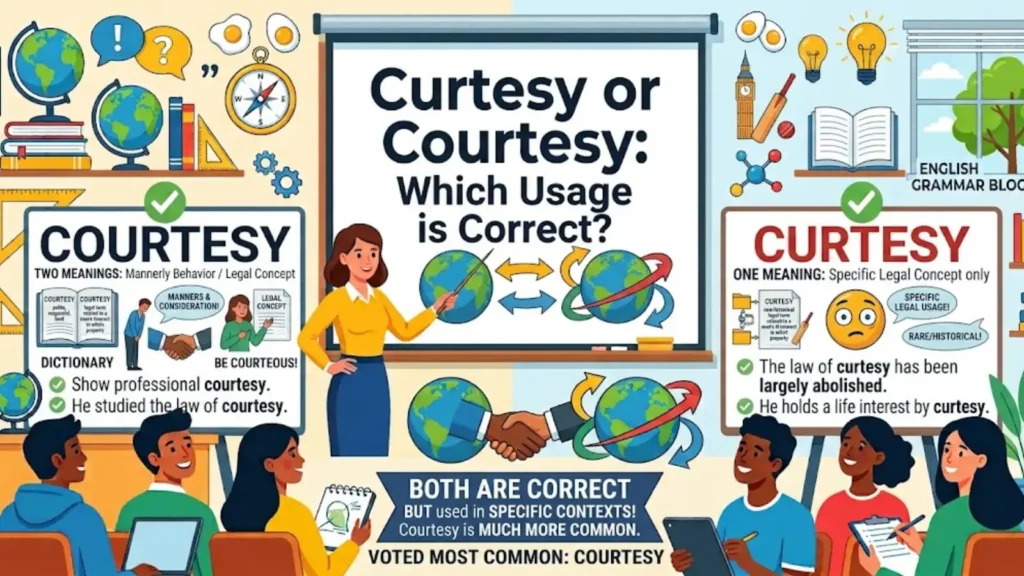
The correct spelling for the common English word meaning polite behavior, respect, or a thoughtful act is courtesy. The spelling curtesy is not normally used for this modern meaning. However, it has appeared historically as a separate word with a different meaning.
This small spelling difference matters in emails, school assignments, business writing, blogs, and professional communication. Therefore, knowing which form to use can help you write more clearly and confidently.
RELATED: Sapphire or Saphire – Which Spelling Is Correct and Why It Matters
What Does “Curtesy or Courtesy” Mean?
When people search for curtesy or courtesy, they usually want to know how to spell the word that describes polite behavior or consideration toward another person.
The correct modern spelling is courtesy.
Courtesy can mean polite behavior, respect, kindness, or a considerate action.
Examples
- Thank you for your courtesy.
- He treated every guest with courtesy.
- As a courtesy, the hotel offered us free transportation.
- Please show courtesy to other passengers.
- The manager called us as a courtesy.
The spelling curtesy is generally incorrect when you mean politeness or respectful behavior.
Therefore, if you are writing a normal sentence about good manners, use courtesy.
Curtesy or Courtesy: The Core Difference
The main difference is simple:
Courtesy is the standard modern English spelling for polite behavior, respect, or a considerate action.
Curtesy is not the normal spelling for this meaning.
For example:
Please treat other customers with courtesy. ✓
Not:
Please treat other customers with curtesy. ✗
Similarly:
Thank you for your courtesy. ✓
Not:
Thank you for your curtesy. ✗
However, there is an interesting historical detail. Curtesy has existed as an English word in older usage, particularly in the legal term courtesy or curtesy connected with a husband’s rights in his deceased wife’s property. This historical use is different from the everyday meaning of politeness.
For modern writing, therefore, courtesy is the spelling you should normally choose.
Why Is “Courtesy” Correct?
The word courtesy comes from older forms of English and French associated with courtly behavior and manners. Over time, its meaning developed around polite and respectful conduct.
Modern English has standardized the spelling as courtesy.
One reason people write curtesy is pronunciation. In ordinary speech, the word can sound like the first vowel is not strongly pronounced. Consequently, writers may spell it according to how they hear it.
However, English spelling does not always perfectly match pronunciation.
Example:
- Courtesy → correct
- Curtesy → generally incorrect for the modern meaning
The letters “ou” in courtesy are important to remember.
A Simple Memory Trick
Think of the word court.
court + esy = courtesy
This is not a strict spelling formula, but it can help you remember the correct form.
You can also connect courtesy with courtly manners. Both ideas relate to polite and respectful behavior.
Courtesy: Meaning and Grammar
Courtesy is usually used as a noun.
It can refer to a quality, behavior, action, or gesture that shows politeness or consideration.
Example 1: Polite Behavior
The teacher treated her students with courtesy.
Here, courtesy means respectful and polite behavior.
Example 2: A Considerate Action
The company provided a courtesy shuttle for its customers.
Here, courtesy describes something provided as a friendly or helpful gesture.
Example 3: Respect
Drivers should show courtesy to pedestrians.
In this sentence, courtesy means consideration and respect.
Moreover, courtesy can appear in several common expressions.
Common Expressions With Courtesy
- common courtesy
- professional courtesy
- as a courtesy
- courtesy call
- courtesy service
- courtesy of
- out of courtesy
For example:
Holding the door open for someone is a matter of common courtesy.
Courtesy vs. Curtesy: Comparison Table
| Feature | Courtesy | Curtesy |
|---|---|---|
| Standard modern spelling | Yes | No, for the usual meaning |
| Means politeness | Yes | No |
| Means respect or consideration | Yes | No |
| Common in modern English | Yes | Rare/historical |
| Used in professional writing | Yes | Generally no |
| Used in “common courtesy” | Yes | No |
| Suitable for everyday communication | Yes | No |
The safest choice for modern writing is courtesy.
How to Use “Courtesy” in Real Life
Understanding a spelling rule is useful, but seeing the word in different situations makes it easier to remember.
1. Everyday Conversation
Courtesy is common when talking about manners.
Please show some courtesy to your neighbors.
She thanked him for his courtesy.
Simple courtesy can make conversations more pleasant.
These examples show how courtesy relates to respectful behavior.
2. Education
Students can use courtesy when writing about classroom behavior, respect, or social manners.
Students should show courtesy to their teachers.
Classroom courtesy creates a better learning environment.
The teacher reminded everyone to speak with courtesy.
Therefore, students should avoid using curtesy in these sentences.
3. Business Communication
Professional communication often requires polite language.
Thank you for your courtesy and assistance.
We appreciate your courtesy during the meeting.
The company offered a courtesy replacement.
In business writing, spelling mistakes can make a message appear less polished. Consequently, using courtesy correctly is important.
4. Blogging
Bloggers may use the word when discussing manners, customer service, or communication.
For example:
Good customer service begins with courtesy and respect.
Another example is:
Online courtesy is important when communicating with readers.
Moreover, bloggers should use the standard spelling because readers may notice spelling errors.
Common Phrases With “Courtesy”
Learning common phrases can make the correct spelling easier to remember.
Common Courtesy
Common courtesy means basic politeness and consideration.
It is common courtesy to listen when someone is speaking.
Professional Courtesy
Professional courtesy refers to polite or respectful behavior in a workplace or professional setting.
The staff handled the complaint with professional courtesy.
As a Courtesy
This phrase means something is done as a polite or considerate gesture.
We offered free delivery as a courtesy.
Courtesy Call
A courtesy call is a call made as a polite gesture, often to provide information or check on something.
The hotel made a courtesy call before our arrival.
Courtesy of
Courtesy of can mean something was provided or made possible by someone.
The photos were provided courtesy of the local museum.
Common Mistakes to Avoid
1. Writing “Curtesy” for Politeness
This is the most common mistake.
❌ Thank you for your curtesy.
✓ Thank you for your courtesy.
2. Using the Wrong Spelling in Formal Emails
Because courtesy is common in professional communication, spelling it incorrectly can reduce the quality of your message.
❌ We appreciate your curtesy.
✓ We appreciate your courtesy.
3. Confusing Spelling With Pronunciation
Some people spell the word based on how they hear it.
However, pronunciation should not be used as the only guide to English spelling.
4. Replacing “Courtesy” With Unnatural Alternatives
Sometimes writers avoid the word because they are unsure about its spelling.
For example, instead of writing:
Thank you for your courtesy.
They may write:
Thank you for your polite behavior.
Both can be correct, but courtesy is perfectly natural and concise.
5. Using “Curtesy” in SEO Content
If you are writing an article targeting the keyword curtesy or courtesy, it is fine to discuss the spelling confusion. However, the correct word should be used naturally throughout the article.
Is “Curtesy” Ever a Word?
Yes, but this point requires some context.
Curtesy has appeared as a historical and legal spelling. It is associated with an old legal concept concerning a husband’s rights to certain property interests after his wife’s death.
This use is uncommon in everyday modern English.
Therefore, seeing curtesy in an old legal document does not necessarily mean it was simply a spelling mistake. Historical English contained spelling variations that are rarely used today.
For ordinary writing, however, you should use courtesy when you mean politeness, kindness, respect, or consideration.
Frequently Asked Questions
Is “curtesy” or “courtesy” correct?
Courtesy is the correct modern spelling when you mean polite behavior, respect, kindness, or consideration.
See also: Cosy or Cozy: Which Spelling Is Correct and When to Use It?
Is “curtesy” a misspelling?
For the common modern meaning of politeness, curtesy is generally considered a misspelling. However, it has historical and legal uses as a separate term.
What does courtesy mean?
Courtesy means polite, respectful, or considerate behavior toward another person. It can also describe something offered as a friendly gesture.
What is an example of courtesy?
Holding a door open for another person is a simple example of courtesy. Saying “please” and “thank you” are also common examples.
Can I use “courtesy” in a business email?
Yes. Courtesy is very common in professional communication.
For example:
Thank you for your courtesy and assistance.
How do you remember the spelling of courtesy?
A useful trick is to connect courtesy with court and courtly manners. Remembering this connection can help you remember the “ou” spelling.
Is courtesy a noun?
Yes. Courtesy is primarily a noun.
Example:
Her courtesy impressed everyone at the meeting.
What is the opposite of courtesy?
Depending on the context, opposites can include rudeness, discourtesy, impoliteness, or disrespect.
Is “courtesy” used in American and British English?
Yes. Courtesy is used in both American and British English.
Which spelling should I use in an essay?
Use courtesy when you mean politeness or respectful behavior. It is the standard spelling in modern English.
Conclusion
When deciding between curtesy or courtesy, the answer is straightforward for modern everyday English: courtesy is the standard spelling for politeness, respect, consideration, or a kind gesture.
Although curtesy can be found in historical or specialized legal contexts, it should not normally replace courtesy in emails, essays, blogs, business writing, or everyday communication.
Remember the simple connection between courtesy and courtly manners. This can help you remember the important “ou” spelling.
Therefore, whenever you want to describe respectful or polite behavior, choose courtesy. Using the correct spelling will make your writing clearer, more professional, and easier for readers to understand.