Do you ever think twice before writing “capital” or “capitol”? You’re not by yourself. Every day, thousands of people look for this. Despite having the similar sound, these two terms have quite different meanings. If you use the incorrect one, your writing may appear amateurish. One alludes to a structure where legislators convene. The other has several connotations pertaining to letters, towns, and money. Because English contains a large number of homophones—words that sound similar but have different spellings and meanings—this mistake is frequent. You will discover the precise distinction between capital and capitol in this guide. You’ll learn when to use each phrase, see clear examples, and steer clear of typical blunders. You won’t ever mix up these two terms again by the end.
Capitol or Capital: Meaning Explained Simply
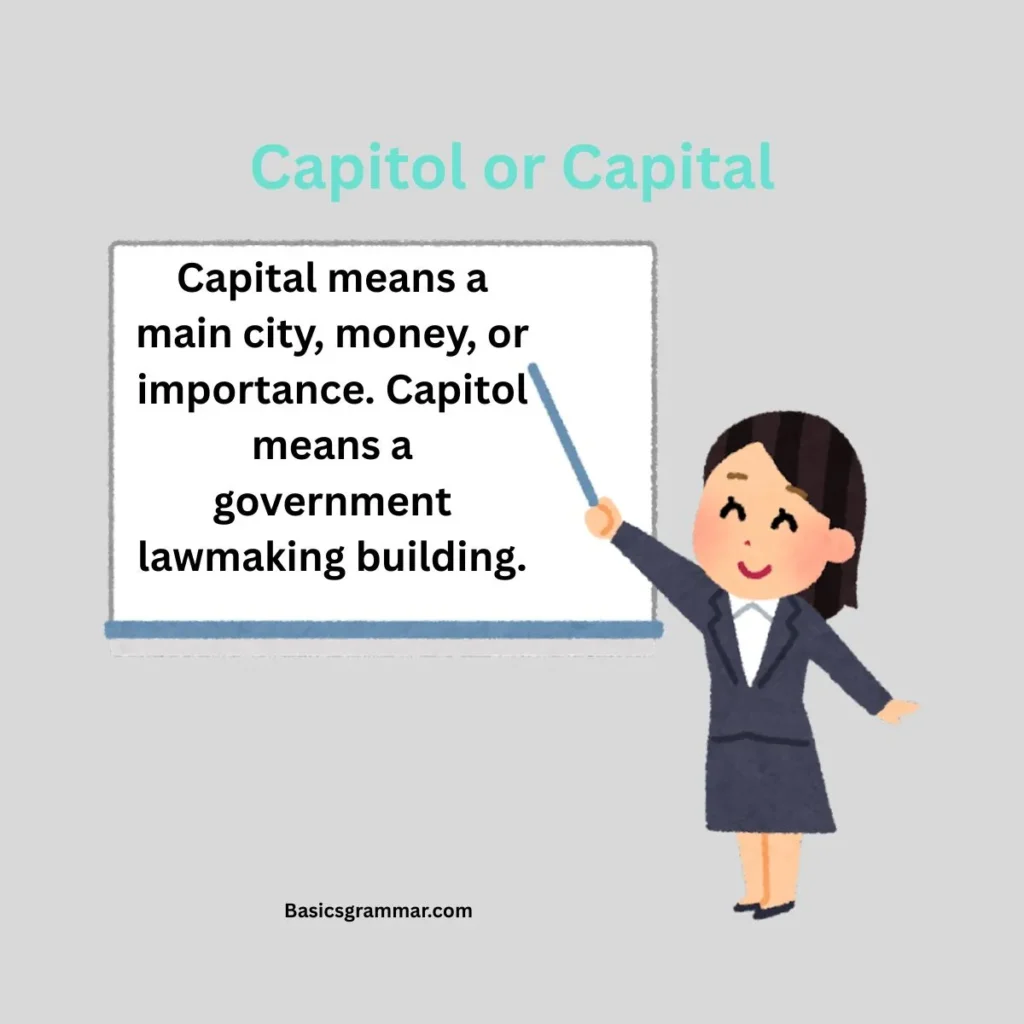
Despite their similar sounds, the terms “capitol” and “capital” have distinct meanings. The term “capitol” describes a particular government structure, such as the U.S. Capitol or a state capitol, where legislators convene. It is primarily used in political contexts and is a noun.
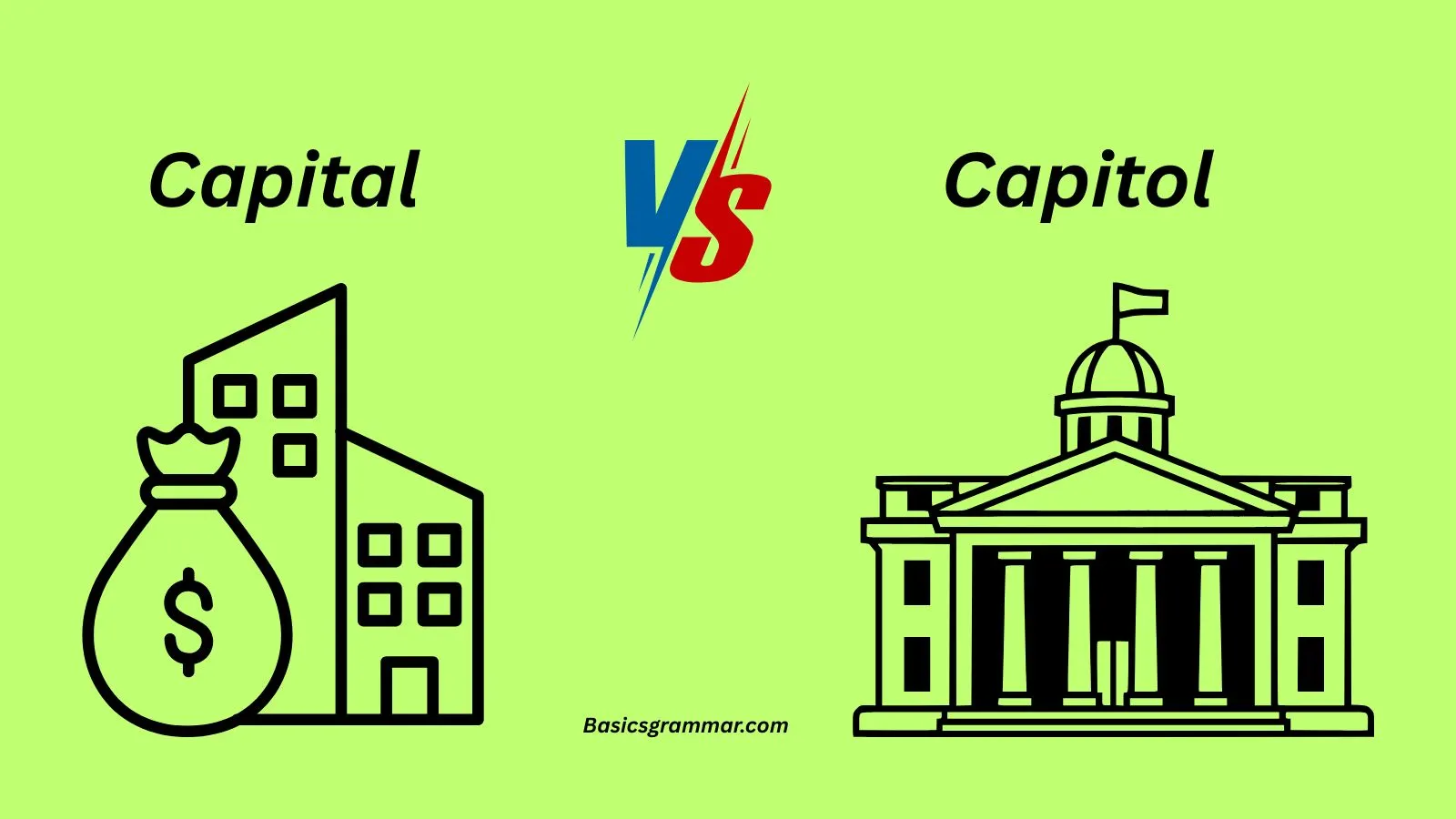
Capital has a broader meaning. It can refer to a capital city, such as Washington, D.C., a capital letter, or money and assets used in business. Because it has multiple meanings, capital is used far more often than capitol in everyday and professional writing.
In short, use capitol when you mean a lawmaking building, and use capital for cities, letters, or money.
Capitol or Capital – Quick Answer
Capitol (with an “o”) refers to a government building where legislators meet. It’s always a building.
Capital (with an “a”) has several meanings:
- A city where government is located (capital city)
- Money or wealth (financial capital)
- An uppercase letter (capital letter)
- Something excellent or serious (capital idea, capital offense)
Quick Example:
- The senator walked into the capitol building in the capital city.
The Origin of Capitol and Capital
Both words come from Latin, but they took different paths.
Capital comes from the Latin word “capitalis,” which means “of the head.” The Romans used “caput” for head. Over time, “capital” came to mean the main or most important thing. That’s why we use it for capital cities (the head city) and capital letters (the letters at the head or top).
Capitol has a more specific origin. It comes from “Capitolium,” the name of a temple in ancient Rome on Capitoline Hill. This temple was the center of Roman government. When Americans built their government building in the 1700s, they called it the Capitol, borrowing from Roman history.
The spelling difference exists because “capitol” kept its Roman temple connection. It stayed specific to government buildings. “Capital” became the general word for everything else.
British English vs American English Spelling
Good news: Both British and American English use the same spellings for these words.
Capitol = government building (US and UK) Capital = city, money, letter (US and UK)
However, usage differs slightly:
Comparison Table
| Feature | American English | British English |
|---|---|---|
| Government building | Capitol (US Capitol) | Parliament building (not called “capitol”) |
| Capital city | Washington, D.C. is the capital | London is the capital |
| Financial capital | Raise capital for business | Raise capital for business |
| Capital letter | Use a capital A | Use a capital A |
| Spelling | No difference | No difference |
Key Difference: Americans say “the Capitol” for their main government building in Washington, D.C. British people don’t use “capitol” much because they call their building “Parliament” or “the Houses of Parliament.”
State capitols in the US also use this spelling. For example: the Texas State Capitol, the California State Capitol.
Which Spelling Should You Use?
Your choice depends on what you’re writing about and your audience.
Use “Capitol” when:
- Writing about the US Capitol building in Washington, D.C.
- Writing about state capitol buildings (Texas Capitol, Ohio Capitol)
- Discussing where lawmakers meet in the United States
Use “Capital” when:
- Naming a capital city (Paris is the capital of France)
- Discussing money or finances (venture capital, capital investment)
- Referring to uppercase letters (Write your name in capital letters)
- Describing something serious or excellent (capital punishment, capital idea)
For US Audiences: Both words are common. Use “capitol” only for government buildings. Use “capital” for everything else.
For UK/Commonwealth Audiences: “Capital” is much more common. “Capitol” is mainly used when discussing American government or buildings.
For Global/International Writing: Stick with “capital” unless specifically writing about American government buildings. Most of the world uses “capital” for cities and money.
Common Mistakes with Capitol and Capital
Here are the most frequent errors people make:
Wrong 1: Writing “capitol city”
- ❌ Wrong: Paris is the capitol of France.
- ✅ Right: Paris is the capital of France.
Error 2: Writing “capital building” for government buildings
- ❌ Wrong: Protesters gathered at the capital building.
- ✅ Right: Protesters gathered at the capitol building.
Mistake 3: Using “capitol” for money
- ❌ Wrong: We need more capitol to start the business.
- ✅ Right: We need more capital to start the business.
Error 4: Writing “capital” for the US building
- ❌ Wrong: Congress meets at the Capital.
- ✅ Right: Congress meets at the Capitol.
Mistake 5: Confusing capital letters
- ❌ Wrong: Please write in capitol letters.
- ✅ Right: Please write in capital letters.
Memory Trick: Think of the “o” in capitol as the dome on top of the building. The building has a dome, so it’s capitol. Everything else is capital.
Capitol or Capital in Everyday Examples
See how these words appear in real writing:
In News Articles
- “The President addressed Congress at the Capitol today.”
- “New York City was once the capital of the United States.”
- “Investors poured capital into tech startups.”
Emails
- “Our meeting is scheduled near the state capitol tomorrow.”
- “Please remember to capitalize proper nouns with a capital letter.”
- “We’re seeking capital to expand our operations.”
Social Media
- “Amazing tour of the Capitol building today! 🏛️”
- “What’s the capital of Australia? (It’s Canberra, not Sydney!)”
- “Need more capital to grow my small business.”
Formal Writing
- “The Supreme Court is located near the Capitol in Washington, D.C.”
- “London serves as both the capital city and financial center.”
- “Capital punishment remains controversial in many states.”
Academic Writing
- “The Texas State Capitol was completed in 1888.”
- “Human capital refers to the skills and knowledge of workers.”
- “Always begin sentences with a capital letter.”
Capitol or Capital – Google Trends & Usage Data
Google Trends shows interesting patterns for these words:
By Country:
- United States: Both words are searched frequently. “Capital” gets 3x more searches than “capitol.”
- United Kingdom: “Capital” dominates. “Capitol” is rarely searched except during US news events.
- Australia/Canada: “Capital” is much more common. “Capitol” appears mainly in American context.
- India: “Capital” is the primary search. “Capitol” has minimal searches.
By Context:
- “Capital” spikes during financial news, business discussions, and geography lessons.
- “Capitol” spikes during US political events, elections, and government news.
- Both words see confusion spikes at the start of school years (September) when students write essays.
Search Intent:
- 60% of searches are “capitol vs capital” or “difference between capitol and capital”
- 25% are looking for “capital of [country name]”
- 15% relate to US Capitol news or events
Comparison Table: Usage by Context
| Context | Capitol | Capital |
|---|---|---|
| Government building | ✅ Always | ❌ Never |
| City/Location | ❌ Never | ✅ Always |
| Money/Finance | ❌ Never | ✅ Always |
| Uppercase letters | ❌ Never | ✅ Always |
| US-specific | ✅ Common | ✅ Common |
| Global usage | ❌ Rare | ✅ Very common |
| Frequency in writing | Low | High |
Frequently Asked Questions (FAQs
Why is the capital city in DC and not in a state?
Washington, D.C. was created as a neutral federal district so no state would have power over the national government.
How do you properly use “capital”?
Use capital for a capital city, capital letters, or money and assets.
When talking about money, is it capitol or capital?
It is always capital when referring to money or financial resources.
Why do they call it capitol?
The word capitol comes from the Capitoline Hill in ancient Rome, where government buildings were located.
Why is Washington, D.C. not called DC anymore?
It is still called D.C.; people simply use Washington or D.C. interchangeably.
What is the difference between capital and capitol?
Capital has many meanings, while capitol refers only to a lawmaking building.
What is the meaning of capitol?
A capitol is a building where a legislature meets, such as the U.S. Capitol.
How to remember capital vs capitol?
Think capitOL = Only One building, while capital has many meanings.
Why do Americans say capitol?
Americans use capitol specifically for government buildings, especially at the state and federal level.
Conclusion
It is common to confuse Capitol with Capital, but once you understand the rule, it is simple to correct. The word “capital” has several different connotations. Cities, money, significance, and other topics are covered. The Capitol is small. It solely refers to structures, mostly in the US, where legislators convene.
If you only have one thing to keep in mind, it’s this: no construction, no capitol. Most errors can be avoided by following this easy guideline. Capital is typically the safest option for professional and international writing. Only when you are positive that you are referring to a particular government facility should you use capital letters.
Clear word choice enhances clarity and trust. You may now write accurately and confidently whenever you encounter Capitol or Capital.
