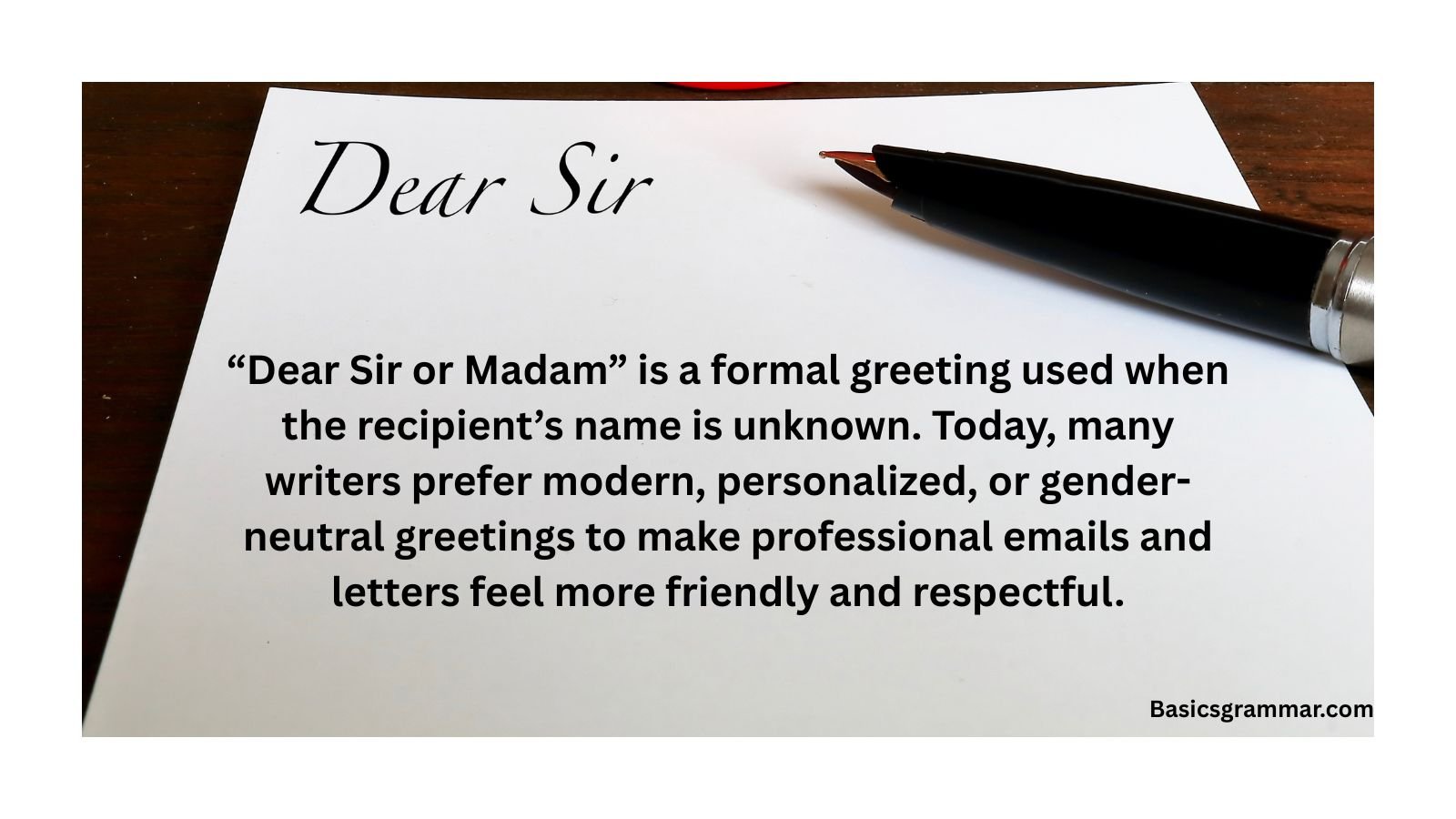
When writing formal emails or letters, choosing the right salutation can be confusing. One of the most searched phrases is “Greetings sir or madam”, often used when you don’t know the recipient’s name or gender. Many people wonder: is it still correct? Should it be capitalized? Can it sound old-fashioned? This article will clear up the confusion and guide you on how to use this salutation professionally.
Whether you are applying for a job, writing to a company, or sending a formal request, understanding the correct usage will make your communication clear, polite, and modern.
Dear Sir or Madam – Quick Answer
“Greetings Sir or Madam” is a formal salutation used in letters or emails when the writer does not know the recipient’s name or gender.
Example:
- Correct: Greetings Sir or Madam, I am writing to apply for the Marketing Manager position at your company.
- Incorrect: dear sir/madam, or Hello Sir or Madam, (too informal for formal letters)
It’s polite, professional, and widely accepted in formal correspondence, though some modern alternatives are emerging.
The Origin of Dear Sir or Madam
The phrase dates back to traditional English correspondence in the 18th and 19th centuries. “Sir” comes from the Old French sieur, meaning “man of rank,” while “madam” comes from ma dame, meaning “my lady.”
Using “Greetings Sir or Madam” became standard for business letters when the recipient was unknown. Today, it is still used in formal letters, applications, and official requests, although email etiquette now sometimes favors more gender-neutral greetings.
British English vs American English Spelling
The phrase “Greetings Sir or Madam” is spelled the same in both British and American English. However, capitalization and punctuation may slightly differ in style guides.
Comparison Table:
| Style | Example Salutation | Notes |
|---|---|---|
| British English | Dear Sir or Madam, | Capitalize each word; comma is standard |
| American English | Dear Sir or Madam: | Colon often preferred in business letters |
While the wording doesn’t change, subtle style differences exist in punctuation.
Which Spelling Should You Use?
- United States: Use Greetings Sir or Madam: with a colon for formal emails or letters.
- United Kingdom/Commonwealth: Use Greetings Sir or Madam, with a comma for letters.
- Global Audience: Either is understood; choose based on formality and regional norms.
If possible, finding the recipient’s name is always better. Otherwise, Greetings Sir or Madam is safe and professional.
Common Mistakes with Dear Sir or Madam
- Using lowercase: “dear sir or madam” → ❌
✅ Correct: Greetings Sir or Madam - Adding unnecessary words: “Dear Sir and/or Madam” → ❌
✅ Correct: Greetings Sir or Madam - ❌Using casual greetings: “Hi Sir or Madam”
✅ Correct: Greetings Sir or Madam - For emails only: Some people think it’s outdated. ✅ Modern alternative: To Whom It May Concern
Dear Sir or Madam in Everyday Examples
Emails:
Dear Sir or Madam, I would like to inquire about your product pricing.
Newsletters/Official Notices:
Dear Sir or Madam, Thank you for your interest in our services.
Social Media (formal company responses):
Dear Sir or Madam, we have received your request and will reply shortly.
Formal Letters:
Dear Sir or Madam, I am submitting my application for the open position of Data Analyst.
Dear Sir or Madam – Google Trends & Usage Data
According to recent trends, searches for “Greetings Sir or Madam” peak during job application seasons and end-of-year correspondence. The highest usage is in United Kingdom, United States, India, and Canada. Users generally search for this phrase to confirm correct spelling, capitalization, and usage in formal letters.
Comparison Table of Common Variations:
| Variation | Usage Frequency | Notes |
|---|---|---|
| Dear Sir or Madam | High | Standard formal greeting |
| To Whom It May Concern | Medium | More modern, neutral |
| Dear Madam or Sir | Low | Rare, sometimes awkward |
| Hello Sir or Madam | Low | Too informal for official use |
FAQs About Dear Sir or Madam
- Is “Greetings Sir or Madam” outdated?
Not entirely, but modern alternatives like To Whom It May Concern or using a name are often preferred. - Do I need a comma or colon?
British style uses a comma; American style often uses a colon. - Can I use it in emails?
Yes, especially for formal or official emails. - Is it gender-neutral?
It is polite and covers all genders, though some prefer fully neutral alternatives. - Should I always try to find the recipient’s name?
Yes. Personalized greetings are more professional. - Can it be used in cover letters?
Absolutely; it’s ideal if the recipient’s name is unknown. - Are there any better alternatives?
To Whom It May Concern or Dear [Job Title] can be used when appropriate.
Conclusion
Greetings Sir or Madam remains a safe and professional greeting when writing formal letters or emails to unknown recipients. While some consider it traditional, it is still widely recognized in professional contexts across the UK, US, and other English-speaking countries. Remember to capitalize correctly, use the appropriate punctuation for your region, and consider using a more personalized greeting when possible.
Using this salutation correctly ensures your correspondence is polite, professional, and universally understood, helping you make a positive impression in both business and official communication.