
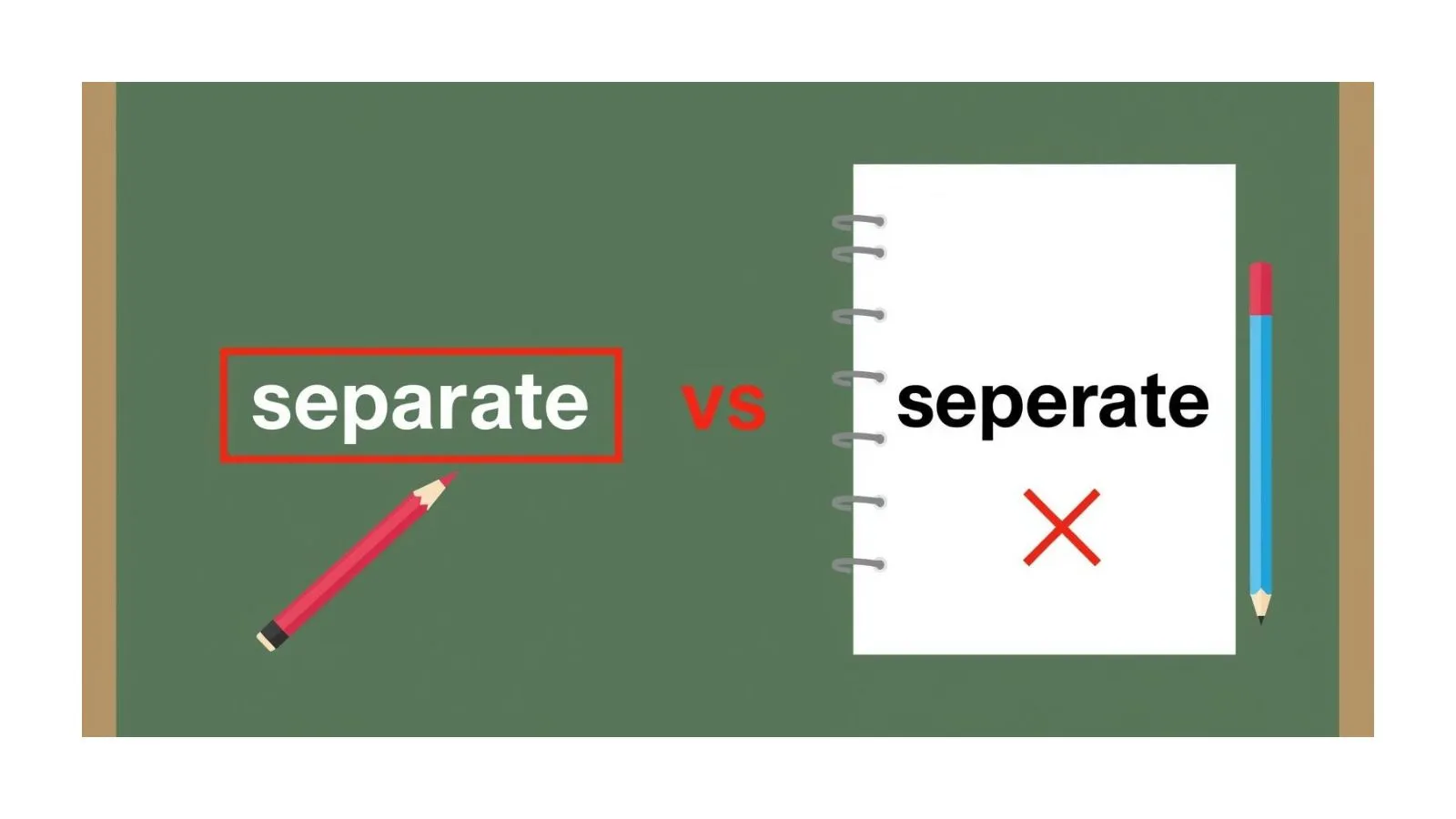
Many people get confused between “separate” and “seperate.” This common spelling mistake appears in emails, essays, social media, and even professional documents. The confusion happens because the word is often pronounced quickly, making it easy to miss the correct vowel pattern. However, using the wrong spelling can harm your credibility and make your writing look unprofessional.
That’s why understanding the correct form is important for students, writers, and professionals alike. This guide will help you learn the correct spelling, understand its origin, avoid common mistakes, and use it confidently in everyday writing. By the end, you’ll never mix up separate and seperate again.
Separate or Seperate – Quick Answer
- ✅ Separate → Correct spelling
- ❌ Seperate → Incorrect spelling
Examples:
- “Please keep the files separate.”
- “We need separate accounts for each department.”
Tip:
Remember: “sep-a-rate” (there is an “a” in the middle).
The Origin of Separate or Seperate
The word separate comes from Latin separatus, meaning “to divide” or “to set apart.” Over time, it entered English with the same spelling structure. The incorrect form seperate likely developed from pronunciation errors, where people replace the “a” with an “e.” This mistake became common in casual writing and typing.
British English vs American English Spelling
| Word | Region | Example Sentence |
|---|---|---|
| Separate | US & UK | “Keep these items in separate boxes.” |
| Seperate | Incorrect | Not used in any standard English |
Note: Unlike colour/color, separate is spelled the same worldwide.
Which Spelling Should You Use?
Always use separate regardless of your audience. It is correct in:
- American English
- British English
- Australian and Canadian English
Avoid seperate in all situations, including informal writing.
Common Mistakes with Separate
- Writing seperate instead of separate
- Forgetting the “a” in the middle
- Confusing pronunciation with spelling
Quick Memory Tip:
👉 “There is ‘a rat’ in sep-a-rate.”
Separate or Seperate in Everyday Examples
- Emails: “Please send the documents in separate files.”
- News: “The company will create separate divisions.”
- Social Media: “I like to keep work and life separate.”
- Formal Writing: “The study used two separate samples.”
Separate or Seperate – Google Trends & Usage Data
- “Separate” dominates global searches across all English-speaking countries.
- “Seperate” appears in search queries but mainly as a spelling correction.
- Common in education-related searches and grammar help topics.
Insight: Correct spelling improves SEO ranking and user trust.
Comparison Table: Separate vs Seperate
| Variation | Correctness | Notes |
|---|---|---|
| Separate | ✅ Correct | Standard spelling worldwide |
| Seperate | ❌ Incorrect | Common spelling mistake |
FAQs About Separate or Seperate
- Is “seperate” ever correct?
No, it is always incorrect. - Why do people misspell “separate”?
Because of pronunciation confusion and typing habits. - Is “separate” the same in US and UK English?
Yes, the spelling is identical worldwide. - How can I remember the correct spelling?
Use the trick: “sep-a-rate” or “there’s a rat in separate.” - Can “separate” be a verb?
Yes, e.g., “Please separate the items carefully.” - Is it important for SEO?
Yes, correct spelling improves credibility and search rankings.
Conclusion
Understanding separate or seperate is essential for clear and professional writing. The correct spelling is always separate, while seperate is a common but incorrect mistake. This word has the same spelling in both American and British English, so there is no regional variation to consider.
By remembering simple tips like “sep-a-rate,” you can avoid errors and write with confidence. Whether you’re sending emails, writing reports, or posting online, using the correct spelling improves readability, credibility, and SEO performance. Paying attention to small details like this makes a big difference in how your writing is perceived.