
Confused between “sometime” and “some time”? You’re not alone. Many English speakers mix these two because they sound the same but have different meanings. Understanding the difference is essential for writing clearly, whether in emails, essays, or social media. People often search for this phrase to avoid embarrassing mistakes in professional or casual writing.
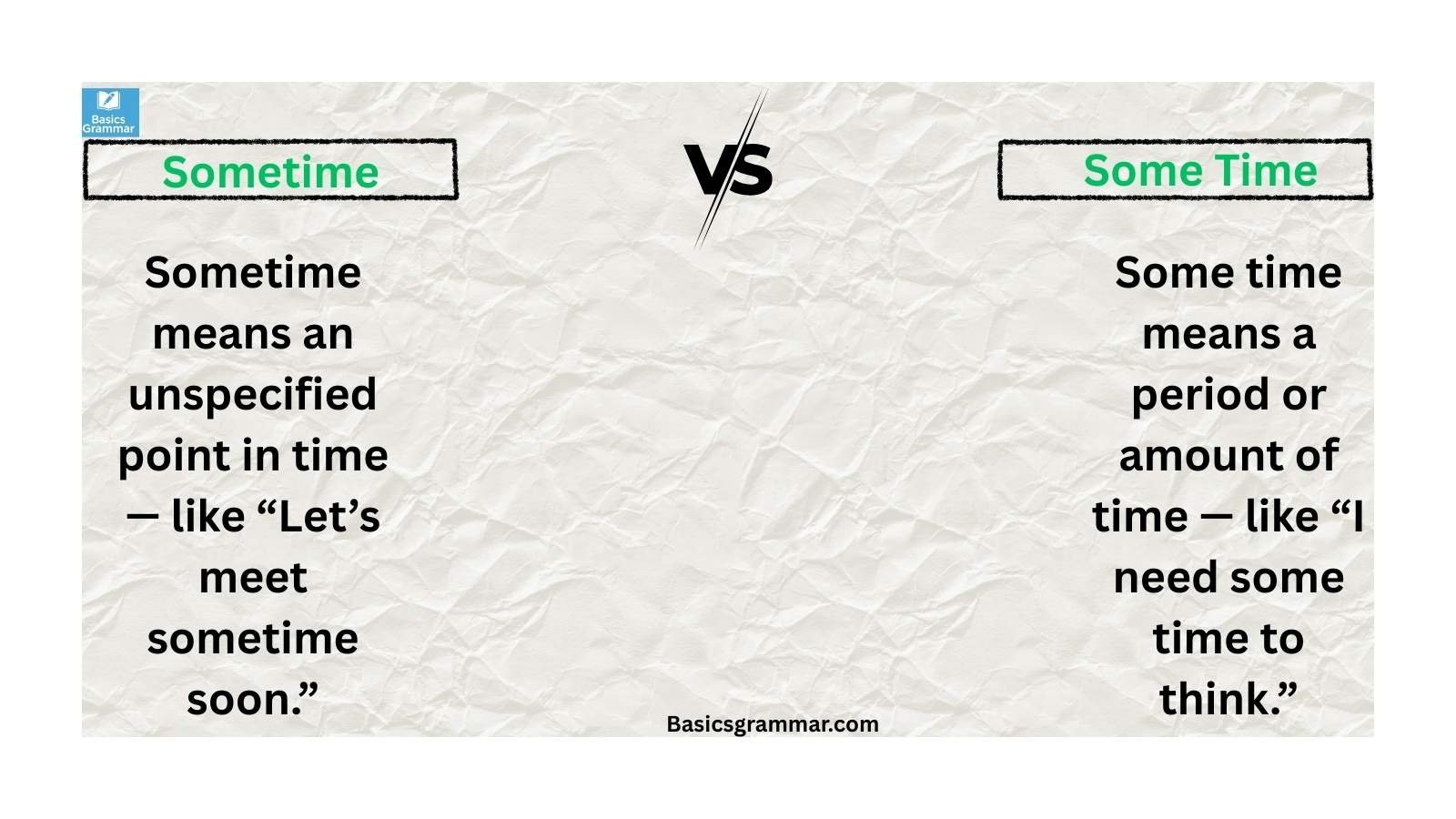
Simply put, “sometime” refers to an unspecified point in time, while “some time” indicates a duration or amount of time. This article explains the difference, gives real-world examples, compares British vs American English, and offers practical advice so you never get confused again.
Sometime or Some Time – Quick Answer
- Sometime → A vague point in time.
Example: “Let’s meet sometime next week.” - Some time → A period or length of time.
Example: “It took some time to finish the project.”
Tip: If you can replace it with “a while,” it’s usually some time.
The Origin of Sometime or Some Time
The word “sometime” comes from Middle English, combining “some” + “time” to mean “at a certain unspecified time.” Over centuries, it became a single word.
“Some time” has always been two words because it emphasizes duration, not a specific moment. English evolves, but spelling rules preserve this distinction.
British English vs American English Spelling
Both British and American English treat “sometime” and “some time” the same way. The difference is not in spelling but in usage preference in formal writing.
| Term | British English Example | American English Example |
|---|---|---|
| Sometime | “We should catch up sometime soon.” | “We should catch up sometime soon.” |
| Some time | “It took some time to solve the issue.” | “It took some time to solve the issue.” |
Note: Both variants are correct; context decides usage.
Which Spelling Should You Use?
- For US audiences: Both work, but some time is clearer in formal writing.
- For UK/Commonwealth audiences: Usage is identical; context matters more than style.
- Global audience: Avoid confusion by using some time when talking about duration. Use sometime only for vague points in time.
Common Mistakes with Sometime or Some Time
- ❌ “I will meet you in some time next week.”
✅ Correct: “I will meet you sometime next week.” - ❌ “It took sometime to finish the task.”
✅ Correct: “It took some time to finish the task.” - ❌ Mixing them in formal writing can confuse readers.
Tip: Ask yourself: Am I talking about a duration (some time) or an unspecified point (sometime)?
Sometime or Some Time in Everyday Examples
- Emails:
“Let’s schedule a meeting sometime next week.” - News articles:
“The team spent some time researching before announcing results.” - Social media:
“We should hang out sometime soon!” - Formal writing:
“Completing the project required some time due to unexpected delays.”
Sometime or Some Time – Google Trends & Usage Data
According to search trends, people often search “sometime vs some time” in English-speaking countries like the US, UK, Canada, and Australia. Queries spike around exam seasons, writing workshops, and content editing periods.
| Country | Sometime Popularity | Some Time Popularity |
|---|---|---|
| USA | High | Higher |
| UK | Medium | High |
| Canada | Medium | Medium |
| Australia | Medium | Medium |
Insight: Using the correct form improves clarity and credibility in all regions.
Keyword Variations Comparison
| Variation | Meaning | Example |
|---|---|---|
| Sometime | Unspecified point in time | “I’ll visit you sometime next month.” |
| Some time | Duration or period of time | “It took some time to understand the problem.” |
| Some Time / Sometime | Common confusion | Avoid mixing them in the same sentence. |
FAQs
- Can I use “sometime” for duration?
No. Use some time for a period of time. - Is “some time” two words everywhere?
Yes, in both British and American English. - Can “sometime” mean “occasionally”?
Yes. “I sometime go hiking on weekends.” - Which is more formal?
Some time is generally clearer in professional writing. - Can I say “sometime soon”?
Yes, this is correct for a vague future point. - Is “sometime or some time” a common search?
Yes, especially among writers, students, and content creators. - How do I remember the difference?
Replace it with “a while.” If it fits, use some time; otherwise, use sometime.
Conclusion
Knowing the difference between sometime and some time is simple but crucial. Sometime points to a vague moment in the future, while some time refers to a duration. Mistakes can confuse readers or make writing seem careless, especially in emails, reports, or online content.
By remembering the quick tip—“sometime” = vague point, “some time” = duration—you can write with confidence. Check your audience: US, UK, or global readers will understand either, but clarity is key. Using these words correctly will enhance professionalism and prevent miscommunication in every form of writing.