Many writers struggle with the spelling “supercede or supersede.” It looks simple, yet it causes frequent mistakes in emails, academic writing, and professional documents. The confusion comes from similar English words like precede and concede, which use -cede, leading people to assume “supercede” is correct. However, this assumption is wrong. Understanding the correct spelling is essential for clear, professional communication.
Whether you are writing a report, blog post, or business email, using the right form improves credibility and avoids errors. This guide explains the correct spelling, origin, common mistakes, and proper usage so you can write confidently and accurately.
Supercede or Supersede – Quick Answer
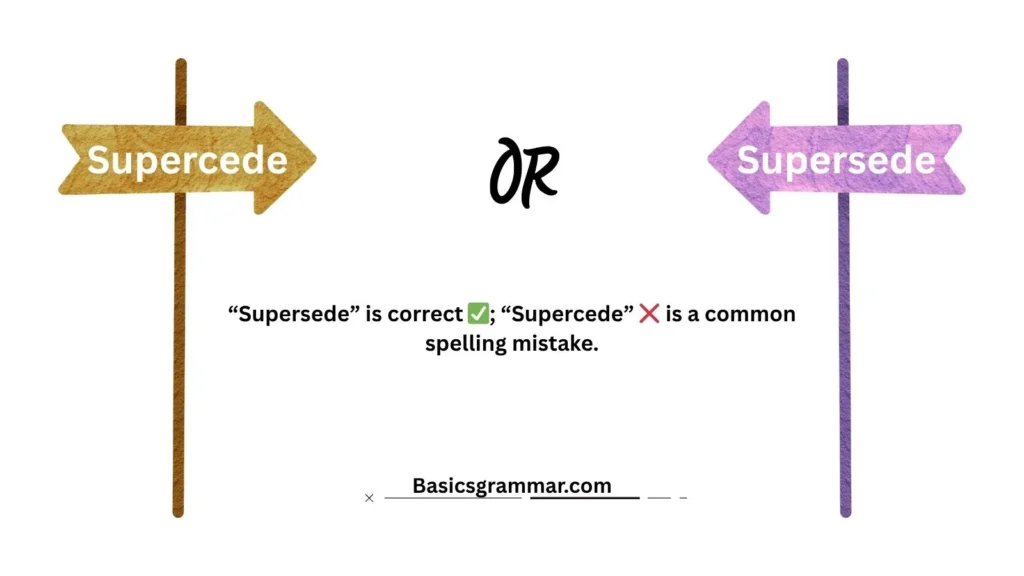
- ✅ Correct: Supersede
- ❌ Incorrect: Supercede
Meaning: To replace something older or less effective.
Examples:
- “This policy will supersede the previous one.”
- “The new law supersedes outdated regulations.”
The Origin of Supercede or Supersede
The word supersede comes from Latin supersedere, meaning “to sit above” or “to replace.” Unlike similar words ending in -cede, this word uses -sede, making it unique. The incorrect spelling supercede likely developed because of confusion with words like precede and concede, which follow a different pattern.
British English vs American English Spelling
| Word | Region | Example Sentence |
|---|---|---|
| Supersede | US & UK | “The update will supersede older versions.” |
| Supercede | Incorrect | Not accepted in any English variant |
Note: There is no difference between British and American English for this word.
Which Spelling Should You Use?
Always use supersede, regardless of your audience. It is the only correct spelling in American English, British English, and all global contexts. Avoid supercede in any professional, academic, or casual writing.
Common Mistakes with Supercede or Supersede
- Writing supercede instead of supersede
- Confusing it with words like precede or intercede
- Forgetting that this word is an exception to the usual -cede rule
Tip:
Remember: Supersede is special—it uses “sede,” not “cede.”
Supercede or Supersede in Everyday Examples
- Emails: “This agreement will supersede all previous contracts.”
- News: “The new policy supersedes earlier guidelines.”
- Social Media: “Technology keeps evolving and superseding old trends!”
- Formal Writing: “The revised document supersedes prior versions.”
Supercede or Supersede – Google Trends & Usage Data
- Supersede is widely used in all English-speaking countries.
- Supercede appears mainly in search queries as a misspelling.
- High usage in legal, business, and academic contexts.
Insight: Using the correct spelling improves SEO credibility and professionalism.
Comparison Table: Supercede vs Supersede
| Variation | Correctness | Notes |
|---|---|---|
| Supersede | ✅ Correct | Standard spelling worldwide |
| Supercede | ❌ Incorrect | Common mistake due to confusion |
FAQs About Supercede or Supersede
- Is supercede ever correct?
No, it is always incorrect. - Why is supersede spelled differently?
It comes from Latin supersedere, not from words ending in -cede. - Does British English use supercede?
No, both UK and US use supersede. - How can I remember the correct spelling?
Think: “Supersede replaces—both have ‘sede.’” - Is supersede commonly used?
Yes, especially in legal, business, and formal writing. - Can supersede be used in casual writing?
Yes, but it appears more often in formal contexts.
Summary
Understanding the difference between supercede or supersede is simple once you know the rule. Supersede is the only correct spelling and is used globally in all forms of English. The incorrect version, supercede, is a common mistake caused by confusion with similar-looking words. Using the correct spelling improves your writing quality, builds trust, and ensures professional communication.
Whether writing emails, reports, or online content, always double-check your spelling. Remember, small details like this make a big difference in clarity and credibility. By mastering this distinction, you can write with confidence and avoid one of the most common English spelling errors.

Hi, I’m John Miles, the voice behind Grammar Meaning! I share clear and practical grammar tips. You’ll find my work on basicsgrammar.com.