You are writing an email, checking an important document, and suddenly you stop at one sentence: “We are insuring that everything is ready.” Something feels slightly off. Then comes the classic question: “Should it be insuring or ensuring?”
These two words look almost identical, and both involve making something happen. That similarity makes them easy to mix up. But they do not have the same meaning.
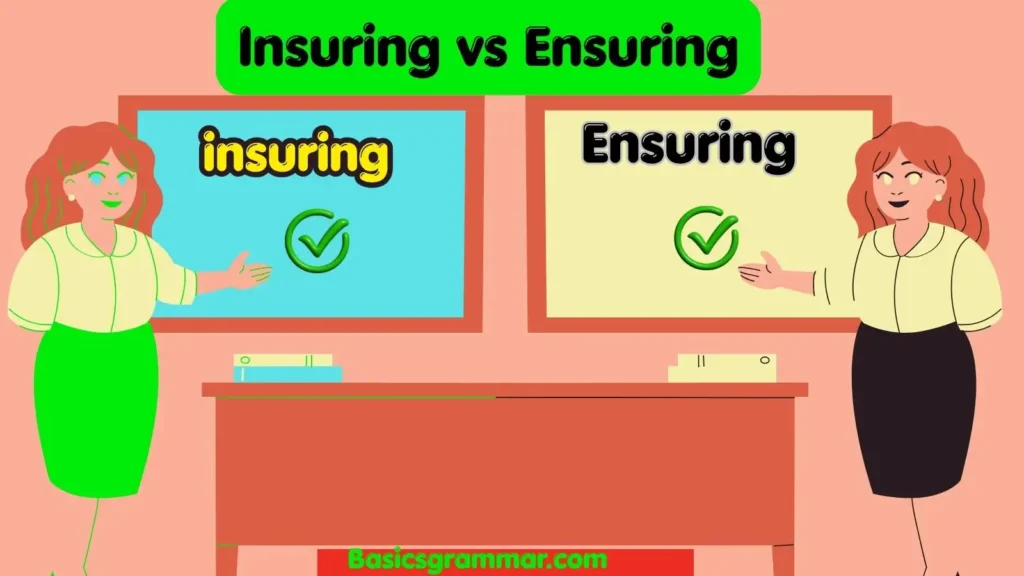
Insuring relates to insurance. You use it when you protect someone or something financially against a possible loss. Ensuring, on the other hand, means making certain that something happens or remains true.
Think of it this way: an insurance company can be insuring your car, while you can be ensuring that your car has enough fuel for a trip.
See also: Break Metal or Brake Metal: Understanding the Correct Usage
Table of Contents
- What Does Insuring vs. Ensuring Mean?
- Background and Origin
- Contexts Where Each Word Is Commonly Used
- Usage Across Different Platforms
- Common Misconceptions
- Common Mistakes
- Similar Words and Alternatives
- How to Choose the Right Word
- Insuring vs. Ensuring in Different Languages and Cultures
- Difference From Similar Words
- Usage in Online Conversations and Social Media
- Popularity and Usage Over Time
- Trusted References
- FAQs
- Conclusion
What Does Insuring vs. Ensuring Mean?
The simplest answer is:
Insuring means providing or obtaining insurance protection against financial loss, damage, illness, death, or another covered risk.
Ensuring means making certain that something happens or is true.
Here is the difference at a glance:
| Word | Meaning | Example |
|---|---|---|
| Insuring | Providing or obtaining insurance protection | We are insuring the house against fire. |
| Ensuring | Making certain that something happens | We are ensuring that the house is secure. |
What Does Insuring Mean?
Insuring is the present participle of insure.
When you insure something, you arrange financial protection against a particular risk.
Example:
- She is insuring her new car.
- The company is insuring its equipment against theft.
- They are insuring the property against storm damage.
The word usually connects to insurance, policies, premiums, coverage, claims, and financial protection.
What Does Ensuring Mean?
Ensuring is the present participle of ensure.
It means making something certain or taking action so that a particular result happens.
For example:
- Please check the doors, ensuring they are locked.
- The teacher is ensuring that every student understands the lesson.
- We are ensuring that all documents are complete.
A simple memory trick:
Insuring = insurance.
Ensuring = making certain.
A Quick Example
Friend 1: “Are you insuring the car?”
Friend 2: “Yes. I bought an insurance policy yesterday.”
Friend 1: “And are you ensuring it has enough fuel?”
Friend 2: “Absolutely. I don’t want to run out halfway there!”
The two words can appear in the same conversation, but they perform completely different jobs.
Background and Origin of Insuring vs. Ensuring
The confusion between these words partly comes from their similar spelling and shared connection to the idea of certainty or protection.
Insure comes through French from Latin roots associated with making something secure or safe. Over time, English developed insure as a word strongly connected with financial protection against risk.
Ensure also has roots connected with making something secure or certain. In modern English, however, it developed a more general meaning: to make certain that something happens.
This distinction became especially useful because English needed separate ways to discuss two different ideas:
- financial protection against risk
- taking action to make a result certain
That is why modern English speakers can say:
- “The company is insuring the building.”
- “The manager is ensuring that the building meets safety standards.”
The words look like siblings, but they have different careers.
Contexts Where Insuring vs. Ensuring Is Commonly Used
In Serious or Formal Conversations
Both words appear frequently in professional and formal writing.
Use insuring when discussing insurance:
The business is insuring its vehicles against accidental damage.
Use ensuring when discussing procedures, standards, or results:
The manager is ensuring that employees follow safety procedures.
Between Friends
Ensuring appears naturally in everyday conversation:
“I’m ensuring we have enough snacks for everyone.”
Insuring can also appear when friends discuss insurance:
“I’m insuring my motorcycle before I take it on the road.”
In Business
Businesses commonly use both words, but their meanings remain separate.
The company is insuring its warehouses against fire.
The supervisor is ensuring that all workers complete their training.
In Education
Teachers and schools often use ensuring:
The teacher is ensuring that every student receives the correct instructions.
Insuring would normally appear only when discussing insurance:
The school is insuring its buildings against property damage.
In Legal or Administrative Writing
Both words can appear in official documents.
For example:
The organization is insuring its property against specified risks.
And:
The organization is ensuring compliance with applicable regulations.
The surrounding meaning usually makes the correct choice clear.
Usage Across Different Platforms
Unlike internet slang, insuring and ensuring are standard English words. They can appear across almost any communication platform.
| Platform | Example | Notes |
|---|---|---|
| “I’m ensuring everything is ready.” | Informal everyday use | |
| Messenger | “We’re insuring the car.” | Insurance context |
| Discord | “I’m ensuring the settings are correct.” | Depends on conversation |
| TikTok | Grammar explanations may compare them | Educational context |
| Captions may use either word | Meaning depends on context | |
| Twitter/X | Grammar discussions may compare them | Short explanations are common |
| Snapchat | Both may appear in ordinary messages | Use based on meaning |
| Slack | “We are ensuring the report is accurate.” | Common in workplace communication |
| Teams | “The company is insuring the equipment.” | Common in professional contexts |
The important point is simple: the platform does not determine the word. The meaning does.
Common Misconceptions About Insuring vs. Ensuring
Misconception 1: They Mean Exactly the Same Thing
They do not.
Insuring specifically connects to insurance or financial protection.
Ensuring means making something certain.
Misconception 2: Ensuring Always Means Protecting Something
Not necessarily.
You can ensure that someone receives an email, that a meeting starts on time, or that a document contains the correct information.
We are ensuring that everyone receives a copy.
Nothing needs insurance here.
Misconception 3: Insuring Is Always the Correct Form of “Making Sure”
This mistake appears often.
You might say:
We are ensuring that everyone arrives on time.
You would not normally say:
We are insuring that everyone arrives on time.
Unless your sentence involves an actual insurance arrangement, ensuring is probably the word you need.
Misconception 4: The Extra “n” Makes No Difference
It actually makes a big difference.
One letter can change the meaning of the entire sentence.
Common Mistakes When Using Insuring vs. Ensuring
Mistake 1: Using Insuring When You Mean Making Sure
Incorrect:
We are insuring that the package arrives safely.
Better:
We are ensuring that the package arrives safely.
Mistake 2: Using Ensuring for an Insurance Policy
Incorrect:
The company is ensuring the building against fire.
Better:
The company is insuring the building against fire.
Mistake 3: Choosing Based Only on Sound
The words sound similar, so pronunciation alone may not help.
Instead, ask yourself:
Am I talking about insurance?
If yes, choose insuring.
Am I talking about making something certain?
If yes, choose ensuring.
Mistake 4: Assuming Context Does Not Matter
Context determines the correct word.
Compare:
The homeowner is insuring the property.
with:
The homeowner is ensuring that the doors are locked.
Both sentences are correct because they express different ideas.
Similar Words and Alternatives
| Word | Meaning | When to Use It |
|---|---|---|
| Insuring | Providing insurance protection | Financial or insurance situations |
| Ensuring | Making something certain | General situations |
| Assuring | Giving someone confidence or removing doubt | When communicating with a person |
| Guaranteeing | Promising that something will happen | Strong promises or commitments |
| Protecting | Keeping something safe from harm | Safety and security |
| Securing | Making something safe or obtaining something | Safety, access, or protection |
| Confirming | Establishing that something is true | Facts, details, or arrangements |
One especially useful comparison is assuring vs. ensuring.
You assure a person:
I assured her that everything was fine.
“You ensure a result or condition:”
I ensured that everything was ready.
Insure property or people against covered risks:
I insured my car.
How to Choose the Right Word
When you are stuck between insuring vs. ensuring, use this three-step test.
Step 1: Look for Insurance
If the sentence involves a policy, premium, coverage, claim, or financial protection, use insuring.
They are insuring the vehicle against theft.
Step 2: Look for “Making Sure”
If you could replace the word with making sure, use ensuring.
She is ensuring that everyone gets a seat.
You could say:
She is making sure that everyone gets a seat.
That confirms the choice.
Step 3: Check the Object
Ask what receives the action.
If you are insuring a car, house, person, or other asset against risk, insuring fits.
If you are ensuring that something happens, ensuring fits.
Insuring vs. Ensuring in Different Languages and Cultures
The distinction can create challenges for English learners because other languages may use one word or expression where English uses two.
| Language | General Approach |
|---|---|
| Spanish | Different expressions commonly distinguish insurance from making something certain |
| Arabic | Context helps distinguish insurance from ensuring an outcome |
| Hindi | Separate expressions can communicate insurance and certainty |
| Urdu | Insurance and making sure usually require different expressions |
| Tagalog | English forms may appear alongside local expressions |
| Tamil | Context usually clarifies the intended meaning |
| Malayalam | English loanwords may appear in everyday communication |
| Marathi | Speakers may use English terms in business and digital settings |
English learners should avoid translating the words mechanically. Instead, focus on the meaning of the sentence.
Difference Between Insuring vs. Ensuring and Similar Words
The biggest confusion often involves insure, ensure, and assure.
| Word | Core Meaning | Example |
|---|---|---|
| Insure | Provide insurance protection | I insured my car. |
| Ensure | Make certain | I ensured the car was ready. |
| Assure | Tell someone confidently | I assured him that the car was ready. |
Here is an easy formula:
Insure = insurance
Ensure = make certain
Assure = reassure a person
This three-word distinction can save you from many grammar headaches.
Insuring vs. Ensuring in Online Conversations & Social Media
Although these words are not internet slang, people frequently discuss them online because their spelling causes confusion.
Grammar posts may ask:
“Is it insuring or ensuring?”
Educational videos may explain the difference between insure, ensure, and assure.
On social media, users may also use examples to demonstrate common English mistakes.
For example:
“We are ensuring everyone gets a ticket.”
versus:
“We are insuring the event equipment.”
The first sentence concerns making something happen. The second concerns insurance protection.
Online communication may be casual, but the distinction remains the same.
Popularity and Usage Over Time
| Period | Usage |
|---|---|
| Earlier English | Related forms developed around ideas of security and certainty |
| 19th–20th centuries | Insurance-related uses of insure became strongly established |
| Late 20th century | Ensure remained common in formal and everyday writing |
| 2000s–2010s | Digital writing increased searches for confusing word pairs |
| 2020s–Present | Online grammar tools continue to highlight the distinction |
The words themselves are not new. What has changed is how easily people can search for explanations when they encounter confusing spellings online.
Trusted References
For additional information about these words, consult reputable English-language dictionaries such as:
- Cambridge Dictionary
- Merriam-Webster
- Oxford Learner’s Dictionaries
- Dictionary.com
These sources provide definitions, pronunciation information, example sentences, and usage guidance.
FAQs
What is the difference between insuring and ensuring?
Insuring relates to insurance and financial protection against risk. Ensuring means making certain that something happens or remains true.
Is “insuring” a real word?
Yes. Insuring is the present participle of insure. For example, “The company is insuring its vehicles against damage.”
Is “ensuring” a real word?
Yes. Ensuring is the present participle of ensure. It means making certain that something happens.
Is it “insuring that” or “ensuring that”?
In most situations involving the meaning making sure, use ensuring that.
For example:
We are ensuring that all employees receive the information.
Use insuring when you mean arranging insurance coverage.
Is ensuring the same as assuring?
No. Ensuring means making something certain, while assuring usually means giving a person confidence or removing their doubts.
The manager ensured that the report was complete.
The manager assured the client that the report was complete.
How can I remember the difference?
Think of insurance when you see insuring.
For ensuring, think making sure.
A quick memory trick is:
INSURING → INSURANCE
ENSURING → ENSURE → MAKE CERTAIN
Conclusion
The difference between insuring vs. ensuring becomes much easier once you focus on meaning rather than spelling.
Insuring deals with insurance and protection against financial risk. You might insure a car, house, business, or other valuable asset. Ensuring means making certain that something happens or remains true. You might ensure that a meeting starts on time, a report contains accurate information, or everyone receives the correct instructions.
If you are still unsure, use the simplest test: Can you replace the word with “making sure”? If yes, you probably need ensuring. The sentence involves an insurance policy or financial protection, choose insuring.
And remember the golden rule: insuring belongs with insurance, while ensuring belongs with certainty. Once that little trick sticks, these two confusing words should stop causing trouble every time they appear on your screen.

Hi, I’m Alex Reed, the voice behind Grammar Meaning! I simplify English grammar into easy lessons. I write for basicsgrammar.com to help you improve daily writing.