Many English learners and writers feel confused about “maybe” and “may be.” These two forms look almost the same, but they have different meanings and uses. This small difference can cause big grammar mistakes in emails, essays, and daily conversations. People often search for this keyword to understand which form is correct and when to use each one. The confusion happens because one is an adverb, while the other is a verb phrase.
Using the wrong form can make your sentence unclear or incorrect. This guide explains the difference in a simple and easy way. By the end, you will know when to use maybe and when to use may be, helping you write clearly and confidently.
Maybe or May Be – Quick Answer
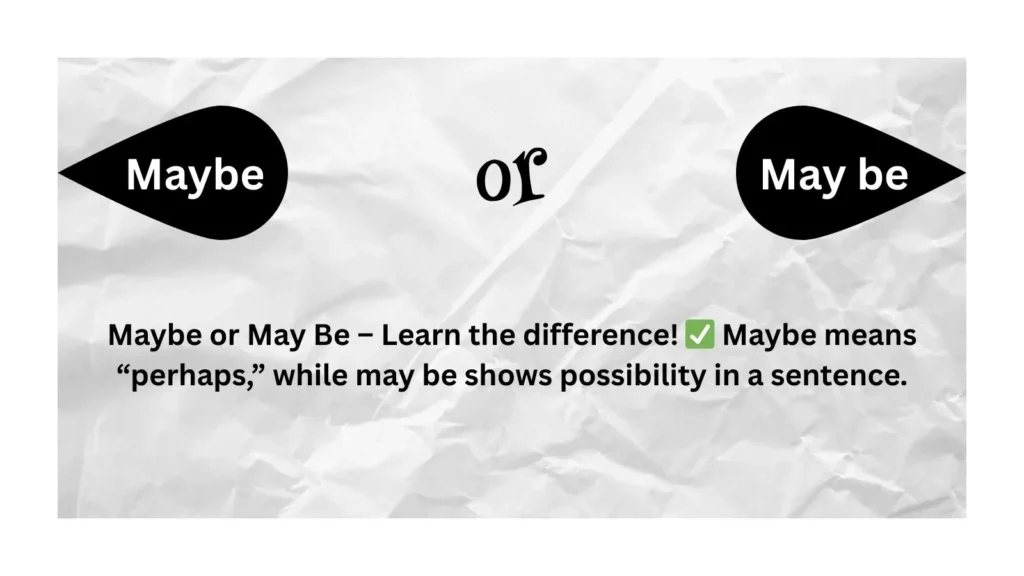
- Maybe → An adverb (means “perhaps”)
- May be → A verb phrase (shows possibility)
Examples:
- “Maybe I will go.” ✅
- “She may be late.” ✅
The Origin of Maybe or May Be
- Maybe developed as a single word meaning “perhaps.”
- May be comes from the verb “may” (possibility) + “be” (state).
Over time, both forms stayed in English but with different roles:
- One as an adverb (maybe)
- One as a verb phrase (may be)
British English vs American English Spelling
| Form | Region | Example Sentence |
|---|---|---|
| Maybe | US & UK | “Maybe we should try again.” |
| May be | US & UK | “He may be right.” |
Note: There is no spelling difference between US and UK English. The difference is grammatical.
Which Spelling Should You Use?
- Use maybe when you mean perhaps.
- Use may be when describing a possibility in a sentence.
Simple Rule:
👉 Replace with “perhaps”—if it works, use maybe.
👉 If it needs a verb, use may be.
Common Mistakes with Maybe or May Be
- Saying: “He maybe late” ❌
- Correct: “He may be late” ✅
- Saying: “May be we should go” ❌
- Correct: “Maybe we should go” ✅
- Mixing both forms incorrectly
Tip: Check if the sentence needs a verb.
Maybe or May Be in Everyday Examples
- Emails: “Maybe we can meet tomorrow.”
- News: “The delay may be due to weather.”
- Social Media: “Maybe it’s just me!”
- Formal Writing: “The results may be affected by errors.”
Maybe or May Be – Google Trends & Usage Data
- Maybe is more common in casual speech and writing.
- May be appears more in formal and grammatical contexts.
- Both are highly searched due to common confusion.
Insight: Correct usage improves clarity and SEO performance.
Comparison Table: Maybe vs May Be
| Form | Type | Meaning | Example |
|---|---|---|---|
| Maybe | Adverb | Perhaps | Maybe I will call |
| May be | Verb phrase | Possible state | She may be tired |
FAQs About Maybe or May Be
- What is the difference between maybe and may be?
Maybe means perhaps; may be shows possibility. - Can I replace maybe with perhaps?
Yes, they have the same meaning. - Is “may be” always two words?
Yes, when used as a verb phrase. - Which is more common?
“Maybe” is more common in daily use. - Is there a US vs UK difference?
No, usage is the same globally. - How can I remember the difference?
Try replacing with “perhaps.” - Why do people confuse these words?
Because they look similar but have different grammar roles.
Conclusion
Understanding maybe or may be is important for clear English writing. The difference is simple: maybe is an adverb that means “perhaps,” while may be is a verb phrase that shows possibility. There is no difference between US and UK English, so the rule is the same everywhere.
Many mistakes happen when people mix these forms or forget their grammar roles. By using a simple trick—replacing with “perhaps”—you can easily choose the correct form. Using these words correctly will improve your grammar, writing clarity, and confidence in both casual and professional communication.

Hi, I’m Lily Brown, the voice behind Grammar Meaning! I make grammar simple and easy for everyone. I create helpful content on basicsgrammar.com.