Quick Answer:
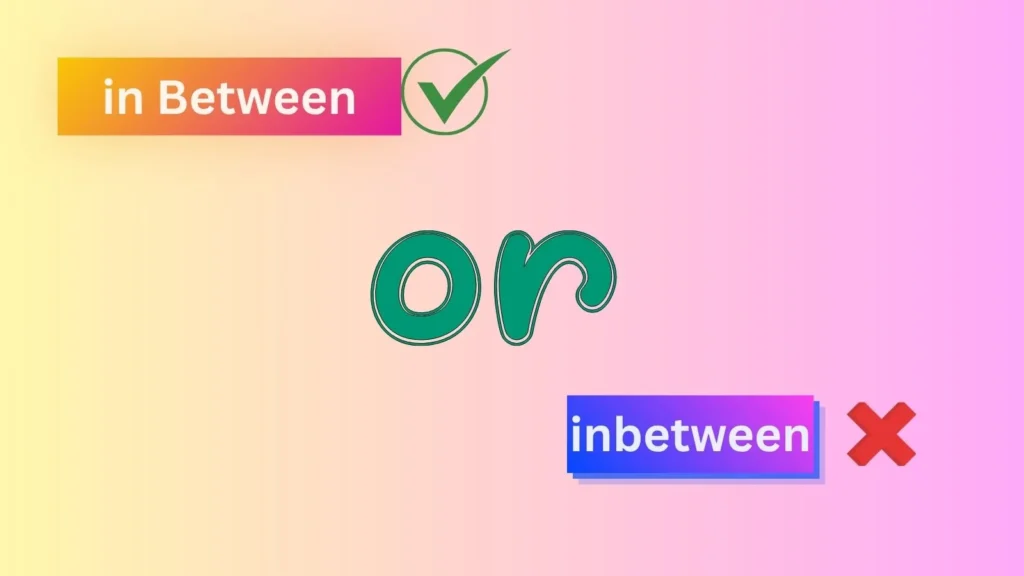
“In between” is correct in standard English; “it is always written as two separate words.“
“Inbetween” “is considered incorrect and rarely used in formal or modern writing.”
Many writers feel confused about whether to use “inbetween” or “in between” in everyday sentences. This small spelling difference can affect clarity, especially in professional or academic writing.
The correct form is “in between,” which acts as a phrase meaning in the middle of two things, places, or times. On the other hand, “inbetween” is not accepted in standard grammar rules.
RELATED: Where or Were: Simple Guide to Never Mix Them Again
Quick Answer – Inbetween or In Between
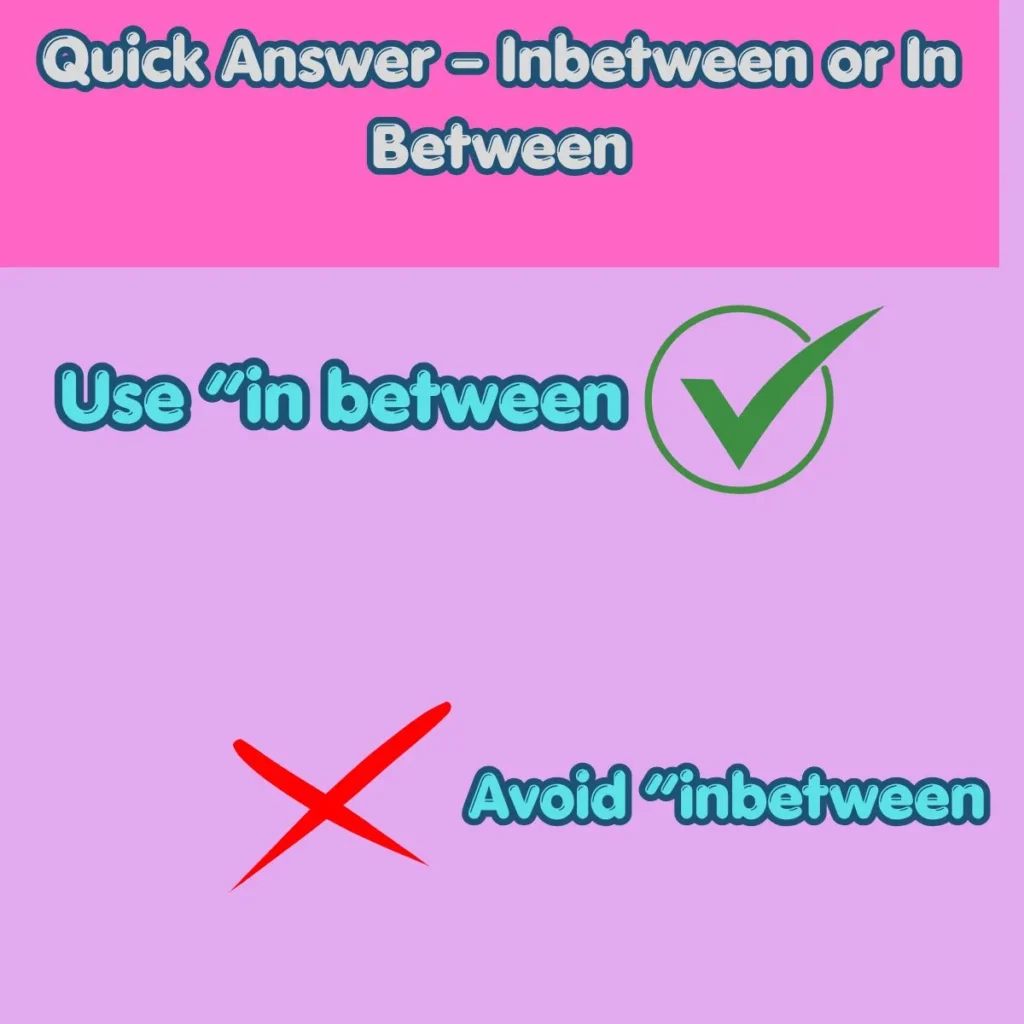
The correct form is “in between” (two words).
👉 “Inbetween” is incorrect and not recognized in standard English.
Examples:
- ✅ She sat in between her two friends.
- ❌ She sat inbetween her two friends.
Use “in between” whenever you want to describe something positioned in the middle of two things.
Spelling Tips: Inbetween or In Between
✅ Use “in between” (two words) in almost all cases.
Example: She sat in between her friends.
❌ Avoid “inbetween” as one word.
Example: It is not standard English.
🧠 Quick memory trick:
If you can replace it with “between,” then write it as two words → in between.
✏️ Check sentence role:
As a phrase (most common): use in between
As an adjective (rare cases), you may see “in-between” with a hyphen
Example: “an in-between stage”
📌 Simple rule:
When unsure, always choose “in between”—it is correct in formal and casual writing.
Meaning of In Between
The phrase “in between” means being in the middle of two things, whether physically, emotionally, or conceptually.
It can refer to:
- Position: The café is in between two buildings.
- Time: I’ll call you in between meetings.
- Abstract ideas: He feels stuck in between two choices.
Think of it as a bridge connecting two sides. The phrase describes placement, transition, or balance. Using in between correctly improves clarity in both formal and casual writing.
Why People Misspell In Between
Many people mistakenly write “inbetween” because English often combines words.
For example:
- address (not “add ress”)
- success (not “sucess”)
These patterns confuse writers into thinking inbetween is acceptable. Fast typing and autocorrect errors also contribute to the mistake.
Another reason is visual familiarity. When words appear frequently online (even incorrectly), people assume they are correct. Always remember: in between stays separate.
Origin of In Between
The phrase “in between” comes from Old English roots.
- “In” comes from Latin in meaning “inside”
- “Between” comes from Old English betweonum, meaning “among” or “in the middle of”
Historically, it has always been used as two separate words. Unlike some modern compound words, in between never merged into one standard form.
British vs American English
Good news: there is no difference between British and American English here.
| Form | British English | American English |
|---|---|---|
| In between | ✅ Correct | ✅ Correct |
| Inbetween | ❌ Incorrect | ❌ Incorrect |
Both dialects agree that “in between” is the only correct spelling.
When to Use In Between
You should use “in between” in almost all types of writing:
- Essays & assignments: The results fall in between two categories.
- Emails: I’ll reply in between tasks.
- Work reports: The data lies in between expected ranges.
- Legal documents: The agreement is valid in between dates.
- Casual writing: Let’s meet in between lunch and dinner.
It works in both formal and informal contexts.
Common Mistakes
Here are frequent errors people make with inbetween or in between:
- ❌ Writing it as one word: inbetween
- ❌ Typing too quickly and skipping the space
- ❌ Assuming it follows compound word rules
Correct vs Incorrect:
- ❌ He stood inbetween the cars.
- ✅ He stood in between the cars.
Always remember: two words, not one.
In Between in Everyday Examples
Using “in between” correctly enhances your writing:
- Emails: I’ll respond in between meetings.
- Social media: Life happens in between plans.
- Professional writing: The solution lies in between extremes.
- School assignments: The answer is in between the two theories.
It’s simple, natural, and widely accepted.
Usage Comparison Table
| Context | Correct Sentence | Incorrect Sentence |
|---|---|---|
| Objects | The shop is in between two houses. | The shop is inbetween two houses. |
| Skills | She is in between beginner and expert. | She is inbetween levels. |
| Legal Terms | Valid in between these dates. | Valid inbetween these dates. |
| Daily Speech | I’m free in between classes. | I’m free inbetween classes. |
FAQs
1. Is “inbetween” ever correct?
No, inbetween is always incorrect in standard English.
2. Why is “in between” written as two words?
Because it is a prepositional phrase, not a compound word.
3. How can I remember the correct spelling?
Think of two things with space in between them—just like the words.
4. Can I use it in formal writing?
Yes, in between works perfectly in formal and informal contexts.
5. Is it different in British English?
No, both British and American English use in between.
6. Is “between” ever one word?
Yes, but only as “between”, not combined with “in.”
7. What’s a simple trick to avoid mistakes?
Always check: if you mean “middle,” write two separate words.
Conclusion
To sum up, the correct form is always “in between”, not “inbetween.” This simple grammar rule can significantly improve your writing clarity and professionalism.
Remember:
- Avoid combining them
- Use two words every time
- Proofread your work carefully
By mastering small details like this, you build stronger writing skills and avoid common mistakes. Keep practicing, and soon it will feel natural!