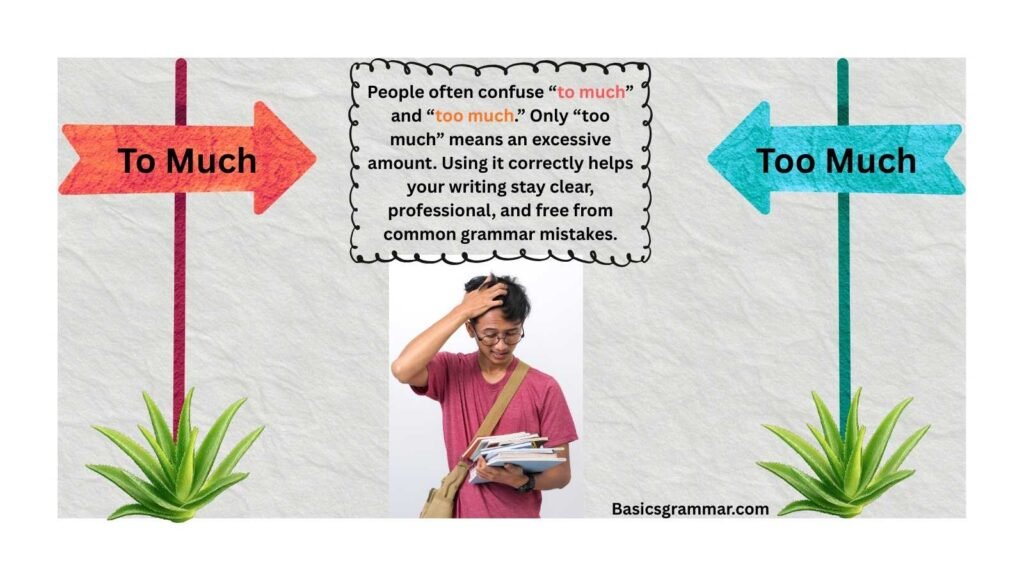
Ever stared at a sentence and wondered whether to write “To Much or Too Much”? This tiny spelling difference confuses thousands of English learners and even fluent writers every day. This confusion happens because the words “to” and “too” sound exactly the same, even though they have completely different meanings and uses.
The phrase “too much” means an excessive amount of something, whereas “to much” is usually incorrect in standard English. Therefore, understanding this simple rule can instantly improve your grammar, writing clarity, and professional communication skills without breaking a sweat.
To Much or Too Much – Quick Answer
Correct usage: “too much” is correct when you want to say an excessive amount.
- ✅ I ate too much cake.
- ✅ She spends too much time on her phone.
Incorrect usage: “to much” is almost always wrong unless it’s part of a larger structure with “to.”
- ❌ I ate to much cake.
- ❌ He gave the book to much detail. (Correct: “in too much detail”)
Rule:
If you are talking about excess, always use “too much”.
Meaning and Definition of To Much or Too Much
1.Too much:
“Too much” is the correct phrase in English and means an excessive amount of something.
It is commonly used when talking about quantity, emotions, food, money, or actions.
Example:
- ✅ I spent too much money on shopping this weekend.
- ✅ She talks too much during online meetings.
- ✅ There is too much sugar in this coffee.
2. To much
“To much” is usually incorrect because “to” works as a preposition or part of an infinitive verb, not as a replacement for “too.”
Examples:
- ❌ I ate to much chocolate at the party.
- ❌ He spends to much time on his phone.
- ❌ There is to much noise in this room.
✅ In all these sentences, “too much” is the correct form.
The Origin of To Much or Too Much
The word “too” comes from Old English tō meaning in addition or excessively. Over time, it became the standard adverb used to indicate more than necessary.
On the other hand, “to” is a preposition used to indicate direction, recipient, or purpose. The confusion happens because they sound identical (homophones), but their meanings are completely different.
Key Difference: To much vs Too much
The main difference between “to much” and “too much” lies in grammar and meaning. However, only one is correct in standard English.
- ❌ To much → Incorrect usage
- ✅ Too much → Correct phrase meaning an excessive amount of something
British English vs American English Spelling
Interestingly, the difference between “to much” and “too much” is the same in both British and American English. Both follow the same rule: use “too much” for excess.
| Feature | British English | American English |
|---|---|---|
| Excessive amount | too much | too much |
| Direction / purpose | to the store | to the store |
| Sound | Identical | Identical |
✅ Note: There is no spelling difference here, only the correct context matters.
Which Spelling Should You Use?
1.US and UK English:
Always use “too much” when describing excess.
2.Global English:
The rule is the same. Using “to much” in place of “too much” is considered incorrect everywhere.
Tip:
If in doubt, replace “too” with “excessively.” If the sentence still makes sense, you have the right choice.
Common Mistakes with To Much or Too Much
❌ I have to much homework.
✅ I have too much homework.
Wrong She is to much funny.
✅ She is too funny.
❌ He drinks to much coffee.
✅ He drinks too much coffee.
❌ I want to much chocolate.
✅ I want too much chocolate.
Tip:
Remember: “to” = direction/purpose, “too” = excess.
To Much or Too Much in Everyday Examples
🏫 In School
- I have too much homework today.
- There is too much noise in the classroom.
- I studied too much before the exam.
📚 In Assignments
- This topic has too much information to summarize.
- The essay contains too much repetition.
- I spent too much time on research.
📧 In Emails
- I am sorry for too much delay in my response.
- There is too much work pending this week.
- I appreciate your help with too much workload pressure.
💬 Everyday Life
- She eats too much fast food.
- We spend too much money on coffee.
- He talks too much during meetings.
⚠️ Common Mistake Reminder
❌ “to much” → incorrect in formal writing
✅ “too much” → correct and standard English
To Much or Too Much – Google Trends & Usage Data
Search trends show that “too much” is far more popular than “to much”. Countries like the US, UK, Canada, and Australia frequently search this topic, especially among students and ESL learners.
Keyword Variations Comparison Table
| Variation | Correct? | Example |
|---|---|---|
| too much | ✅ Correct | “I have too much work.” |
| to much | ❌ Incorrect | “I have to much work.” |
| to many | ❌ Incorrect | “There are to many people.” |
| too many | ✅ Correct | “There are too many people.” |
FAQs(Frequently Asked Questions)
Q1. Can I ever use “to much”?
Only if “to” is part of another grammatical structure, like “to a much greater extent.” Otherwise, it’s incorrect.
Q2. Is “too much” used in both formal and informal writing?
Yes, it’s correct everywhere when referring to excess.
Q3. How do I remember the difference?
“Too” = excess. “To” = direction or purpose. If you can replace “too” with “excessively,” it’s correct.
Q4. Is “too much” the same in British and American English?
Yes, the usage rule is identical.
Q5. Are there similar confusing words?
Yes, like “its vs it’s,” “your vs you’re,” and “then vs than.”
Q6. Can I use “too much” in social media captions?
Absolutely, it’s common and correct.
Q7. Does “too much” have a negative connotation?
Not necessarily. It just indicates excess, which can be positive, negative, or neutral depending on context.
Conclusion
Understanding the difference between “to much” and “too much” is simple once you remember the key rule: “too much” always refers to an excessive amount. This applies in American, British, and global English. Mistakes like “to much” are common but easily avoidable with this simple tip: if it shows excess, use too.
Correct usage improves writing in emails, social media, formal documents, and even casual conversations. Remember, direction uses to, excess uses too. Keeping this distinction clear ensures your grammar is professional and your sentences are easy to read.

Hi, I’m John Miles, the voice behind Grammar Meaning! I share clear and practical grammar tips. You’ll find my work on basicsgrammar.com.