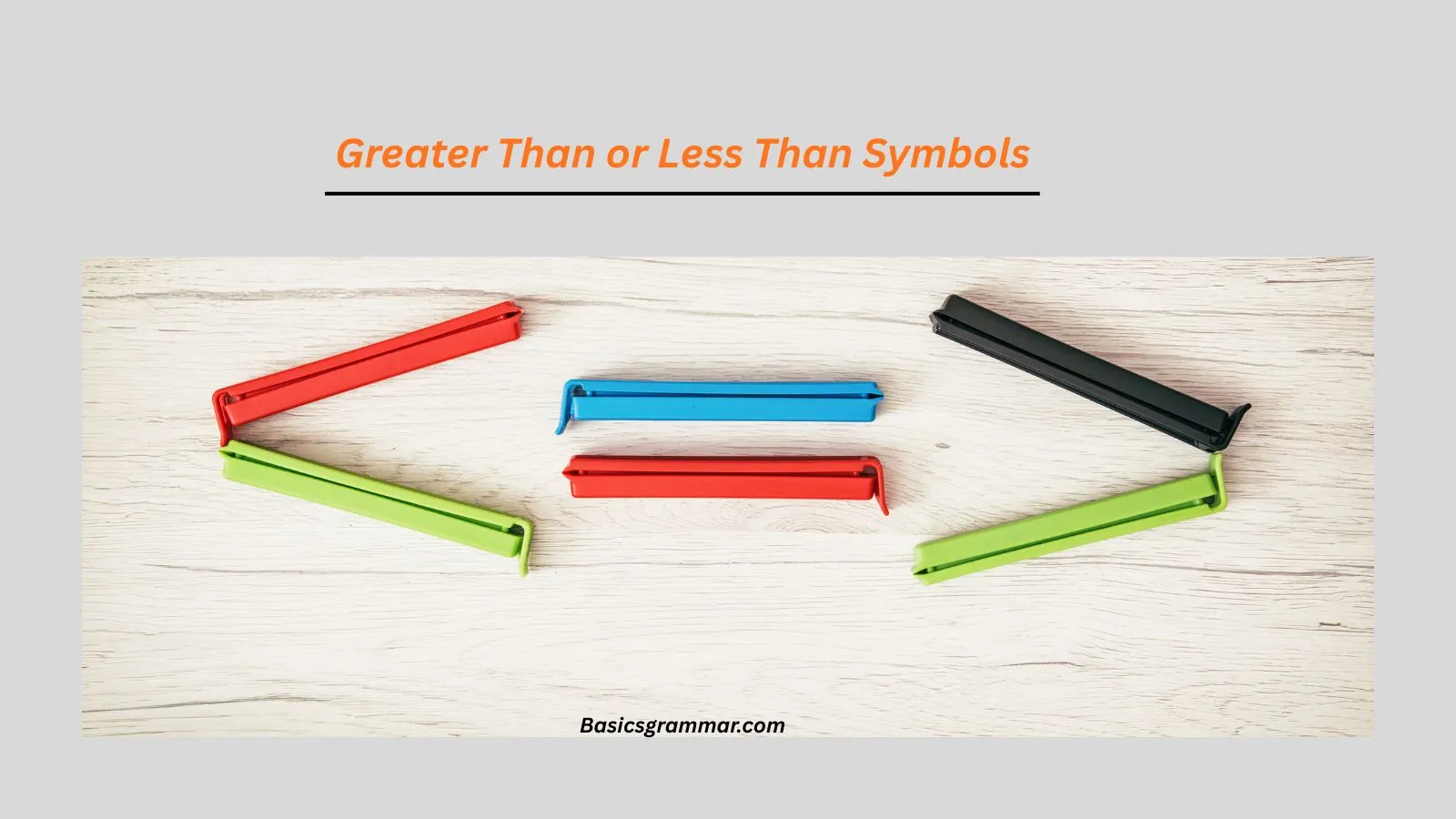
Symbols that are greater than or less than are little indicators, yet they cause a lot of confusion. When they see greater than or less than symbols in arithmetic, coding, coursework, spreadsheets, and even emails, many individuals look them up because they’re not entirely sure what they imply. Is > less than or larger than? < points in the opposite direction; why? What other uses do these symbols have outside of mathematics?
This subject addresses a very real-world issue. Students want their schoolwork completed quickly. In reports and correspondence, professionals must correctly use the symbols. Every day, data analysts and programmers encounter them in reasoning and calculations. Even parents who assist their children with math can confuse them.
Everything is explained in easy language in this guide. A quick response will be given initially, followed by more in-depth explanations, real-world examples, and typical errors to steer clear of. By the conclusion, you will have a good understanding of larger than and less than symbols, as well as when and how to utilize them appropriately in every circumstance.
Greater Than or Less Than Symbols Examples
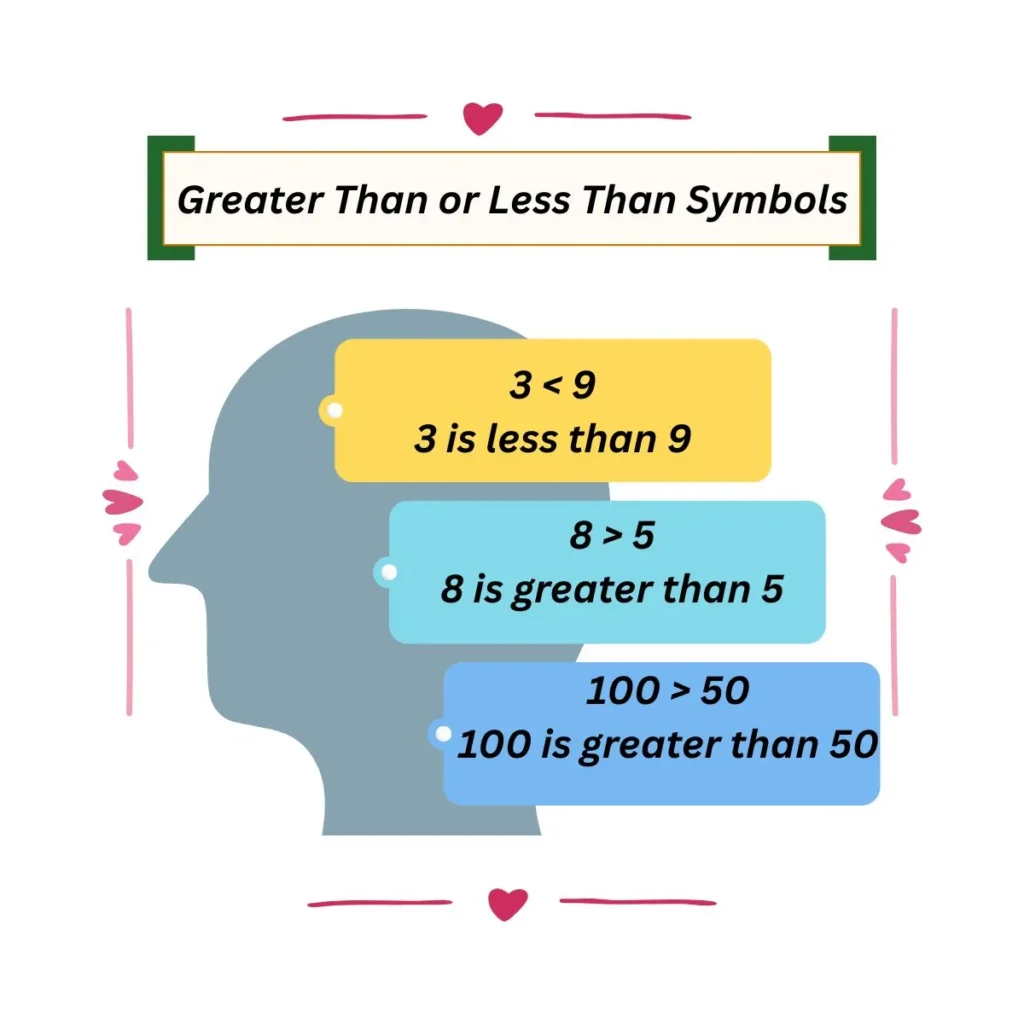
Greater than (>) and less than (<) symbols are used to compare numbers, values, or amounts. They show which value is bigger or smaller.
Basic Math Examples
- 8 > 5 → 8 is greater than 5
- 3 < 9 → 3 is less than 9
- 12 > 10 → 12 is bigger than 10
- 4 < 7 → 4 is smaller than 7
School and Homework Examples
- “Ali scored 85 > 70, so he passed.”
- “There are 6 < 10 questions left.”
Everyday Life Examples
- “The price is > $100.”
- “The temperature is < 20°C today.”
- “My screen time today was > 5 hours.”
Office and Work Examples
- “Sales this month are > last month.”
- “Applicants must be > 18 years old.”
- “Errors are now < 2%.”
Social Media Examples
- “Health > wealth.”
- “Peace > money.”
- “Quality > quantity.”
Simple Tip to Remember
The symbol always opens toward the bigger value.
Think of it like a mouth that eats the larger number.
Greater Than or Less Than Symbols in Academic and Professional Writing
Greater than (>) and less than (<) symbols are commonly used in academic writing, especially in subjects like mathematics, science, economics, and statistics. They help compare numbers clearly and save space in formulas, tables, charts, and research data. For example, researchers may write “values > 100 were excluded” or “error rates remained < 5%.” In academic text, these symbols are best used with numbers rather than words, and writers should always follow the required style guide.
In professional writing, such as business reports, technical documents, and presentations, these symbols improve clarity and efficiency. They are widely used in spreadsheets, performance reports, and data summaries, for example, “revenue increased to > $1 million” or “downtime was < 2 hours.” However, in formal letters or narrative writing, it is better to use words like greater than or less than instead of symbols.
Greater Than or Less Than Symbols – Quick Answer
The greater than (>) symbol means a value is bigger.
The less than (<) symbol means a value is smaller.
Examples:
- 5 > 3 → 5 is greater than 3
- 2 < 6 → 2 is less than 6
- 10 > 7 → 10 is bigger than 7
A simple trick: the open side always points to the larger number.
The Origin of Greater Than or Less Than Symbols
The greater than and less than symbols come from mathematics in the 16th century. They were first used by Welsh mathematician Thomas Harriot in 1631. He introduced these symbols to show comparisons clearly and quickly.
The symbols are based on the idea of an open mouth. The wider side “eats” the bigger value. This visual idea helped students understand size comparison faster.
There are no spelling differences in the symbols themselves. However, people write the names differently in text, such as “greater than sign” or “greater-than symbol.” These variations exist due to writing style, not language rules.
British English vs American English Spelling
There is no spelling difference between British and American English for greater than or less than symbols. The symbols and their meanings are the same worldwide.
Examples:
- British English: 5 > 2
- American English: 5 > 2
Comparison Table
| Aspect | British English | American English |
|---|---|---|
| Symbol | > , < | > , < |
| Meaning | Same | Same |
| Usage | Same | Same |
Which Spelling Should You Use?
Since symbols are universal, you can use them anywhere without worry.
- US audience: Use standard symbols (>, <)
- UK/Commonwealth audience: Use standard symbols (>, <)
- Global audience: Symbols are preferred because they avoid language confusion
Symbols are often better than words like “more than” or “less than” in technical or global communication.
Common Mistakes with Greater Than or Less Than Symbols
Many people make simple but common errors.
Frequent mistakes:
- Reversing the symbols
❌ 3 > 8
✅ 3 < 8 - Mixing symbols with words
❌ greater then
✅ greater than - Using symbols in formal writing where words are required
❌ Sales > last year
✅ Sales were greater than last year
Greater Than or Less Than Symbols in Everyday Examples
Emails:
- “Orders this month are > 500 units.”
News:
- “Inflation is < 5% for the first time in years.”
Social Media:
- “Happiness > money.”
Formal Writing:
- “Participants aged > 18 years were included in the study.”
Greater Than or Less Than Symbols – Google Trends & Usage Data
Search interest for greater than or less than symbols is high in:
- Students and teachers
- Coding and programming
- Data analysis and Excel
- Online exams and test prep
Countries with high search volume include the US, UK, India, and Pakistan. Usage increases during exam seasons and coding bootcamps.
Keyword Variations Comparison Table
| Variation | Meaning |
|---|---|
| Greater than symbol | > |
| Less than symbol | < |
| More than sign | > |
| Smaller than sign | < |
FAQs
1. Is “greater than” the same as “more than”?
Yes, they have the same meaning, but “greater than” is more formal and used in math.
2. What are common mistakes using “greater than”?
People often reverse the symbol or confuse > with <.
3. What is this (>) called?
It is called the greater than symbol.
4. What’s the difference between “greater than” and “≥”?
“Greater than” (>) means strictly bigger, while ≥ means greater than or equal to.
5. Which <> is greater than?
The symbol > means greater than.
6. What does “<” mean?
It means less than.
7. How to type ≥ on keyboard?
Use Alt + 242 (Windows) or insert it from the symbol menu.
8. How to use <>?
Use > when the left value is bigger and < when the left value is smaller.
Summarization
Despite their seeming simplicity, greater than and less than symbols are crucial to everyday communication, math, education, and technology. Time is saved and errors are avoided when > and < are used correctly. When comparing numbers, values, or data, these symbols provide instant clarity.
The key rule is simple: the larger number is shown by the open side. These symbols are perfect for international communication because there are no regional or spelling variations. But context is important. Words are superior in formal text, whereas symbols are more effective in math, data, and technical writing.
You can utilize greater than or less than symbols with confidence if you are aware of their history, application, and typical mistakes. Gaining proficiency with these symbols enhances accuracy and clarity in your work, regardless of whether you are a professional, student, or content producer.