Vice Versa or Visa Versa – Quick Answer
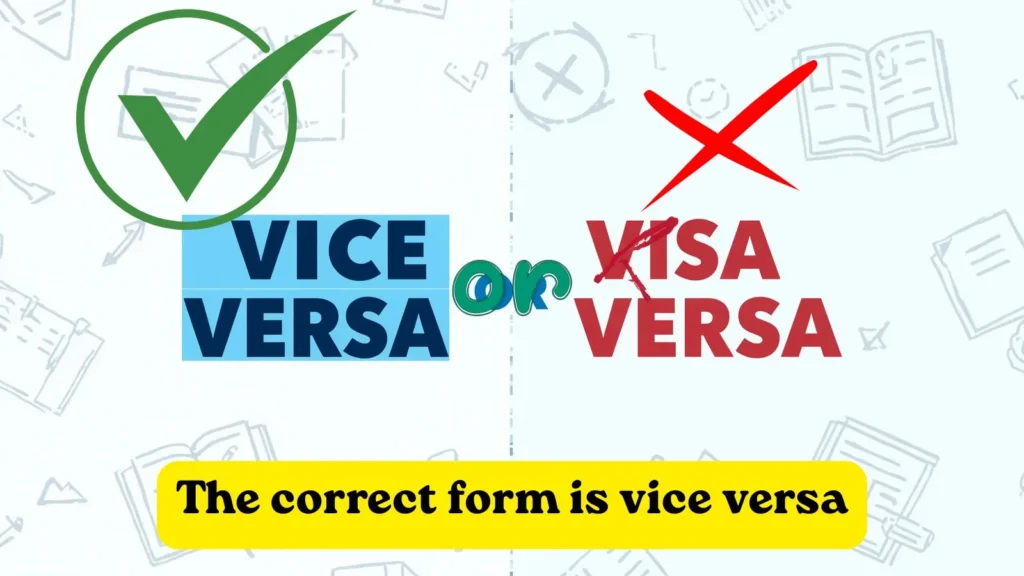
Short answer: The correct form is vice versa.
- Meaning: “In reverse order” or “the other way around.”
- Example 1: She helps him, and vice versa. (He helps her too.)
- Example 2: The teacher learns from students, and vice versa.
Incorrect form:
visa versa – This is a common misspelling. Remember, there’s no “a” in the middle.
|RELATED: Someday or One Day: Simple Guide to Use Them Correctly
The Origin of Vice Versa
Vice versa comes from Latin:
- “Vice” = in place of
- “Versa” = turned
So, literally, it means “the position being reversed.”
- Historical usage: First recorded in English in the 16th century.
- Why confusion exists: “Visa” is a familiar word (like a credit card or travel document), so many mistakenly write visa versa.
British English vs American English Spelling
Both British and American English use the same spelling: vice versa. There is no alternative spelling that is considered correct in either variant.
| Feature | American English | British English |
|---|---|---|
| Correct spelling | vice versa | vice versa |
| Incorrect common error | visa versa | visa versa |
| Usage in formal writing | Yes | Yes |
| Usage in informal writing | Yes | Yes |
💡 Tip:
Avoid using visa versa in any professional or academic context.
Which Spelling Should You Use?
You should always use “vice versa.” This is the correct and standard spelling in English. It is used to show that something is true in the opposite direction as well.
The spelling “visa versa” is incorrect and commonly used by mistake because it sounds similar when spoken. However, it has no meaning in English grammar or vocabulary.
In both formal writing and daily communication, only “vice versa” is accepted. Using the correct form helps you write more professionally and avoid grammar errors.
Common Mistakes with Vice Versa
Incorrect: She likes him, and visa versa.❌
Correct: She likes him, and vice versa.✅
Using it at the start of a sentence incorrectly:
Incorrect: Vice versa, he helped her.❌
Correct: He helped her, and vice versa.✅
Treating it as two words in an unusual way:
Incorrect: viceversa❌
Correct: vice versa✅
✅ Always remember: it’s two words, not altered.
Everyday Examples
❌ Incorrect Usage (Visa Versa):
- I respect my teacher, visa versa.
- She supports me, visa versa.
- We help each other, visa versa.
✔ Correct Usage (Vice Versa):
Business & Office:
- Managers guide employees, and vice versa.
- The sales team supports the marketing team, and vice versa.
Education:
- Teachers teach students, and vice versa.
- Students ask questions from teachers, and vice versa.
Everyday Life:
- I cook for my family, and vice versa.
- My friend helps me with work, and vice versa.
- Parents care for children, and vice versa.
Note:
Always use “vice versa” because “visa versa” is incorrect.
Vice Versa – Google Trends & Usage Data
- Popularity: Searches for “vice versa” spike in English-speaking countries like the US, UK, Canada, and Australia.
- Incorrect form: “visa versa” sees minor search traffic but is flagged as wrong by grammar sites.
- Context: Most searches occur when users are proofreading or drafting emails, essays, or social media posts.
Comparison Table: Vice Versa or Visa Versa
| Variation | Correct? | Example Usage |
|---|---|---|
| vice versa | ✅ Yes | She helps him, and vice versa. |
| visa versa | ❌ No | She helps him, and visa versa. (incorrect) |
| viceversa | ❌ No | She helps him, and viceversa. (incorrect) |
FAQs About Vice Versa
1. What is the correct spelling: vice versa or visa versa?
The correct spelling is vice versa. “Visa versa” is incorrect.
|See also: Capitol or Capital: What’s the Difference and When to Use Each?
2. What does vice versa mean?
It means the reverse is also true or both ways.
3. Is visa versa a real phrase?
No, “visa versa” is a common spelling mistake.
4. How do you use vice versa in a sentence?
Example: I help him, and vice versa.
5. Can vice versa be used in formal writing?
Yes, it is widely used in both formal and informal writing.
6. Why do people confuse visa versa and vice versa?
Because of pronunciation, many people mishear and misspell it.
7. Is vice versa used in everyday English?
Yes, it is commonly used in daily conversations and writing.
Conclusion
The correct spelling is vice versa, a two-word phrase from Latin meaning “in reverse order.” Miswriting it as visa versa is a frequent error. Both British and American English use the same spelling, so writers globally should stick to vice versa to avoid mistakes. It’s versatile, appearing in emails, news, social media, and formal documents whenever reciprocal actions are described.

Hi, I’m Alex Reed, the voice behind Grammar Meaning! I simplify English grammar into easy lessons. I write for basicsgrammar.com to help you improve daily writing.