
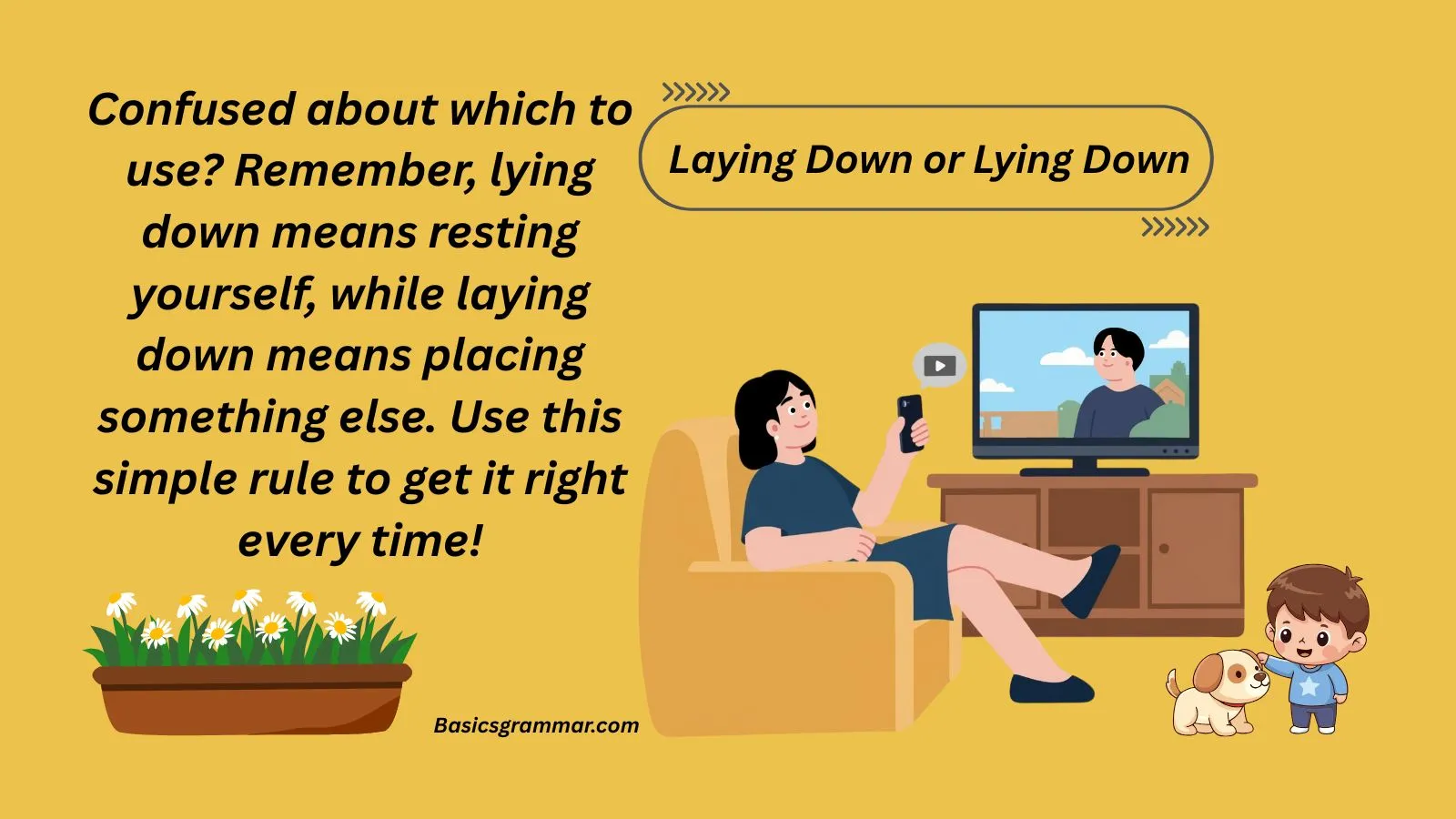
Understanding the difference between Laying Down or Lying Down is important for anyone learning English. Many learners confuse these terms because both relate to resting positions, but their grammar use is different. Knowing the correct use helps improve speaking and writing confidence. The phrase laying down vs lying down difference often appears in English lessons and grammar discussions. Learners frequently ask about laying down meaning, while teachers explain lying down meaning in daily conversations. Mastering correct usage of laying and lying makes communication clearer, and practicing lay vs lie grammar rules helps avoid common mistakes in professional and casual English writing.
Guidance on Choosing the Correct Phrase Based on Audience and Context

Choosing whether to use “laying down” or “lying down” depends largely on the context and your audience. Both British and American English follow the same grammar rules for these phrases, so the difference isn’t regional but situational.
- Audience Consideration:
If you are writing for a professional or academic audience, it is important to use the phrases correctly to maintain clarity and credibility. Use “lying down” when describing a person or animal resting themselves without an object involved. Use “laying down” only when referring to placing an object or something else down. - Context Matters:
In informal conversations or social media, you might hear “laying down” used incorrectly to mean resting, but in formal writing, this is considered a mistake. For global audiences, especially learners of English, it’s best to stick to the correct usage to avoid confusion. - Practical Tip:
Ask yourself, Is there an object being placed down? If yes, use “laying down”. If no, use “lying down.” This simple test helps writers and speakers choose the correct phrase regardless of region.
Identifying and Correcting Common Errors in the Use of “Laying Down” and “Lying Down”
Many people mistakenly interchange “laying down” and “lying down”, but understanding the grammatical differences can help avoid these common errors.
- Common Mistake #1:
Saying “I am laying down” to mean resting.
Correction: It should be “I am lying down” because no object is being placed. - Common Mistake #2:
Using “laying down” when describing someone reclining.
Correction: Use “lying down” when referring to a person or animal resting themselves. - Common Mistake #3:
Confusing past tense forms, e.g., “Yesterday I laid down” when you mean “I lay down.”
Correction: “Lay” is the past tense of “lie,” so “I lay down yesterday” is correct when talking about resting. - Remember:
The verb “lay” requires a direct object (something being placed down), while “lie” does not. Practicing this rule can drastically reduce errors.
Laying Down or Lying Down – Quick Answer
Use lying down when someone rests or reclines by themselves.
Use laying down when someone places something else flat.
Examples:
- ✅ I am lying down on the couch.
- ✅ She is laying down the baby in the crib.
- ❌ I am laying down on the couch. (Incorrect)
Simple rule:
If there is no object, use lying down.
If there is an object, use laying down.
The Origin of Laying Down or Lying Down
The confusion comes from Old English. The verb lie (meaning to recline) comes from licgan. The verb lay (meaning to place something) comes from lecgan. Over time, their meanings stayed different, but their forms started to look alike.
The real trouble starts with verb tenses:
- Present: lie / lay
- Past: lay / laid
- -ing form: lying / laying
Because “lay” is both a present tense and a past tense (of lie), many speakers mix them up. This is not a spelling issue—it is a grammar and usage issue that has existed for centuries.
British English vs American English Spelling
Good news: There is no spelling difference between British and American English for laying down or lying down. Both follow the same grammar rules.
The confusion happens in spoken usage, not spelling.
Comparison Table
| Aspect | British English | American English |
|---|---|---|
| Correct form | lying down | lying down |
| With an object | laying down | laying down |
| Common mistake | “laying down” for rest | “laying down” for rest |
| Grammar rules | Same | Same |
Which Spelling Should You Use?
Since there is no spelling difference, your choice depends on meaning, not location.
- US audience: Follow standard grammar rules (lie vs lay).
- UK/Commonwealth audience: Same rules apply.
- Global audience: Always use the grammatically correct form to sound professional.
Tip: If you write for SEO, education, or business, always use lying down when no object is involved.
Common Mistakes with Laying Down or Lying Down
Here are the most frequent errors:
- ❌ I am laying down right now.
✅ I am lying down right now. - Error He was laying on the bed.
Write He was lying on the bed. - ❌ She is lying the book on the table.
✅ She is laying the book on the table.
Memory trick:
People lie. Objects get laid.
Laying Down or Lying Down in Everyday Examples
Emails
- I am lying down with a fever today.
- Please finish the files before laying down the equipment.
News
- The injured player remained lying down on the field.
Social Media
- Just lying down and watching movies.
Formal Writing
- The patient was advised to remain lying down for two hours.
Laying Down or Lying Down – Google Trends & Usage Data
Search interest for “laying down or lying down” is high in:
- The United States
- United Kingdom
- Canada
- Australia
- India
Most searches happen in:
- Grammar help queries
- Student assignments
- Blog and content writing
“Lying down” appears more often in professional writing, while “laying down” is commonly misused in casual speech. This shows why people keep searching for clarity.
Comparison Table: Keyword Variations
| Phrase | Correct Use | Example |
|---|---|---|
| lying down | No object | I am lying down. |
| laying down | Needs object | I am laying down the rules. |
| lay down | Command/action | Lay down the book. |
| lie down | Action of rest | Lie down and relax. |
FAQs: Laying Down or Lying Down
Is it laying in bed or lying in bed?
Correct form is lying in bed, because you are resting yourself, not placing something.
Do you say I am lying down or laying down?
Correct sentence is I am lying down.
Is it correct to say “laying” or “lying”?
Use lying when you rest yourself; laying means putting something down.
Is it laying or lying on the couch?
Correct usage is lying on the couch.
Is it laying or lying in the hospital bed?
Correct phrase is lying in the hospital bed.
Is it laying or lying on a chair?
Correct form is lying on a chair.
Is it correct to say I’m laying in bed?
No, correct sentence is I’m lying in bed.
Is it laying or lying on a pillow?
Correct phrase is lying on a pillow.
Conclusion
In conclusion, understanding Laying Down or Lying Down becomes easier when learners practice correct sentence structure in daily use. Following a clear grammar usage guide helps avoid common mistakes in spoken and written English. Learning through English grammar explanation and regular sentence structure examples improves confidence and communication skills. Many teachers include this topic in an English learning guide to help students master verb usage. Using correct forms in conversation supports better fluency through spoken English practice tips. With consistent practice and attention to context, learners can easily remember when to use laying or lying in both formal writing and everyday conversations.
