Many English learners and native speakers alike get confused by wood and woods. At first glance, the two words seem almost identical. However, they do not always mean the same thing. Choosing the wrong form can change the meaning of a sentence and make your writing less clear.
People often search for “wood or woods” because they see both words used in books, news articles, social media posts, and everyday conversations. Is one correct and the other wrong? Does it depend on context? Should you use wood when talking about trees and woods when talking about forests?
Learn more about: Unkept or Unkempt: Which Spelling Is Correct?
Wood or Woods – Quick Answer
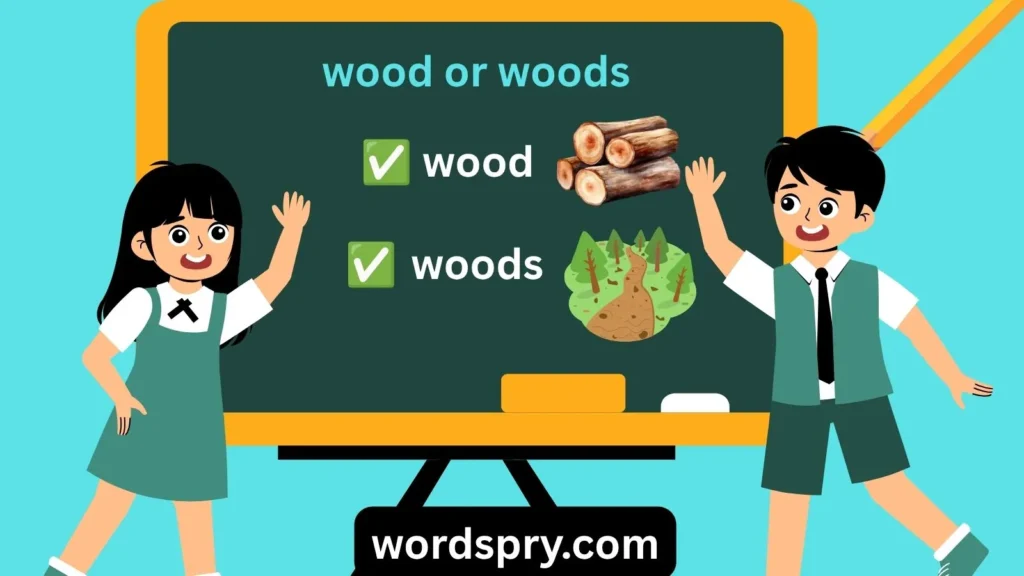
Wood and woods are both correct, but they have different meanings.
- Wood usually refers to the material that comes from trees.
- Woods usually refers to a small forest or area filled with trees.
Examples
✅ The table is made of wood.
I bought a chair made from wood. ✅
✅ We walked through the woods after lunch.
A deer appeared from the woods.✅
Quick Comparison
| Word | Meaning | Example |
|---|---|---|
| Wood | Material from trees | This desk is made of wood. |
| Woods | Forest or wooded area | They camped in the woods. |
The Origin of Wood or Woods
The word wood comes from the Old English word wudu, meaning “tree,” “forest,” or “timber.” Hundreds of years ago, the word had a broader meaning than it does today.
Over time, English speakers began using wood mainly for the material obtained from trees. Meanwhile, the plural form woods developed a separate meaning. It became commonly used to describe areas covered by trees.
This is why modern English has two related but distinct words:
- Wood = tree material
- Woods = forested land
The difference is not a spelling mistake. It is a natural result of how English evolved over centuries.
British English vs American English Spelling
Unlike many spelling differences in English, wood and woods are not a British-versus-American issue. Both forms are used in the United States, the United Kingdom, Canada, Australia, and other English-speaking countries.
The choice depends on meaning rather than regional spelling rules.
Comparison Table
| Usage | British English | American English |
|---|---|---|
| Material from trees | Wood | Wood |
| Small forest | Woods | Woods |
| Furniture material | Wood | Wood |
| Walking in a forest | Woods | Woods |
| Timber products | Wood | Wood |
Examples
British English
- For example, the door is made of wood.
- Additionally, we walked through the woods.
American English
- Similarly, the fence is made of wood.
- Moreover, they got lost in the woods.
Overall, the usage remains the same in both varieties of English.nglish.
Which Spelling Should You Use?
The correct choice depends on what you want to say.
Use “Wood” When:
- Talking about tree material
- Discussing furniture
- Referring to timber
- Describing wooden objects
Examples
- The floor is made of wood.
- Wood is a renewable resource.
- I prefer wood furniture.
Use “Woods” When:
- For example, talking about a forest.
- In addition, referring to a wooded area.
- Likewise, describing places with many trees.
Examples
- For example, the cabin sits near the woods.
- Additionally, we explored the woods all afternoon.
- Furthermore, animals live in the woods.
Audience-Based Advice
| Audience | Recommended Usage |
|---|---|
| US Readers | Follow standard meaning |
| UK Readers | Follow standard meaning |
| Commonwealth Countries | Follow standard meaning |
| Global Audience | Use the word that matches your meaning |
Since both forms are accepted worldwide, meaning matters more than location.
Common Mistakes with Wood or Woods
Many writers use these words incorrectly because they focus on spelling instead of meaning.
Mistake 1
❌ The chair is made of woods.
✅ The chair is made of wood.
Reason: Furniture is made from the material, not a forest.
Mistake 2
❌ We went hiking in the wood.
✅ We went hiking in the woods.
Reason: A forested area is usually called the woods.
Mistake 3
❌ The woods on my desk looks beautiful.
✅ The wood on my desk looks beautiful.
Reason: The desk material is wood.
Mistake 4
❌ I bought woods for my fireplace.
✅ I bought wood for my fireplace.
Reason: Firewood is treated as wood, not woods.
Wood or Woods in Everyday Examples
Understanding real-world usage makes the difference easier to remember.
In Emails
Wood
- For example, “The cabinet is made of solid wood.”
Woods
- Similarly, “Our cabin is located near the woods.”
Therefore, using these words in real-life contexts helps reinforce their correct meanings and usage.
In News Writing
Wood
“Demand for wood products increased this year.”
Woods
“The missing hikers were found in the woods.”
On Social Media
Wood
“Just finished building a wood coffee table.”
Woods
“Beautiful walk through the woods today!”
In Formal Writing
Wood
“Wood remains a widely used construction material.”
Woods
“The research area included nearby woods and grasslands.”
Wood or Woods – Google Trends & Usage Data
Search interest shows that people frequently look for the difference between wood and woods because both appear regularly in English writing.
Typical Usage Patterns
| Word | Common Context |
|---|---|
| Wood | Furniture, construction, timber, materials |
| Woods | Nature, hiking, forests, wildlife |
Popular Countries
For example, the terms are commonly searched in:
- United States
- United Kingdom
- Canada
- Australia
- New Zealand
Overall, these English-speaking countries frequently use and search for the terms wood and woods in various contexts.
Context Matters
When discussing building materials, wood dominates usage.
When discussing outdoor environments, woods is more common.
Wood vs Woods Comparison Table
| Feature | Wood | Woods |
|---|---|---|
| Part of Speech | Noun | Noun |
| Main Meaning | Material from trees | Forest or wooded area |
| Refers to Furniture | Yes | No |
| Refers to Forests | Rarely | Yes |
| Used in Construction | Yes | No |
| Used for Nature Locations | No | Yes |
| Common Example | Wood floor | Woods trail |
FAQs
Is wood or woods correct?
Both are correct. However, use wood for the material and woods for a forested area.
Why do people say “the woods”?
In fact, “the woods” is a traditional English expression meaning a forest or area filled with trees.
Can wood mean a forest?
Historically, yes. However, in modern English, this meaning is rare. Most people use woods for forests.
Is furniture made of wood or woods?
Of course, furniture is made of wood.
Do British and American English use different spellings?
No, both varieties use wood and woods in the same way.
What does “in the woods” mean?
Simply put, it means being in a forest or wooded area.
Which word is more common?
Generally, wood is more common because it appears in construction, furniture, manufacturing, and everyday discussions.
Conclusion
The difference between wood and woods is simple once you understand the meaning behind each word. Wood refers to the material that comes from trees and is commonly used for furniture, buildings, flooring, tools, and many other products. Woods, on the other hand, refers to a forest or an area covered with trees.
This distinction remains the same in British English, American English, and other major forms of English. The choice is not about regional spelling preferences. Instead, it is about context. If you are talking about timber, furniture, or construction materials, use wood. If you are talking about nature, forests, hiking trails, or wildlife habitats, use woods.
Remember this easy rule: wood is a material, woods is a place. Following this guideline will help you write more clearly, avoid common mistakes, and communicate confidently in both formal and informal situations.

Hi, I’m Mark Cole, the voice behind Grammar Meaning! I explain tricky grammar rules in simple ways. I write useful guides on basicsgrammar.com.