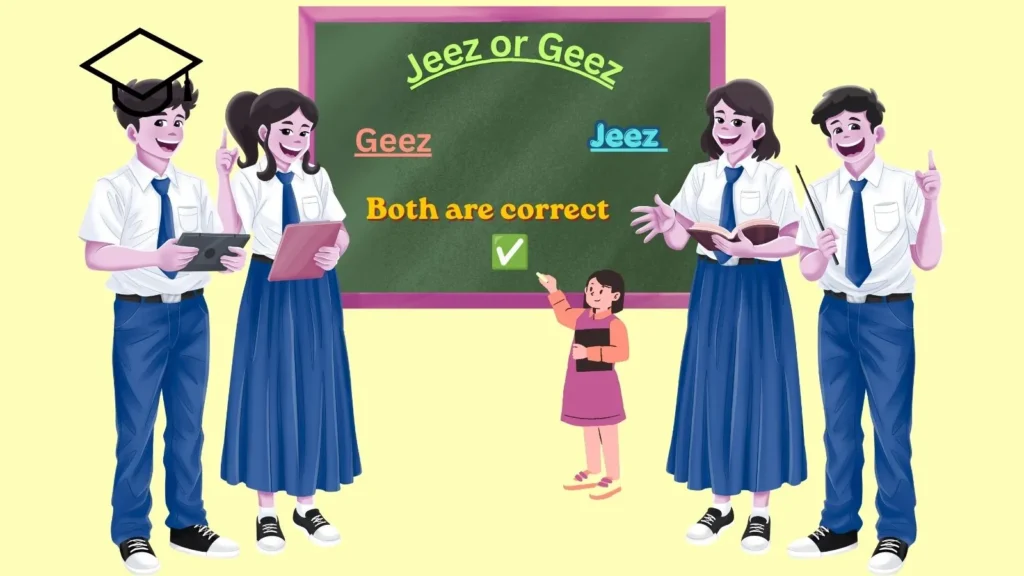
Quick Answer: Both “Jeez” and “Geez” are correct. They are informal exclamations used to show surprise, annoyance, frustration, or excitement. “Geez” is more common, while “Jeez” is an accepted spelling that reflects the pronunciation more closely.
Imagine you receive a surprising message from a friend. Without thinking, you reply, “Geez, I didn’t expect that!” Later, you see someone else write “Jeez!” Now you start wondering which spelling is actually correct. Is one wrong? Does one sound more polite? Or are they both acceptable?
Many English learners search for Jeez or Geez because both words sound exactly the same but appear with different spellings online, in books, movies, and social media. This creates confusion, especially for people learning informal English. By understanding Jeez or Geez, you can choose the best spelling for your audience and communicate naturally in everyday English.
See Also: Break Metal or Brake Metal: Understanding the Correct Usage
Pronunciation
Jeez
US Pronunciation: /dʒiːz/
UK Pronunciation: /dʒiːz/
Geez
US Pronunciation: /dʒiːz/
UK Pronunciation: /dʒiːz/
Note: Both words have exactly the same pronunciation. This is why many people think they are different versions of the same word.
Transition
Now that you know both spellings are accepted, let’s compare Jeez or Geez in detail and see when each one is used.
Difference Between Jeez or Geez
Although Jeez and Geez usually mean the same thing, there are small differences in spelling, style, and usage.
1. Correctness
Both Jeez and Geez are correct spellings.
Neither is considered wrong.
Examples
Jeez
- Jeez, that was loud!
- Jeez, I forgot my keys.
Geez
- Geez, that movie was amazing!
- Geez, you’re fast.
2. Popularity
Geez is used more often in modern English.
Jeez is less common but still widely accepted.
Examples
- Geez, I can’t believe it.
- Geez, what happened?
- Jeez, that surprised me.
- Jeez, you’re early today.
3. Origin
Both words developed as mild substitutes for “Jesus.”
People began using them to avoid saying the religious name directly.
Examples
- Geez! That scared me.
- Jeez! I wasn’t ready.
4. Tone
Both expressions are informal.
They are suitable for casual conversations but not for formal writing.
Examples
- Geez, that’s funny.
- Jeez, slow down!
5. Emotion
Both words express emotion.
They can show surprise, frustration, excitement, or disbelief.
Examples
Surprise
- Geez! You won the prize!
- Jeez! That’s incredible!
Frustration
- Geez, this computer is slow.
- Jeez, I keep making mistakes.
6. Everyday Usage
People use both words in speech, text messages, and social media.
Geez appears slightly more often.
Examples
- Geez, I’m tired.
- Jeez, what a long day.
7. Professional Writing
Neither word is suitable for business reports, academic papers, or legal documents.
Choose more formal expressions instead.
Examples
Instead of:
- Geez, the report is late.
Write:
- Unfortunately, the report is delayed.
Instead of:
- Jeez, this is difficult.
Write:
- This task is challenging.
8. Dictionary Recognition
Most modern dictionaries recognize both spellings.
Many dictionaries list Geez as the main entry and Jeez as a spelling variant.
Examples
- Dictionaries define Geez as a mild exclamation.
- Jeez is also recognized as an accepted variant.
9. Frequency in Media
Movies, TV shows, comics, and social media commonly use Geez.
Jeez also appears but less frequently.
Examples
- Geez, give me a break!
- Jeez, that’s unbelievable!
10. Best Choice
If you are unsure which spelling to use, choose Geez because it is slightly more common in modern English.
If you prefer a spelling that matches the pronunciation more closely, Jeez is also correct.
Examples
- Geez, that was close!
- Jeez, I almost missed the bus!
Nature and Behaviour of Jeez or Geez
Jeez
Jeez is an informal interjection. People use it to express strong feelings without sounding too offensive. It is considered a softened form of Jesus, making it a polite alternative in casual speech.
Common Emotions
- Surprise
- Annoyance
- Frustration
- Excitement
- Disbelief
Examples
- Jeez, that’s expensive!
- Jeez, I didn’t know that.
Geez
Geez is also an informal interjection with the same meaning as Jeez. It is slightly more common in everyday English, especially in American conversations and online communication.
Common Emotions
- Shock
- Amazement
- Irritation
- Impatience
- Humor
Examples
- Geez, that took forever.
- Geez, what a beautiful view.
Why People Get Confused About Jeez or Geez
Many people become confused because Jeez and Geez sound exactly alike. Since both spellings appear online, readers often wonder if one is wrong. In reality, both are accepted in modern English.
Another reason is that these words are informal expressions, not strict grammar terms. Different writers, publishers, and speakers simply prefer different spellings. Some dictionaries list Geez as the primary form, while others include Jeez as an alternative spelling.
A simple way to remember is this:
- Geez = More common in everyday English. ✅
- Jeez = Also correct and widely accepted. ✅
If you want the safest choice for casual writing, Geez is generally the better option because it appears more often in modern English.
Comparison Table
| Feature | Jeez | Geez |
|---|---|---|
| Correct spelling | ✅ Yes | ✅ Yes |
| Meaning | Mild exclamation | Mild exclamation |
| Pronunciation | /dʒiːz/ | /dʒiːz/ |
| Formal writing | ❌ No | ❌ No |
| Casual conversation | ✅ Yes | ✅ Yes |
| Social media | ✅ Common | ✅ More common |
| Business writing | ❌ Avoid | ❌ Avoid |
| Dictionary accepted | ✅ Yes | ✅ Yes |
| Global usage | Common | More common |
| Recommended choice | Good | Slightly preferred |
Similarity:
Both words express surprise, annoyance, excitement, frustration, or disbelief. They have the same meaning and pronunciation.
The Origin of Jeez or Geez
Both Jeez and Geez come from the name Jesus. They developed as euphemisms, which are softer words used instead of expressions that some people may consider too strong or offensive.
The original expression “Jesus!” was often used to show surprise or shock. Over time, English speakers created milder forms like Geez, Jeez, Gee, and Gosh to avoid using a religious name directly.
The spelling Geez appeared in American English during the early 20th century and became popular in newspapers, comic strips, and everyday speech. Jeez later emerged as another accepted spelling because it matches the way the word is pronounced.
Today, both spellings are widely understood. However, Geez appears more often in dictionaries, books, movies, and online writing.
British vs American English
Unlike many English words, Jeez and Geez do not have different British and American spellings. Both varieties of English recognize both forms.
American English
American speakers commonly use:
- Geez, that’s amazing!
- Jeez, slow down!
Most American dictionaries list Geez as the more common spelling.
British English
British speakers also understand both words.
Examples:
- Geez, what happened?
- Jeez, that was unexpected!
Although these expressions are less common in formal British writing, they often appear in casual speech, television, and online conversations.
Which Spelling Is More Common?
| Region | Preferred Form |
|---|---|
| United States | Geez |
| United Kingdom | Geez (slightly more common) |
| Canada | Geez |
| Australia | Geez |
| Global English | Geez |
Jeez remains correct everywhere, but Geez is generally seen more often.
Which One Should You Use?
The answer depends on your writing style.
If you are writing casual conversations, stories, text messages, or social media posts, either spelling is correct.
However, if you want the spelling that most readers expect, choose Geez because it is more common.
Use “Geez”
- Casual conversations
- Text messages
- Social media
- Dialogue in stories
- Informal blogs
Use “Jeez”
- Personal preference
- Creative writing
- Dialogue where pronunciation is emphasized
Avoid Both In
- Academic writing
- Business reports
- Legal documents
- Formal letters
- Research papers
In formal writing, replace them with expressions such as:
- Surprisingly
- Unfortunately
- I was shocked
- That’s unexpected
Common Mistakes
Many people use Jeez and Geez correctly, but there are still some common mistakes.
Mistake 1
Using either word in formal writing.
❌ Geez, the project failed.
✅ Unfortunately, the project failed.
Mistake 2
Thinking one spelling is wrong.
❌ Jeez is incorrect.
✅ Both spellings are correct.
Mistake 3
Using them in professional emails.
❌ Geez, I forgot the report.
✅ I apologize. I forgot the report.
Mistake 4
Overusing the expression.
❌ Geez! Geez! Geez!
✅ Use it only when it fits naturally.
Mistake 5
Using them in academic essays.
❌ Jeez, the results were surprising.
✅ The results were surprising.
Quick Memory Tip
- Geez = More common.
- Jeez = Also correct.
- Both sound exactly the same.
Everyday Usage Examples
Emails
- Geez, I almost forgot our meeting.
- Jeez, thanks for reminding me.
(Avoid these in professional emails.)
Social Media
- Geez, this sunset is beautiful!
- Jeez, I can’t believe I won!
News Headlines
These words rarely appear in serious news stories but may be used in interviews or entertainment articles.
Examples:
- “Geez, that ending shocked everyone,” said the actor.
- Fans reacted with “Jeez!” after the surprise announcement.
Conversations
- Geez, you’re early today.
- Jeez, that was close!
Creative Writing
- “Geez,” Jake whispered. “That scared me.”
- “Jeez,” she laughed. “I wasn’t expecting that.”
Usage Trends
The use of Geez and Jeez has grown with digital communication. Today, both words appear frequently in text messages, online chats, memes, social media posts, and movie dialogue. They help speakers express surprise or frustration in a friendly and informal way.
Among the two spellings, Geez remains the more popular choice. It appears more often in books, magazines, subtitles, online articles, and dictionaries. Search trends also show that people usually write Geez in everyday communication.
Jeez, however, has also become widely accepted. Many writers prefer it because it looks closer to the pronunciation and the original word Jesus. It often appears in novels, blogs, and online conversations.
Overall, modern English accepts both spellings. If you want the most common and widely recognized form, choose Geez. If you prefer Jeez, readers will still understand your meaning because both spellings are correct in informal English.
Metaphors and Similes
Although Jeez and Geez are interjections rather than descriptive words, writers sometimes use them in figurative language to make dialogue sound more natural.
Metaphors
- “Geez” is the spark of surprise in everyday speech.
- “Jeez” is a safety valve for sudden emotions.
- A simple “Geez!” can break the silence in a conversation.
Similes
- He looked shocked like someone saying, “Geez!”
- She laughed like a friend who had just said, “Jeez!”
- The crowd reacted like everyone had shouted, “Geez!”
These examples show how the words add emotion and personality to speech.
Connotative Meaning
Both Jeez and Geez usually carry neutral or slightly positive meanings. Their exact feeling depends on the speaker’s tone and the situation.
Positive Meaning
They can express pleasant surprise or excitement.
Examples
- Geez, that’s wonderful!
- Jeez, you did an amazing job!
Neutral Meaning
They simply show surprise.
Examples
- Geez, I didn’t know that.
- Jeez, that’s interesting.
Negative Meaning
They may express annoyance, frustration, or disappointment.
Examples
- Geez, this traffic is terrible.
- Jeez, why is the internet so slow?
The words themselves are not offensive, but using them repeatedly may sound impatient.
Idioms and Proverbs
There are no traditional idioms that include Jeez or Geez, but they often appear alongside common English expressions.
1. Better late than never.
Example
- Geez, you’re late, but better late than never.
2. Every cloud has a silver lining.
Example
- Jeez, today was difficult, but every cloud has a silver lining.
3. Don’t cry over spilled milk.
Example
- Jeez, don’t cry over spilled milk. We can fix it.
4. Keep your chin up.
Example
- Jeez, keep your chin up. Tomorrow will be better.
These expressions often appear together in everyday conversations.
Literature and Movies
Because Jeez and Geez are informal expressions, they are more common in dialogue than in formal writing.
Literature
Modern fiction often uses these words to make conversations sound realistic.
Examples include:
- The Catcher in the Rye (1951) features natural teenage dialogue and mild exclamations.
- Diary of a Wimpy Kid (2007) uses casual language similar to “Geez!” in everyday conversations.
Movies
These words frequently appear in comedy, family, and action films.
Examples:
- Home Alone (United States)
- Toy Story (United States)
Characters often use “Geez!” or “Jeez!” to express surprise or frustration naturally.
Why This Difference Matters
Knowing the difference between Jeez or Geez helps you choose the right tone for your writing. While both spellings are correct, they belong in informal English. Understanding this prevents you from using them in situations where more professional language is expected.
For English learners, this comparison builds confidence. Instead of wondering which spelling is correct, you can focus on choosing the one that best fits your audience. It also helps you understand dialogue in books, movies, television shows, and social media.
Learning small differences like this improves both writing and reading skills.
Usefulness in Daily Life
You may use Geez or Jeez when:
- Talking with friends
- Sending text messages
- Posting on social media
- Writing stories
- Creating movie dialogue
- Chatting online
- Reacting to surprising news
Situational Preference
Both Jeez and Geez are acceptable in informal English, but Geez is generally the better choice because it appears more often in books, dictionaries, movies, and everyday conversations. Use either spelling when chatting with friends, posting on social media, or writing realistic dialogue in stories. However, avoid both expressions in formal situations such as business emails, academic essays, legal documents, and professional reports. In these settings, choose neutral expressions like “That’s surprising,” “Unfortunately,” or “I was shocked.” If you want your writing to sound natural and widely recognized, Geez is the safest option. If you prefer Jeez, readers will still understand your meaning because both spellings are accepted in modern informal English.
FAQs
Is “Geez” correct?
Yes. Geez is a correct and very common informal exclamation.
Is “Jeez” also correct?
Yes. Jeez is also accepted and has the same meaning as Geez.
Which spelling is more common?
Geez is generally more common in modern English.
Are “Jeez” and “Geez” offensive?
Most people consider them mild and much less offensive than saying “Jesus!” directly.
Can I use them in professional writing?
No. They are informal expressions and should be avoided in formal documents.
Do British and American English use both spellings?
Yes. Both varieties of English recognize Jeez and Geez.
How can I remember which one to use?
Remember that Geez is the more common spelling, while Jeez is an accepted alternative. Either one is correct in casual writing.
Conclusion
Understanding the difference between Jeez or Geez is easier than it first appears. In modern English, both “Jeez” and “Geez” are correct, and they usually mean the same thing. They are mild exclamations used to express surprise, frustration, annoyance, excitement, or disbelief. Both words developed as softer alternatives to “Jesus,” making them more suitable for everyday informal conversations.
The main difference is not meaning but spelling and usage preference. Geez is generally the more common spelling and appears more frequently in dictionaries, books, movies, and online communication. Jeez is also widely accepted and is often chosen because it closely matches the word’s pronunciation.
The simplest rule is this: use “Geez” if you want the most common choice, or “Jeez” if you prefer that spelling—but stay consistent throughout your writing.

Hi, I’m Lily Brown, the voice behind Grammar Meaning! I make grammar simple and easy for everyone. I create helpful content on basicsgrammar.com.