Have you ever stopped while writing a sentence and wondered whether flier or flyer is correct? You are not alone. Both spellings are real English words, and both appear in major dictionaries. However, their use can change depending on meaning, region, and writing style.
The confusion often appears when people write about an advertising leaflet, an air traveler, or someone who flies an aircraft. For example, you may see “hand out flyers” in one article and “hand out fliers” in another. Both forms can be correct, but flyer is usually the safer choice for a promotional leaflet.
Merriam-Webster lists flier as the main form for someone or something that flies, while flyer is usually preferred for an advertising circular. Cambridge also treats flyer and flier as accepted variants, with regional differences in use.
So, which spelling should you choose? This guide explains the difference, history, regional preferences, common mistakes, examples, and practical writing advice.
Flier or Flyer – Quick Answer
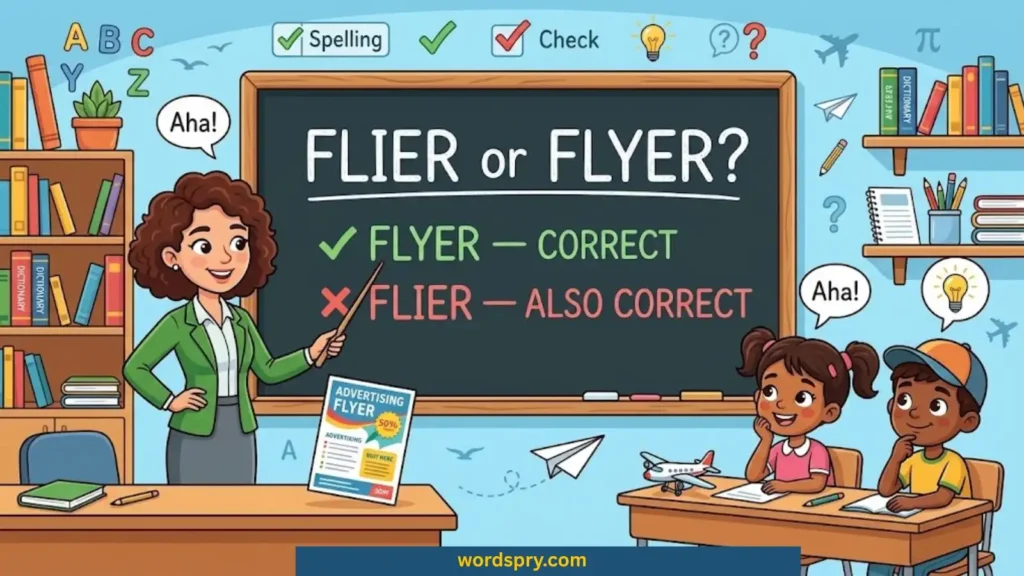
“Flier and flyer are both correct spellings.” The best choice depends mainly on the meaning and your audience.
Use flyer when you mean a small printed or digital advertisement:
- We handed out flyers for the concert.
- The store created a colorful flyer for its sale.
- Please share the event flyer online.
Use flier when referring to someone or something that flies, especially in some American English contexts:
- She is a frequent flier.
- The eagle is a powerful flier.
- He took a flier on a risky investment.
However, these rules are not absolute. Oxford lists flyer as its main entry and gives flier as another spelling.
Quick comparison
| Word | Common meaning | Example |
|---|---|---|
| flier | Person or thing that flies | He is a frequent flier. |
| flyer | Advertisement or leaflet | I picked up a flyer. |
| flier | Risky venture | She took a flier on the business. |
| flyer | Person who flies | He is an experienced flyer. |
| flyer | Advertisement | They distributed flyers. |
The key point is simple: both spellings are correct, but “flyer” is often the clearest choice for advertising material.
The Origin of Flier or Flyer
Both flier and flyer come from the verb fly. The basic idea is someone or something that flies.
The suffix -er commonly forms nouns that describe a person or thing performing an action. Therefore, “fly” plus “-er” naturally produced a word for someone or something that flies.
The spelling flier has a long history. Merriam-Webster records its first known use in the 15th century.
The form flyer also developed as a spelling variant. Over time, English speakers used both forms in different contexts. The two spellings survived because English does not always follow one strict spelling pattern.
There is another reason for the confusion. The word developed several meanings.
It can describe:
- A person who flies.
- A passenger who travels by air.
- A pilot or aviator.
- A bird, insect, or other flying creature.
- A printed advertisement.
- A risky or speculative venture.
Modern dictionaries recognize these meanings. Oxford, for example, lists both spellings and includes meanings connected with aviation, flying creatures, advertisements, and fast movement.
Interestingly, flyer has become especially common for advertising material. This makes sense because “flyer” is visually connected with the base word fly, while the spelling has become firmly established in marketing and everyday business writing.
British English vs American English Spelling
There is no simple rule saying that flier is British and flyer is American. That would be misleading.
Both forms appear in American and British English. However, dictionaries show differences in preference and meaning.
Cambridge describes flier as a mainly American spelling of flyer in one entry, while its flyer entry presents flyer as the standard form and lists flier as mainly American in some uses.
Oxford also lists flyer as its main headword and identifies flier as an alternative spelling.
British vs American comparison
| Meaning | British English | American English |
|---|---|---|
| Advertising leaflet | flyer is common | flyer is very common |
| Person who flies | flyer / flier | flier / flyer |
| Air passenger | frequent flyer is common | frequent flier is also common |
| Risky venture | take a flier | take a flier |
| Flying creature | flyer / flier | flier / flyer |
The most important point is that regional English does not completely separate these spellings.
Style guides can also make different choices. For example, one government style guide notes that AP style uses flier for a handbill, although both forms are acceptable.
Therefore, writers should follow the style guide used by their organization when one exists.
Which Spelling Should You Use?
Your choice should depend on meaning, audience, and consistency.
For advertisements
Choose flyer if you mean a promotional sheet, leaflet, or digital advertisement.
Example:
Download our new summer sale flyer.
This is the most familiar choice for many readers.
For American audiences
Both spellings are accepted. However, flyer works well for advertisements, while flier is often seen in expressions involving air travel or risk.
For example:
She is a frequent flier.
We printed 2,000 flyers for the event.
For British audiences
Flyer is a strong general choice, especially for advertising material. Oxford and Cambridge both recognize flyer and flier as variants.
For international audiences
If you want the safest general choice, use flyer for an advertisement.
It is familiar, easy to understand, and widely used in marketing.
Most importantly, stay consistent. Do not switch between flier and flyer randomly within the same document.
Common Mistakes with Flier or Flyer
Writers often make mistakes because they assume one spelling must always be correct.
Mistake 1: Thinking “flier” is wrong
Incorrect idea:
Flier is always wrong.
That is false. Flier is a valid dictionary word. Merriam-Webster lists it as the primary form for someone or something that flies.
Mistake 2: Thinking “flyer” is only American
Incorrect idea:
British writers must use flier.
This is also incorrect. British dictionaries recognize flyer as a standard spelling.
Mistake 3: Using “flier” for every advertisement
Although flier can mean an advertising leaflet, flyer is often the clearer and more familiar choice.
Better:
We created a flyer for the charity event.
Mistake 4: Changing spelling within one article
Avoid writing:
Download our flyer. We printed 500 fliers yesterday.
If both refer to the same type of advertising material, choose one form and use it consistently.
Better:
Download our flyer. We printed 500 flyers yesterday.
Mistake 5: Confusing “flyer” with “fly”
Remember that flyer is a noun.
The flyer contains information about the event.
The verb is simply:
Please fly to Chicago tomorrow.
Flier or Flyer in Everyday Examples
Both forms appear in everyday English. Here are useful examples from different writing situations.
In emails
Please see the attached flyer for our upcoming workshop.
Could you send the event flyer to the team?
For business emails, flyer is usually a clear choice when you mean promotional material.
In news writing
Volunteers distributed flyers across the neighborhood.
The airline welcomed several hundred frequent fliers.
News organizations may follow their own style guides, so their preferred spelling can differ.
In social media
Check out our new event flyer!
Share this flyer with your friends.
The spelling flyer is especially natural for digital marketing posts.
In formal writing
The organization distributed informational flyers to local residents.
The study examined travel habits among frequent air fliers.
Both forms can work in formal writing. The meaning should guide your choice.
In everyday conversation
Did you see the flyer for the concert?
My brother is a nervous flier.
These examples show why context matters more than a simple “right versus wrong” rule.
Flier or Flyer – Google Trends & Usage Data
People often use Google Trends to compare spelling variants. However, Google explains that Trends does not automatically provide results for misspellings, spelling variations, synonyms, or singular and plural forms when comparing search terms.
Therefore, a Google Trends comparison between flier and flyer should not be treated as a perfect measurement of total language use.
Still, broader dictionary evidence and online usage show a useful pattern: flyer is especially strong for advertising and promotional material, while flier remains common for people or things that fly and in phrases such as take a flier. Merriam-Webster and Cambridge both document these differences.
Usage by context
| Context | More natural choice |
|---|---|
| Advertising leaflet | flyer |
| Event promotion | flyer |
| Online advertisement | flyer |
| Airline passenger | flier or flyer |
| Pilot | flier or flyer |
| Flying animal | flier or flyer |
| Risky venture | flier |
| “Take a ___” | flier is common |
So, instead of asking which spelling “wins” worldwide, ask which spelling fits your meaning and audience.
Flier vs Flyer: Comparison Table
| Feature | Flier | Flyer |
|---|---|---|
| Correct spelling | Yes | Yes |
| Person who flies | Yes | Yes |
| Air passenger | Yes | Yes |
| Flying creature | Yes | Yes |
| Advertising leaflet | Yes | Yes |
| Marketing material | Common | Very common |
| Risky venture | Very common | Also accepted |
| British English | Accepted | Common |
| American English | Accepted | Accepted |
| Best general choice for ads | Good | Preferred for clarity |
The important lesson is that neither spelling is universally wrong. Flyer is often the best choice for promotional material, while flier remains strongly established in several other meanings.
FAQs About Flier or Flyer
1. Is “flier” or “flyer” correct?
Both flier and flyer are correct. The preferred form depends on meaning, regional usage, and style guide.
2. Is “flyer” the correct spelling for an advertisement?
Yes. Flyer is a common and widely accepted spelling for a small advertisement or promotional leaflet.
3. Is “flier” an American spelling?
Flier is especially established in American English, but it is not limited to the United States. British English also recognizes the spelling.
4. Is “frequent flyer” or “frequent flier” correct?
Both are correct. Frequent flyer is widely used, while frequent flier is also accepted, especially in American English.
5. Should I write “take a flier” or “take a flyer”?
Both forms can be found, but take a flier is a well-established expression meaning to take a risk.
6. Which spelling is better for marketing?
Flyer is usually the safest choice for marketing material. For example, “Download our new product flyer” sounds natural and clear.
7. Does British English use “flier”?
Yes. British English uses both flier and flyer. Oxford lists flyer as the main entry and gives flier as an alternative.
Conclusion
The flier or flyer question has a simple answer: both spellings are correct. The right choice depends on what you mean, where your readers are, and which style guide you follow.
When you mean a promotional leaflet, advertisement, or event handout, flyer is usually the clearest choice. For example, “We distributed flyers at the festival” is natural and widely understood. When you mean someone who flies, flier and flyer can both work. In expressions such as take a flier, the spelling flier remains especially common.
Most importantly, do not treat one form as universally wrong. Major dictionaries recognize both spellings and document their different uses.
If you are writing for a broad international audience, flyer is a practical choice for advertising material. For aviation or risk-related meanings, check your preferred dictionary or style guide. Finally, choose one form and use it consistently throughout your writing.