Many people get confused between “someday” and “one day” because both talk about time in the future. They sound similar, but their meanings are not exactly the same. This small difference can change how your sentence feels.
Writers, students, and bloggers often search this topic to avoid mistakes in grammar and improve clarity. Using the wrong phrase may not sound natural, especially in formal writing or professional communication.
The good news is that the difference is easy to understand. One phrase is more general, while the other can be more specific or even used for past events. Once you learn this, your writing will become clearer and more confident.
Someday or One Day – Quick Answer
Both phrases are correct, but they are used in different ways.
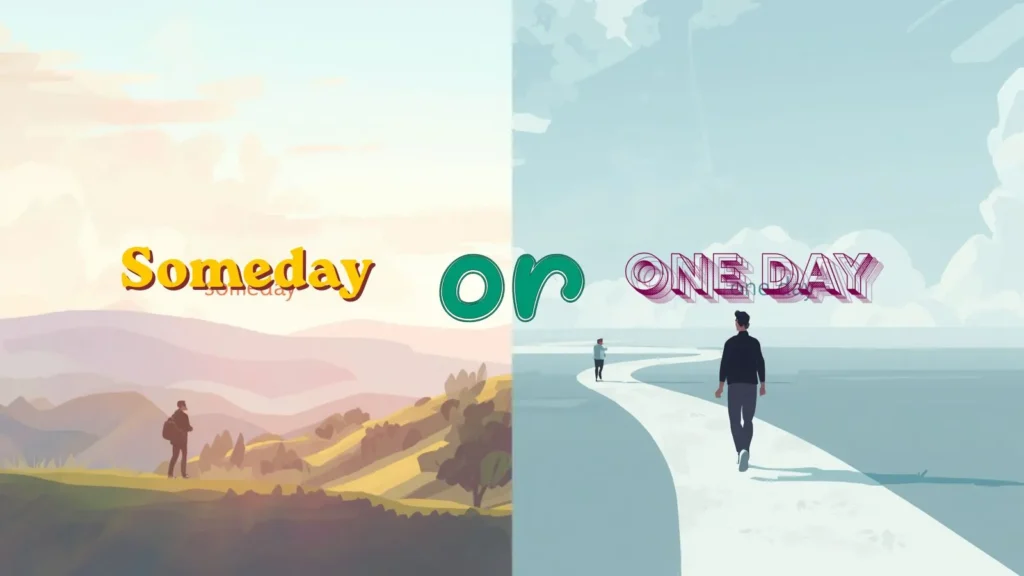
- Someday means at an unknown time in the future
- Example: I will travel the world someday.
- One day can mean a specific future day or a day in the past
- Example (future): One day, I will start a business.
- Example (past): One day, I met an old friend.
👉 Simple rule:
Use the first for general future hopes and the second for clearer or story-based situations.
The Origin of Someday or One Day
The phrase “one day” is older and has been used for many years in English. It simply means a single day and can refer to both past and future events.
Later, “someday” developed from the phrase “some day.” Over time, it became one word and started to mean an unspecified future time.
Why both exist:
- One form is literal and exact
- The other is more abstract and flexible
This is why both are still widely used today.
British English vs American English Spelling
There is no major spelling conflict, but usage differs slightly.
- Someday is more common in American English
- Some day may appear in British writing for clarity
- One day is common everywhere
Comparison Table
| Form | American English | British English | Style |
|---|---|---|---|
| Someday | Very common | Less common | Informal |
| Some day | Rare | Sometimes used | Formal |
| One day | Common | Common | Neutral |
Which Spelling Should You Use?
Your choice depends on your audience:
- For US readers:
Use “someday” for natural flow - For UK or Commonwealth readers:
“Some day” or “one day” works well - For global content:
Keep it simple and use “someday” or “one day” based on meaning
👉 Tip: Choose based on clarity, not just style.
Common Mistakes with Someday or One Day
Here are some common errors:
I will meet you one day soon.❌
✔ I will meet you someday.
Someday, I saw him at the market.❌
✔ One day, I saw him at the market.
Some day I will be successful.❌
✔ Someday I will be successful.
Key point:
Do not use “someday” for past events.
Someday or One Day in Everyday Examples
Emails:
I hope we meet someday.
News:
One day, the law changed everything.
Social Media:
I will achieve my goals someday.
Formal Writing:
One day, the results may improve with time.
Someday or One Day – Google Trends & Usage Data
Search data shows that both phrases are popular but used differently.
- “Someday” is common in motivational and personal content
- “One day” appears more in stories, news, and general searches
Insight:
One version has broader usage, while the other is more emotional and future-focused.
Keyword Comparison Table
| Phrase | Meaning | Time Type | Example |
|---|---|---|---|
| Someday | Unclear future | General | I will succeed someday |
| One day | Specific time | Past/Future | One day, I met her |
| Some day | Formal use | Slightly specific | Some day you will understand |
FAQs
1. Is there a big difference between the two?
Yes, one is general while the other can be specific or used in stories.
2. Can I use the first phrase for past events?
No, it is only for future situations.
3. Which is better for writing?
It depends on your sentence meaning and tone.
4. Is “some day” still correct?
Yes, but it is less common today.
5. Which is better for SEO?
Both can be used, but avoid repeating them too often.
6. Is one more formal than the other?
The combined form is slightly more casual.
7. Can they be used in the same paragraph?
Yes, if the meanings are clearly different.
Conclusion
Understanding the difference between these two time expressions is simple once you focus on meaning. One is used for dreams and general future plans, while the other works better for storytelling or more defined moments.
Using the correct phrase helps your writing sound natural and clear. It also improves readability, especially for blogs, articles, and professional communication. Small grammar choices like this can make a big difference.
For best results, always think about your sentence context. If your idea is open and uncertain, choose the more general option. If your sentence needs clarity or refers to a real moment, use the more specific one.

Hi, I’m John Miles, the voice behind Grammar Meaning! I share clear and practical grammar tips. You’ll find my work on basicsgrammar.com.