Do you write everyday or every day? Many people feel stuck here. The words look the same. They sound the same. But they do not mean the same thing. This small space can change your whole sentence.
People search “everyday vs every day” because they want clear answers. Students, writers, and even professionals mix them up. It happens in emails, blogs, and social posts. The mistake is common. But the fix is easy once you know the rule.
Here is the key: one is an adjective. The other is a phrase. If you use the wrong one, your sentence may sound odd or wrong. That is why learning this matters.
In this guide, you will get a quick answer, simple examples, and clear tips. By the end, you will use both forms with full confidence.
Everyday vs Every Day – Quick Answer
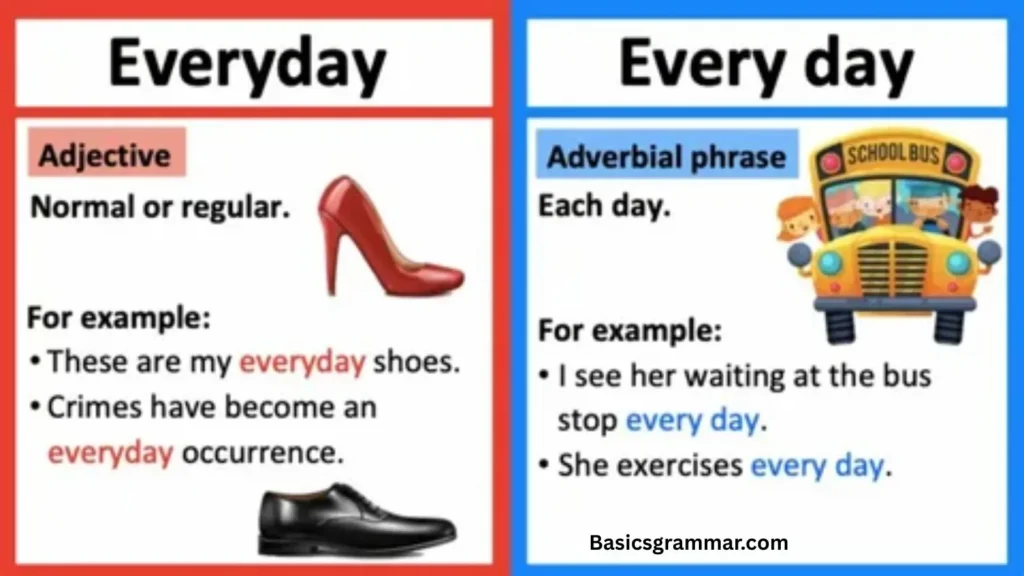
- Everyday = adjective (means normal or common)
- Every day = phrase (means each day)
Examples:
- Correct: These are my everyday shoes.
- Correct: I walk every day.
- Wrong: I walk everyday. ❌
👉 Tip: If you can replace it with “each day,” use every day.
The Origin of Everyday vs Every Day
The phrase every day came first. It means “each day.” Over time, people used it often. Then, the combined form everyday appeared as an adjective.
Language changes with use. Words join when people use them often together. That is why “everyday” became one word. But the meaning changed slightly. It now describes something ordinary.
👉 So:
- Every day = time
- Everyday = description
British English vs American English Spelling
Good news! There is no difference between British and American English here. Both use the same rules.
Comparison Table
| Form | American English | British English | Meaning |
|---|---|---|---|
| Everyday | Yes | Yes | Normal/common |
| Every day | Yes | Yes | Each day |
Examples:
- US: She wears everyday clothes.
- UK: He runs every day.
👉 Same spelling, same meaning, everywhere.
Which Spelling Should You Use?
Use the correct form based on meaning, not location.
- Use everyday for things
- everyday tasks
- Use every day for time
- I study every day
Audience Advice:
- US audience: Follow the same rule
- UK/Commonwealth: Same usage
- Global writing: Always follow meaning
👉 Focus on grammar, not region.
Common Mistakes with Everyday vs Every Day
I go to the gym everyday.❌
✅ I go to the gym every day.
❌ These are every day shoes.
These are everyday shoes.✅
❌ Mixing both in one sentence
Use one correct form clearly✅
👉 Trick: Try adding a noun after “everyday.” If it fits, it is correct.
Everyday vs Every Day in Everyday Examples
Emails:
- I check my email every day.
News:
- These are everyday problems people face.
Social Media:
- I post every day!
Formal Writing:
- Everyday activities shape habits over time.
👉 Notice how meaning changes with spacing.
Everyday vs Every Day – Google Trends & Usage Data
Search data shows both terms are popular. However, they are used in different ways.
- Every day is searched more often
- Everyday appears in writing and content
Usage Insights:
- USA & UK: High use of both
- Students: Often confuse them
- Writers: Use both correctly in context
👉 Most searches come from confusion, not meaning.
Comparison Table: Keyword Variations
| Term | Type | Meaning | Example |
|---|---|---|---|
| Everyday | Adjective | Normal/common | Everyday life is busy |
| Every day | Phrase | Each day | I exercise every day |
| Everyday use | Phrase | Daily use item | Shoes for everyday use |
FAQs
1. Is everyday one word or two?
Both exist. Meaning decides usage.
2. What does everyday mean?
It means normal or common.
3. What does every day mean?
It means each day.
4. Can I use everyday for time?
No, use “every day” for time.
5. Why do people confuse them?
Because they look and sound the same.
6. Is this rule the same worldwide?
Yes, it is the same in all English forms.
7. Easy way to remember?
Use “each day” test for “every day.”
Conclusion
The difference between everyday vs every day is small but important. One word can change your meaning. Everyday describes something common. Every day talks about time.
Many people confuse them because they sound the same. But once you learn the rule, it becomes easy. Just remember the simple test: if you mean “each day,” use two words. If you describe something, use one word.
There is no difference between British and American English. This makes things easier. You only need to focus on meaning, not location.
Using the correct form improves your writing. It makes your message clear and professional. Small details like this can make a big difference. Now you know the rule. Use it every day in your writing.