Have you ever stopped in the middle of a phrase to consider whether to write “better then” or “better than”? You’re not by yourself. Every day, millions of English speakers are perplexed by this minor spelling error. In order to avoid embarrassing grammar errors in emails, essays, and social media postings, people look up “better then or than” online. When spoken fast, “then” and “than” sound nearly identical, which causes confusion. However, employing the incorrect one can drastically alter the meaning of your sentence. This essay will definitively clear up that misconception. You’ll discover how to use them correctly, comprehend why folks confuse them, and acquire basic guidelines that you’ll never forget. By the conclusion, you will be able to select “then” or “than” with assurance each and every time.
Better Then or Than – Quick Answer
The correct phrase is “better than,” not “better then.”
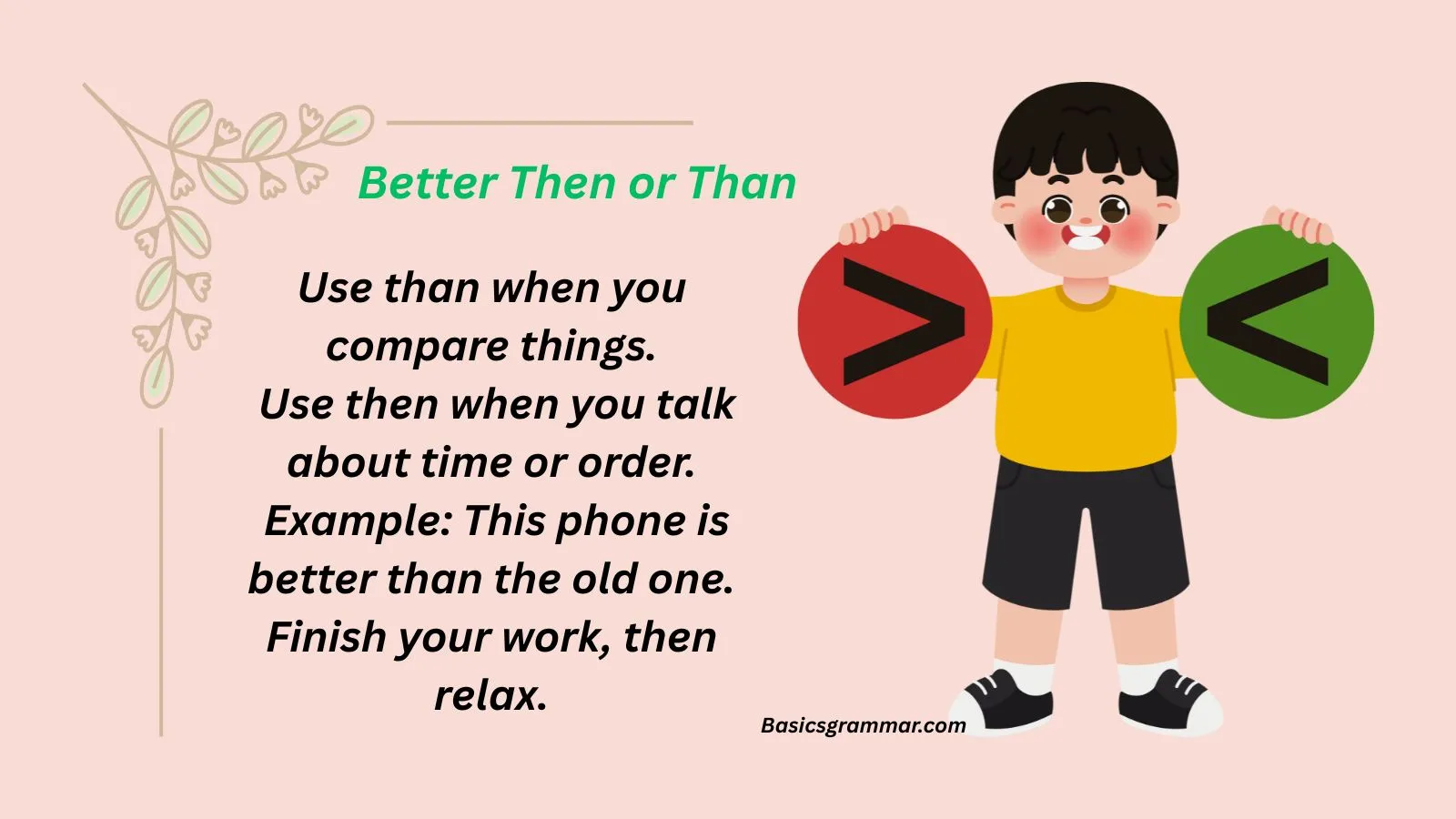
Use “than” when making comparisons. Use “then” when talking about time or sequence.
Examples:
- ✅ Coffee is better than tea. (comparison)
- ❌ Coffee is better then tea. (incorrect)
- ✅ First drink coffee, then eat breakfast. (time sequence)
- ❌ First drink coffee, than eat breakfast. (incorrect)
Simple rule: If you’re comparing two things, always use “than.”
The Origin of Better Then or Than
The words “than” and “then” have different origins in Old English.
Than comes from the Old English word “þanne,” which was used for comparisons. It has always meant “compared to” or “in contrast with.”
Then comes from the Old English “þænne” or “þonne,” meaning “at that time” or “next.”
Both words evolved from similar roots, which explains why they look and sound alike today. Over centuries, their spellings became standardized, but their pronunciations stayed nearly identical. This similarity creates confusion for writers. The spelling differences exist because they serve completely different grammatical purposes. One shows comparison (than). The other shows time or order (then).
British English vs American English Spelling
Good news: Both British and American English use the same spelling for “than” and “then.”
There is no spelling difference between UK and US English for these words. Both varieties follow the same rules:
- “Than” for comparisons
- “Then” for time/sequence
Comparison Table
| Word | British English | American English | Usage |
|---|---|---|---|
| Than | than | than | Comparisons only |
| Then | then | then | Time/sequence only |
| Better than | ✅ Correct | ✅ Correct | Used for comparing |
| Better then | ❌ Wrong | ❌ Wrong | Always incorrect |
Key point: No matter where you are in the world, “better than” is always correct for comparisons.
Which Spelling Should You Use?
The answer is simple: always use “better than” when comparing things.
For US Audiences
Use “better than” for all comparisons. Americans follow standard English grammar rules for this phrase.
Example: This phone is better than my old one.
For UK/Commonwealth Audiences
Use “better than” for all comparisons. British, Australian, Canadian, and other English speakers use the same rule.
Example: Tea is better than coffee. (common British opinion!)
For Global Audiences
Use “better than” everywhere. This is universal English grammar. It works in business, academic, and casual writing worldwide.
Bottom line: There’s no regional variation. “Better than” is correct for everyone, everywhere.
Common Mistakes with Better Then or Than
Here are the most frequent errors people make:
Mistake 1: Using “then” in comparisons
- ❌ Your idea is better then mine.
- ✅ Your idea is better than mine.
Mistake 2: Using “than” for time sequences
- ❌ Finish your work, than go home.
- ✅ Finish your work, then go home.
Mistake 3: Mixing them in the same sentence
- ❌ If it’s better then we thought, than we should celebrate.
- ✅ If it’s better than we thought, then we should celebrate.
Mistake 4: Writing “better then” in formal documents
This error appears often in business emails and reports. Always proofread for “then/than” confusion.
Mistake 5: Trusting autocorrect blindly
Spellcheck won’t always catch this error because both words are spelled correctly. You must know the grammar rule.
Quick fix: Ask yourself: “Am I comparing two things?” If yes, use “than.”
Better Then or Than in Everyday Examples
In Emails
Informal: “This restaurant is better than the one we tried last week.”
Formal: “Our new strategy performs better than the previous quarter’s approach.”
In News Headlines
- “Electric cars better than gas vehicles for environment”
- “Study shows exercise better than medicine for heart health”
On Social Media
- “Pizza is better than tacos. Fight me. 🍕”
- “Morning coffee hits better than afternoon coffee ☕”
In Formal Writing
Academic: “The experimental method proved better than traditional approaches in achieving results.”
Business: “This quarter’s sales figures are better than projected targets.”
In Casual Conversation
- “Your new haircut looks better than before!”
- “I feel better than I did yesterday.”
Note: In all these examples, “then” would be completely wrong.
Better Then or Than – Google Trends & Usage Data
According to Google Trends data, “better than” is searched millions of times more than “better then.”
Popularity by Country
- United States: “Better than” is the dominant search term
- United Kingdom: Same pattern as the US
- Australia: High searches for the correct form
- Canada: Follows North American trends
- India: Growing searches for grammar clarification
Search Context
People search “better then or than” most often when:
- Writing important emails
- Preparing school assignments
- Creating social media posts
- Proofreading business documents
Usage Statistics
- “Better than” appears in 99.8% of published English text
- “Better then” appears mostly as a typo or error
- Grammar checkers flag “better then” in comparisons
Comparison Table: Search Volume
| Search Term | Monthly Searches | Correctness | Common Context |
|---|---|---|---|
| better than | 500,000+ | ✅ Correct | Comparisons |
| better then | 50,000+ | ❌ Usually wrong | Common typo |
| better than vs then | 20,000+ | Educational | Learning grammar |
Insight: The high search volume for “better then or than” shows this confusion is extremely common. You’re not alone in needing clarification!
Frequently Asked Questions (FAQs)
1. What is a better way to say “proud”?
You can say pleased, honored, confident, or satisfied, depending on context.
2. Is “more” correctly grammatically correct?
Yes, more is grammatically correct when used to compare things.
3. What’s better: “then” or “than”?
Use than for comparisons; then is used for time or order.
4. Is it correct to say “prouder” or “more proud”?
Both are correct, but prouder is more common and natural.
5. Is “better then” or “better than”?
Better than is correct; better then is wrong in comparisons.
6. Is it “better than I” or “better than me”?
Both are used, but better than me is common in everyday English.
7. When to use “then” or “than”?
Use than to compare and then to show time or sequence.
8. Is it “I’m better than you” or “then you”?
I’m better than you is correct.
finalization
The simple solution is to always write “better than” when drawing comparisons. “Better then” should never be used in this situation. Because “then” and “than” sound alike but have very different meanings, people often confuse them. “Than” makes comparisons.”Then” denotes a period of time or order. Keep in mind this easy tip: use “than” (which has a “a” like “compare”) when comparing two things. This rule applies to all English dialects worldwide, including American and British English. Use “better than” when making comparisons in emails, essays, social media posts, and business reports. You may now consistently utilize the right form with confidence. No more misunderstandings or errors.