
Many writers search for “coaches or coach’s” because these two forms look similar but mean very different things. A single apostrophe can change the whole sentence. That small mark often causes big confusion in emails, school work, sports writing, and even news headlines. People are unsure when to show ownership and when to simply talk about more than one coach.
This confusion is common because English uses apostrophes for ownership, not for making words plural. Writers often mix up coach’s vs coaches, especially when writing fast. Is it one coach who owns something? Or is it many coaches without ownership? These questions matter for clarity in sentence meaning and reader understanding.
This guide solves that problem. It gives a quick answer first, then explains the rules in simple words. You will learn how to use apostrophes correctly, avoid common apostrophe mistakes, and improve writing ownership in English. By the end, you will know exactly when to use coaches or coach’s with confidence.
Grammatical Role of Coaches or Coach’s in Sentence Structure
In sentence structure, coaches and coach’s perform different grammatical roles. Coaches is a plural noun. It refers to more than one coach and often functions as a subject or object in a sentence. For example, “The coaches are planning the training session.” Here, coaches is the subject performing the action.
Coach’s, on the other hand, is a singular possessive noun. It shows ownership or a close relationship between a coach and something else. It usually comes before another noun. For example, “The coach’s strategy improved the team’s performance.” In this sentence, coach’s modifies strategy by showing who owns it.
Understanding these roles helps writers build grammatically correct sentences. Using coaches when referring to people and coach’s when showing possession ensures clarity, accuracy, and professional writing quality.
How Apostrophes Change the Meaning of Coaches or Coach’s
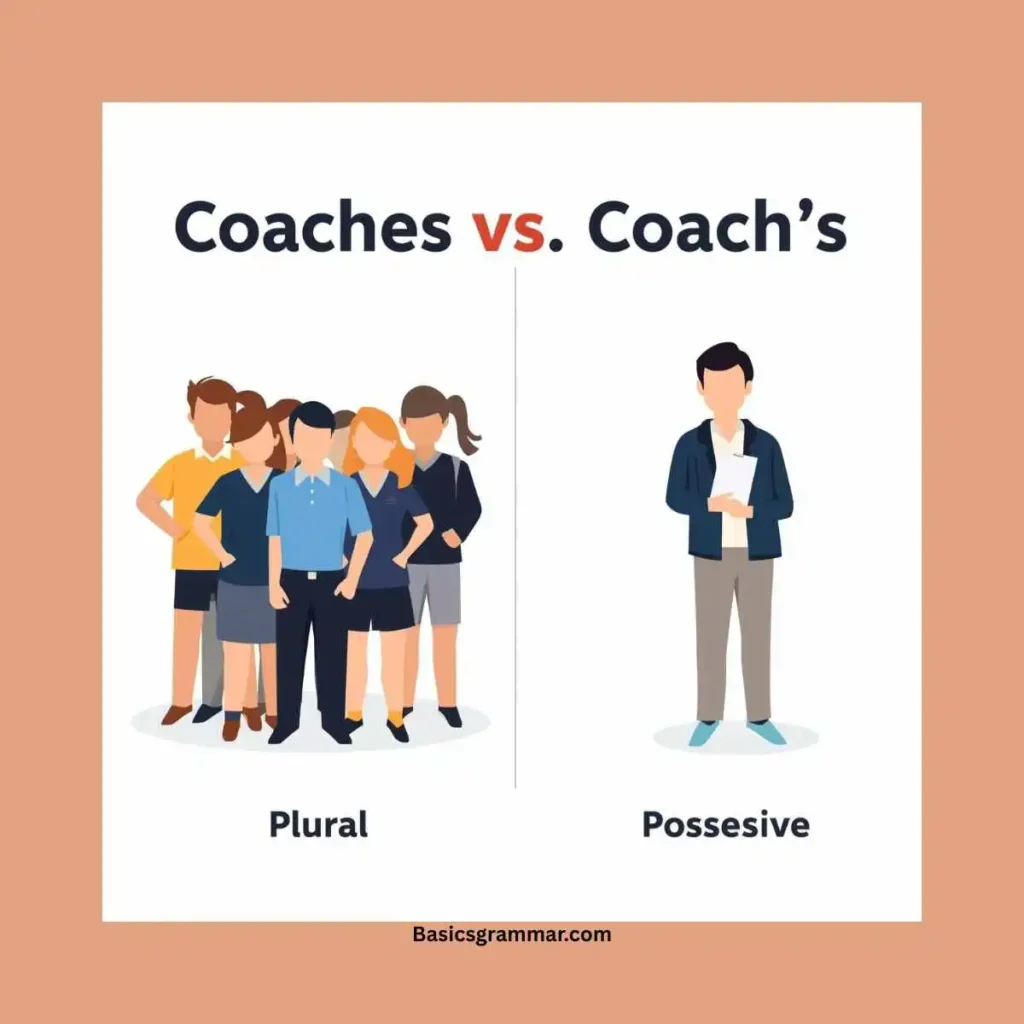
Apostrophes play a critical role in changing the meaning of coaches or coach’s. Without an apostrophe, coaches simply means more than one coach. For example, “The coaches discussed new tactics.” There is no ownership involved—only quantity.
When an apostrophe is added, as in coach’s, the meaning changes to possession. It tells the reader that something belongs to one coach. For example, “The coach’s decision was final.” The apostrophe clearly shows that the decision belongs to the coach.
Misusing apostrophes can confuse readers and weaken professional writing. Apostrophes should never be used to form plurals. They exist only to show possession or contraction. Correct apostrophe usage ensures that the intended meaning of coaches or coach’s is immediately clear to the reader.
Proofreading Tips for Coaches or Coach’s
When proofreading text that includes coaches or coach’s, focus first on meaning, not spelling. Ask yourself whether the sentence refers to more than one coach or to something belonging to a coach. If the word refers to people in plural, the correct form is coaches. If the sentence shows ownership by a single coach, the correct form is coach’s.
Next, check the noun that follows the word. Possessive forms like coach’s are usually followed by an object, such as plan, decision, office, or strategy. If no owned item appears, the apostrophe is likely incorrect. For example, “The coach’s attended the meeting” is wrong because there is no possession.
Reading the sentence out loud can also help. If you hear an idea of ownership, an apostrophe may be needed. Finally, watch for overuse of apostrophes, especially in headings and captions. Apostrophes never create plurals, and removing unnecessary ones is a key step in professional proofreading.
Coaches or Coach’s – Quick Answer
Coaches = plural form
Coach’s = singular possessive form
Examples:
- Coaches are attending the meeting.
- The coach’s whistle is broken.
If you mean more than one coach, use coaches.
If you mean something belonging to one coach, use coach’s.
The Origin of Coaches or Coach’s
The word coach comes from the Hungarian word kocsi, meaning a carriage. Over time, it came to mean someone who trains or guides others. English later added grammar rules for plural and possession.
- Coaches follows a simple plural rule: add -es.
- Coach’s follows the possessive rule: add ’s to show ownership.
The apostrophe exists to show possession, not plurality. Confusion happens because spoken English sounds the same, but written English does not.
British English vs American English Spelling
There is no spelling difference between British and American English for coaches or coach’s. The rules are the same.
Comparison Table
| Form | British English | American English | Meaning |
|---|---|---|---|
| coaches | coaches | coaches | More than one coach |
| coach’s | coach’s | coach’s | Belonging to one coach |
| coaches’ | coaches’ | coaches’ | Belonging to multiple coaches |
Which Spelling Should You Use?
Choose based on meaning, not location.
- US audience: Follow standard grammar rules.
- UK / Commonwealth: Same rules apply.
- Global audience: Use clear grammar to avoid confusion.
Simple rule:
- Ask: How many coaches?
- Ask: Is something owned by a coach?
Your answers decide the spelling.
Common Mistakes with Coaches or Coach’s
❌ Mistakes:
- The coach’s are ready.
- All coaches strategy failed.
✅ Corrections:
- The coaches are ready.
- The coach’s strategy failed.
Tip: Apostrophes never make words plural.
Coaches or Coach’s in Everyday Examples
Emails
- The coach’s schedule has changed.
- All coaches must attend.
News
- Local coaches support new rules.
- The coach’s decision shocked fans.
Social Media
- Shoutout to our amazing coaches!
- Loved the coach’s speech today.
Formal Writing
- The coach’s responsibilities include training.
- Experienced coaches improve performance.
Coaches or Coach’s – Google Trends & Usage Data
Search data shows that “coaches or coach’s” is often typed by:
- Students
- ESL learners
- Content writers
People usually search this phrase when proofreading or writing online. The confusion is global and appears equally in the US, UK, and Commonwealth countries. Most searches aim to quickly confirm plural vs possessive usage, not spelling differences.
Comparison Table: Coaches or Coach’s
| Variation | Type | Meaning | Example |
|---|---|---|---|
| coaches | Plural | More than one coach | The coaches agreed |
| coach’s | Singular possessive | Belongs to one coach | The coach’s bag |
| coaches’ | Plural possessive | Belongs to many coaches | The coaches’ room |
FAQs
What is the plural for coach?
The plural of coach is coaches.
Is it coaches box or coach’s box?
Use coach’s box if it belongs to one coach; use coaches’ box if shared by multiple coaches.
How do you say multiple coaches?
You say coaches (no apostrophe).
Is it a coaches or coach’s award?
Coach’s award = given by one coach; coaches’ award = given by several coaches.
Do you say coaches or coach’s?
Use coaches for plural; coach’s to show something belongs to one coach.
Conclusion
Once you concentrate on meaning, it becomes easy to distinguish between coaches. The word “coaches” always refers to more than one coach. Coaches always demonstrate a single coach’s ownership. In both British and American English, the apostrophe never turns a word plural.
The majority of errors occur because written English necessitates clarity, but spoken English obscures the distinction. By posing two brief queries: How many coaches are there? and Is something owned?—you can consistently select the appropriate form. This ability helps you avoid typical grammatical errors, enhances your writing, and increases your professionalism.
Using coaches or coaches appropriately conveys confidence and clarity whether you are writing an email, social media post, article, or official document. You won’t ever doubt these forms again if you use this guide as a guide.
