

Do you write on a daily basis? You’re not alone if you’ve ever stopped in the middle of a statement to consider which is right. Because the two forms appear almost identical yet have quite different meanings, this is one of the most often asked grammatical questions in English. A tiny spacing can alter a word’s function and occasionally a sentence’s entire meaning.
Because both forms seem correct at first glance, people search for “everyday vs. every day.” Even proficient English speakers frequently mix them up in emails, blogs, and professional writing, and spellcheck is rarely helpful. Uncertainty over whether the word is functioning as an adjective or a temporal expression is typically the cause of the issue.
This essay quickly clears up that confusion. You’ll receive a prompt response, concise examples, and useful guidelines that you can use immediately. We’ll also go over the terms’ history, typical errors, practical applications, and how various audiences anticipate their writing. By the time it’s all over, you won’t ever have to choose between daily and every day again.
The Role of Grammar in Differentiating Everyday and Every Day
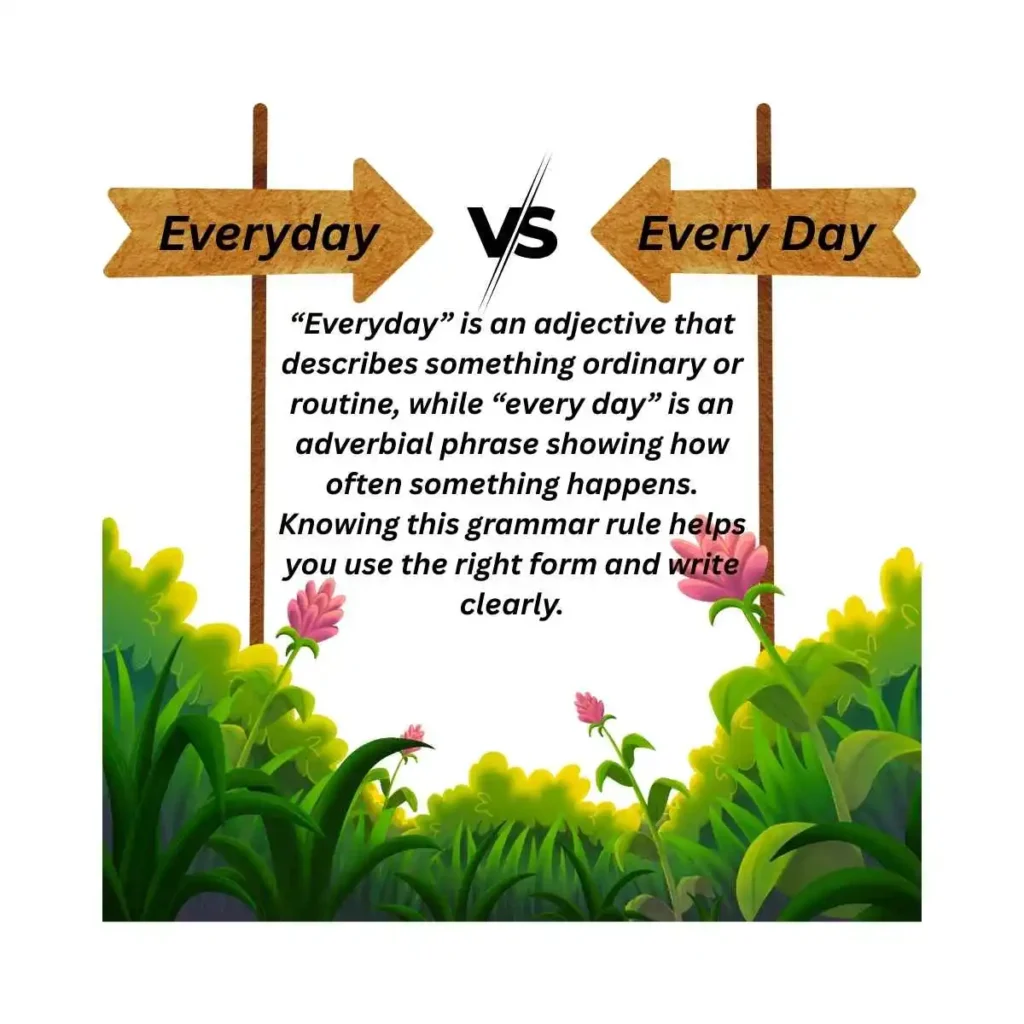
Grammar plays a crucial role in understanding the difference between everyday and every day. The key distinction lies in their grammatical function: everyday is an adjective used to describe nouns, indicating something ordinary, typical, or routine. For example, in the sentence “She wears everyday clothes,” everyday modifies the noun “clothes” and tells us they are ordinary or casual. Conversely, every day is an adverbial phrase that modifies verbs, indicating how often an action occurs—specifically, on a daily basis. For instance, “She exercises every day” uses every day to describe the frequency of the action “exercises.”
Understanding their grammatical roles helps writers choose the correct form and avoid confusion. When a word or phrase describes a noun, the adjective form everyday is appropriate. When referring to time or frequency, the two-word phrase every day is necessary. This grammatical distinction ensures clarity and precision in writing, preventing misinterpretations and enhancing communication effectiveness. Mastering this simple grammar rule is essential for both native speakers and English learners alike.
Future Trends: Will Everyday and Every Day Ever Merge
Language is always evolving, and English is no exception. Compound words frequently start as two separate words and gradually merge into one over time—examples include any time becoming anytime and some day becoming someday. This natural progression raises the question: could every day eventually merge into the single word everyday? While this is possible, the answer lies in the distinct grammatical roles these terms currently play. Because everyday is an adjective and every day is an adverbial phrase indicating frequency, merging them could cause confusion or loss of meaning, making such a change unlikely in the near future.
Moreover, current language trends and usage data suggest that speakers and writers value clarity in communication. Since the difference between everyday and every day is important for conveying meaning precisely, most style guides, educators, and professional writers emphasize maintaining this distinction. Even with the rise of informal digital communication, where language tends to become more flexible, the need to separate descriptive terms from time expressions remains strong. This continued emphasis on clarity and precision suggests that any merging of these forms would face significant resistance.
That said, language is unpredictable, and the influence of technology, social media, and informal writing styles could eventually blur the lines between many word pairs, including everyday and every day. Innovations like voice-to-text and AI-driven writing tools may further impact how these words are used or understood. However, until a widespread shift occurs in both spoken and written English, the distinction between everyday and every day will likely remain firmly in place, serving as a small but vital piece of clear, effective communication.
Everyday vs Every Day – Quick Answer
Everyday (one word) is an adjective.
It describes something ordinary or routine.
Every day (two words) is an adverbial phrase.
It means something happens daily.
Examples:
- This is my everyday routine.
- I walk to work every day.
Simple test:
If you can replace it with “daily”, use every day.
If it describes a noun, use everyday.
The Origin of Everyday vs Every Day
The phrase every day comes from Old and Middle English, where every meant “each” and day referred to a 24-hour period. It was always written as two words because it described time.
Over time, English speakers began combining frequently used word pairs. This created everyday, a compound adjective meaning “common” or “normal.” English does this often, just like any time → anytime or some day → someday.
The spelling difference exists because the function is different:
- Two words = time expression
- One word = descriptive adjective
The meanings split, but the root words stayed the same.
British English vs American English Spelling
There is no spelling difference between British and American English for everyday and every day. Both follow the same grammar rules.
The confusion here is not regional—it’s grammatical.
Comparison Table
| Form | British English | American English | Usage Type |
|---|---|---|---|
| everyday | Same | Same | Adjective |
| every day | Same | Same | Time phrase |
Examples (both varieties):
- Everyday clothes are comfortable.
- I drink tea every day.
Which Spelling Should You Use?
Use everyday if you are describing a noun:
- everyday problems
- everyday language
Use every day if you are talking about frequency or time:
- I exercise every day.
- She calls her parents every day.
Audience advice:
- US audience: Same rules apply
- UK/Commonwealth: Same rules apply
- Global audience: These rules are universally accepted
There is no style guide that treats them differently by region.
Common Mistakes with Everyday vs Every Day
Here are the most frequent errors:
❌ I go to the gym everyday.
✅ I go to the gym every day.
Wrong This is an every day task.
Wright This is an everyday task.
❌ Social media is part of my every day life.
✅ Social media is part of my everyday life.
Tip:
If the word comes before a noun, it’s usually everyday.
Everyday vs Every Day in Everyday Examples
Emails:
- This is part of my everyday workflow.
- I check my inbox every day.
News:
- Rising prices affect everyday consumers.
- Markets are monitored every day.
Social Media:
- Sharing everyday moments
- Posting stories every day
Formal Writing:
- Everyday language improves clarity.
- Data is collected every day.
Everyday vs Every Day – Google Trends & Usage Data
Search data shows that “everyday vs every day” is popular worldwide, especially in:
- United States
- United Kingdom
- India
- Australia
Most searches come from:
- Students
- Content writers
- ESL learners
The phrase spikes during exam seasons and content-writing trends. Users mainly want a quick rule, followed by clear examples, which is why short explanations perform best in search results.
Comparison Table: Everyday vs Every Day
| Feature | Everyday | Every Day |
|---|---|---|
| Word type | Adjective | Adverbial phrase |
| Number of words | One | Two |
| Meaning | Ordinary, routine | Daily, each day |
| Used before noun | Yes | No |
| Example | Everyday shoes | Walk every day |
FAQs
1. Is “everyday” one word always correct?
No. It’s only correct when used as an adjective.
2. Can I replace “every day” with “daily”?
Yes. If “daily” works, use every day.
3. Is “everyday” informal?
No. It’s correct in both formal and informal writing.
4. Do British and American English use them differently?
No. The rules are the same.
5. Can “everyday” come after a noun?
Rarely. It usually comes before a noun.
6. Why does spellcheck not catch this error?
Because both forms are grammatically correct words.
7. Which one is more common?
“Every day” appears more often because it describes frequency.
Conclusion
The influence on clarity is significant, although there is little difference between everyday and every day. Something commonplace is described with a single word. How frequently something occurs is described in two words. The misunderstanding vanishes as you realize this.
Remember the basic idea: every day is an adjective and every day is about time. If you are describing a noun, keep it coherent. If you’re talking about daily activities, keep it apart. Correspondence, academic writing, journalism, and informal posts are all subject to this rule.
Grammar is at issue here, not British or American spelling. Learning this distinction enhances accuracy and trustworthiness, which benefits professionals, students, and writers alike. Try using “daily” for the sentence whenever in question. You have the solution if it fits.