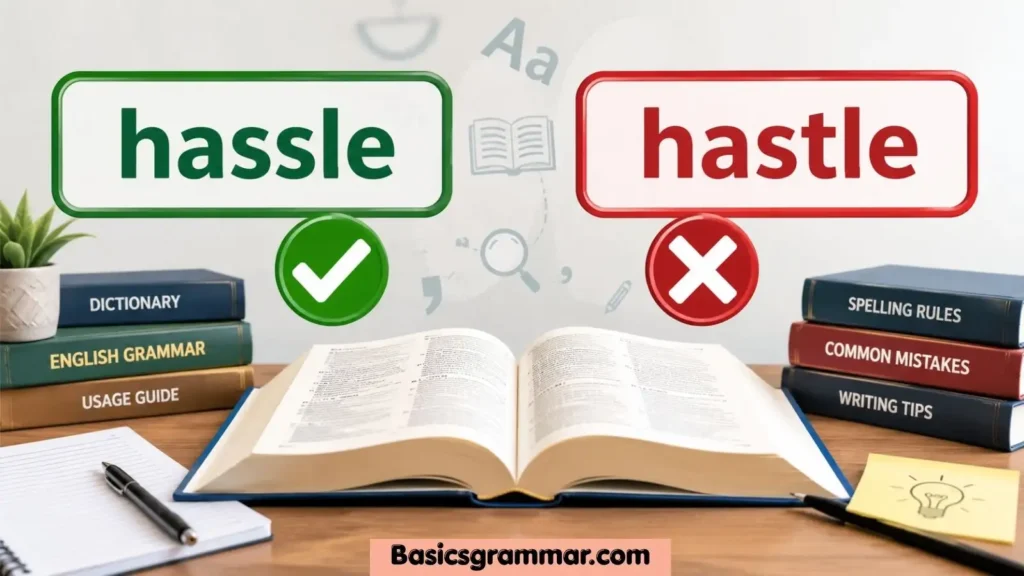
Hassle or hastle is a common spelling question for English learners, students, and everyday writers. The correct spelling is hassle, while hastle is an incorrect spelling in standard English.
The word hassle usually means an annoying problem, difficulty, or situation that causes extra effort. It can also work as a verb when someone causes trouble or makes something unnecessarily difficult. For example, you might say, “I do not want the hassle of returning the product.”
People often write hastle because the pronunciation can make the word seem as if it contains only one s. Fast typing can also cause the extra letter to disappear. Since hassle contains a double s, remembering its spelling can be tricky.
Learning the difference matters because correct spelling improves your English grammar, writing, vocabulary, and communication. A small spelling mistake can also make an email, school assignment, or professional document look less polished.
The good news is simple: hassle is the standard and correct spelling. Hastle is not the spelling you should use in standard English.
Now, let’s look at the meaning, pronunciation, origin, grammar, examples, and common mistakes surrounding hassle or hastle.
Quick Answer
✅ Correct spelling: Hassle
❌ Incorrect spelling: Hastle
Hassle means an annoying problem, difficulty, inconvenience, or unnecessary trouble.
It can function as both a noun and a verb.
Example as a noun:
Traveling without a reservation can be a hassle.
Example as a verb:
The staff should not hassle customers about minor issues.
The spelling hastle does not represent the standard English word hassle.
| Spelling | Correct? | Meaning |
|---|---|---|
| hassle | ✅ Yes | Annoying trouble or difficulty |
| hastle | ❌ No | Incorrect spelling of hassle |
So, whenever you mean trouble, inconvenience, or annoyance, choose hassle.
What Does Hassle Mean?
Hassle describes something that causes annoyance, difficulty, inconvenience, or extra effort.
In everyday English, people often use it when a task feels more difficult than it should.
For example:
Finding parking in the city can be a hassle.
The speaker does not necessarily mean that parking is impossible. Instead, finding a parking space takes extra time and creates frustration.
Hassle as a noun
As a noun, hassle means an annoying situation or difficult task.
Examples include:
- Dealing with paperwork can be a hassle.
- Moving house is often a hassle.
- I do not need the hassle of another repair.
- Online shopping usually saves me the hassle of visiting stores.
You will often see hassle with words such as avoid, deal with, cause, and save.
Hassle as a verb
Hassle can also work as a verb.
As a verb, it means to annoy, bother, or pressure someone.
The salesperson kept hassling me.
Stop hassling your brother.
This meaning focuses on a person rather than a difficult task.
Everyday meaning
In casual conversation, hassle often means trouble or annoyance.
I do not want the hassle.
This sentence means:
I do not want the trouble or inconvenience.
Professional meaning
Businesses also use hassle in less formal communication.
For example:
Our new service makes payment easier and removes the hassle of paperwork.
The word sounds natural in marketing and customer-focused writing. However, formal academic writing may use words such as difficulty, inconvenience, or complication instead.
Real-life examples
- The long checkout line was a hassle.
- We avoided the hassle by booking online.
- Getting a refund became a major hassle.
- Please do not hassle the employees.
- The new system reduces administrative hassles.
Interesting facts
One useful fact about hassle is that it can describe both a problem and an action toward a person.
Compare:
The paperwork is a hassle.
Here, hassle is a noun.
The manager hassled the employee.
Here, hassled is a verb.
Why “Hastle” Is Incorrect
The main reason people write hastle is simple: pronunciation does not always show every letter clearly.
When people say hassle quickly, the double s does not sound like two separate sounds. Therefore, learners sometimes hear the word and write hastle.
However, standard English spells the word:
H-A-S-S-L-E
Not:
H-A-S-T-L-E
Why do people make this spelling mistake?
Several factors can cause the error.
1. Pronunciation confusion
The word hassle sounds roughly like HAS-uhl. The pronunciation does not strongly highlight the second s.
2. Typing mistakes
When people type quickly, they may accidentally leave out one letter.
3. Visual confusion
English contains many words with similar patterns. Writers may unconsciously create a spelling that looks reasonable.
4. Memory mistakes
Someone may remember the pronunciation correctly but fail to remember the exact spelling.
Simple memory trick
Use this easy trick:
Hassle has “SS” for extra Stress.
Think:
Ha + ss + le = hassle
Remember the double s, and you can avoid the common hastle mistake.
Another useful idea is to connect hassle with stress. Both words can describe something annoying or difficult.
Hassle = extra stress or trouble.
Origin and Etymology
The history of hassle is interesting because the word does not come from Latin or Old French in the way many common English words do.
Hassle developed in English as a relatively modern informal word. Its exact early history is not completely certain, but dictionaries generally trace it to American English usage in the 19th century.
The word first appeared as a verb connected with arguing, bothering, or dealing with difficulty. Later, English speakers also used it as a noun for an annoying situation or troublesome task.
Over time, the meaning expanded.
Today, hassle can refer to:
- annoyance
- inconvenience
- trouble
- difficulty
- unwanted effort
- bothering someone
The word became especially common in informal American English and later spread widely through global English.
Unlike some English spelling questions, hassle does not have a British-versus-American spelling difference. Both varieties use hassle.
Pronunciation Guide
The standard pronunciation of hassle is approximately:
HAS-uhl
The first syllable receives the main stress.
US pronunciation
American English commonly pronounces hassle as:
/ˈhæsəl/
UK pronunciation
British English also commonly uses:
/ˈhæsəl/
The pronunciation remains very similar across both varieties.
Syllable breakdown
You can divide the word into two spoken parts:
has-sle
In natural speech, however, it sounds closer to:
HAS-uhl
Common pronunciation mistake
Some learners may pronounce the word as though it were spelled hastle.
That pronunciation can encourage the wrong spelling.
Instead, focus on the sound:
HAS-uhl
Easy pronunciation trick
Say:
has + uhl
Then remember that the written word contains double s:
hassle
Pronunciation and spelling do not always match perfectly in English. That is why visual memory can help.
How the Word Is Used in Modern English
Modern speakers use hassle frequently in informal and everyday communication.
Daily conversation
I do not want the hassle of cooking tonight.
Driving downtown is such a hassle.
Academic writing
In formal academic writing, hassle may sound too casual in some contexts.
Instead of:
Students face the hassle of long registration procedures.
A more formal version could be:
Students face difficulties during the registration process.
Still, hassle can appear in less formal educational writing.
Business writing
Businesses often use hassle when speaking directly to customers.
We make online payments simple and hassle-free.
The expression hassle-free is especially common.
Professional communication
You might see the word in internal messages or casual workplace communication.
Let’s find a simpler process and avoid unnecessary hassle.
Digital communication
Social media and online conversations frequently use hassle because it is short, natural, and conversational.
Returning this item was such a hassle!
No hassle. I can handle it.
The word fits naturally into modern digital communication.
Common Collocations With Hassle
A collocation is a group of words that commonly appear together.
| Common phrase | Meaning |
|---|---|
| avoid the hassle | prevent trouble or inconvenience |
| deal with the hassle | handle an annoying problem |
| a lot of hassle | much trouble or difficulty |
| unnecessary hassle | trouble that could have been avoided |
| save the hassle | prevent someone from dealing with trouble |
| cause a hassle | create difficulty |
| hassle-free | without trouble or inconvenience |
| administrative hassle | difficult paperwork or procedures |
| legal hassle | troublesome legal matters |
| travel hassle | inconvenience during travel |
Examples
Online banking helps me avoid the hassle of visiting a branch.
The new process is hassle-free.
We do not need unnecessary hassle.
This service saves customers a lot of hassle.
These phrases can help you use hassle more naturally.
Difference Between Similar Words
Several words have meanings close to hassle, but they do not always work in the same situations.
Hassle vs Trouble
Hassle usually suggests annoyance or inconvenience.
Trouble has a much broader meaning.
Finding a parking space is a hassle.
The car is having trouble starting.
Hassle vs Inconvenience
Inconvenience sounds more formal.
The delay caused some inconvenience.
The delay was a hassle.
Both sentences work, but the second sounds more conversational.
Hassle vs Annoyance
Annoyance focuses on irritation.
Hassle often includes extra effort or difficulty.
The constant noise was an annoyance.
Dealing with the paperwork was a hassle.
Hassle vs Problem
Problem is a broad term for something that needs attention.
Hassle usually emphasizes the frustration involved.
| Word | Main idea | Example |
|---|---|---|
| Hassle | Annoying difficulty | The paperwork is a hassle. |
| Trouble | Difficulty or problem | We had trouble finding the address. |
| Inconvenience | Disruption or discomfort | The delay caused inconvenience. |
| Annoyance | Something irritating | The noise was an annoyance. |
| Problem | Something that needs solving | We have a technical problem. |
Grammar Rules for Hassle
Hassle can function as both a noun and a verb.
Hassle as a noun
As a noun, hassle can be countable or uncountable depending on the meaning and construction.
For example:
Traveling can be a hassle.
Here, it refers generally to an annoying experience.
It can also appear in the plural:
We faced several hassles during the trip.
Common noun structures
You can use:
- a hassle
- the hassle
- some hassle
- a lot of hassle
- unnecessary hassle
- several hassles
Examples:
It was a hassle.
I want to avoid the hassle.
We had a lot of hassle with the old system.
Hassle as a verb
The verb means to bother, annoy, or pressure someone.
Examples:
Stop hassling me.
Customers should not be hassled unnecessarily.
The verb can take different forms:
| Form | Example |
|---|---|
| Base | hassle |
| Third person | hassles |
| Past | hassled |
| Present participle | hassling |
Notice the spelling of hassling. The final e disappears before -ing.
hassle → hassling
Articles
Use a when referring to one particular hassle:
It was a hassle.
Use the when both people understand which difficulty you mean:
I want to avoid the hassle.
Real Sentence Examples
Daily life
Grocery shopping after work can be a hassle.
I do not want the hassle of changing hotels.
School
Completing the paperwork was a hassle for the students.
The new online system reduces registration hassles.
Workplace
The old system created unnecessary hassle for employees.
We changed the process to avoid the hassle of manual reports.
Books and articles
The character wanted to escape the hassle of city life.
In a story, hassle can help create a natural, conversational voice.
Social media
Moving to a new apartment is such a hassle!
No hassle. I’ll take care of it.
Negative examples
❌ Hastle is the correct spelling.
✅ Hassle is the correct spelling.
❌ I do not want the hastle of returning it.
✅ I do not want the hassle of returning it.
Common Spelling Mistakes
The most common mistake is writing hastle instead of hassle.
❌ Hastle
This spelling is incorrect when you mean the standard English word hassle.
✅ Hassle
This is the correct spelling.
Another mistake occurs when writers forget the second s:
❌ Hasle
✅ Hassle
The word contains ss before le.
Keyboard errors
Typing quickly can cause missing letters. Because the two s letters appear together, writers may accidentally type only one.
Always proofread words that contain repeated letters.
Phonetic confusion
English spelling often does not perfectly match pronunciation. Therefore, spelling a word based only on its sound can produce errors.
For example, the sound of hassle does not clearly tell you that the written form contains two s letters.
Memory trick
Remember:
Hassle has double S.
Or:
Hassle = extra stress.
Both ideas can help you remember the spelling.
Why People Search “Hassle or Hastle”
The search query “hassle or hastle” shows clear spelling and grammar intent.
People usually search this phrase because they want a quick answer before using the word in writing.
Educational intent
Students may want to know which spelling belongs in an assignment.
Grammar correction
English learners may see both versions online and wonder whether both are accepted.
Writing improvement
Bloggers, writers, and professionals often check uncertain spellings before publishing content.
Student searches
Students may search for the correct spelling while completing essays, reports, or language exercises.
Content writer searches
Content writers need accurate spelling because repeated errors can reduce the quality and credibility of published work.
The intent behind this keyword is therefore simple:
Which spelling is correct, and how should I use it?
The answer is hassle.
Real-Life Case Study
Imagine a customer-service employee writing an email.
The employee types:
“We apologize for the hastle caused by the delayed delivery.”
The meaning is understandable, but the spelling error makes the email look less professional.
A corrected version says:
“We apologize for the hassle caused by the delayed delivery.”
The second sentence looks polished and trustworthy.
This small example shows why correct spelling matters in professional communication. A single spelling mistake may not change the meaning, but repeated mistakes can affect how readers judge the writer.
In academic work, a spelling error may also reduce the overall quality of an assignment. Therefore, checking uncertain words before submitting important writing is a useful habit.
Expert Insight
English learners should avoid relying only on pronunciation when learning spelling. English contains many words whose sounds do not reveal their exact written forms.
For hassle, the safest approach is to memorize the spelling pattern:
h-a-s-s-l-e
Then connect it with the meaning of annoyance, trouble, or inconvenience.
A useful language-learning principle is:
Learn words through meaning, spelling, and context together.
This approach makes vocabulary easier to remember because you are not memorizing letters in isolation.
When you learn hassle, also learn common expressions such as:
- hassle-free
- avoid the hassle
- unnecessary hassle
- a lot of hassle
- deal with the hassle
This gives you a stronger understanding of real-world word usage.
Hassle or Hastle: Quick Comparison
| Feature | Hassle | Hastle |
|---|---|---|
| Standard English word | ✅ Yes | ❌ No |
| Correct spelling | ✅ Yes | ❌ No |
| Meaning | Trouble or annoyance | No standard meaning |
| Can be a noun | ✅ Yes | ❌ No |
| Can be a verb | ✅ Yes | ❌ No |
| Used in British English | ✅ Yes | ❌ No |
| Used in American English | ✅ Yes | ❌ No |
| Example | This is a hassle. | Incorrect spelling |
FAQs About Hassle or Hastle
1. Is “hastle” a real English word?
Hastle is not the standard spelling of the word meaning trouble, annoyance, or inconvenience. In normal English writing, use hassle.
2. What is the correct spelling, hassle or hastle?
Hassle is the correct spelling. It contains two s letters.
3. What does hassle mean?
Hassle means an annoying problem, difficulty, inconvenience, or situation that requires extra effort.
The paperwork was a hassle.
4. Is hassle a noun or a verb?
It can be both.
As a noun:
The delay was a hassle.
As a verb:
Stop hassling me.
5. Why do people spell hassle as hastle?
People often make this mistake because the pronunciation does not clearly reveal the double s. Fast typing and memory errors can also cause the mistake.
6. Is hassle used in British English?
Yes. Hassle is used in both British English and American English.
7. Is “hassle-free” correct?
Yes. Hassle-free is a common expression meaning without trouble or inconvenience.
The service provides a hassle-free experience.
8. What is the plural of hassle?
The plural is hassles.
We experienced several hassles during the trip.
9. How can I remember the spelling of hassle?
Remember that hassle has double S:
HAS + S + LE = HASSLE
You can also connect it with the idea of extra stress.
10. What is a simple sentence using hassle?
Finding parking downtown is a hassle.
This sentence uses hassle as a noun to describe an annoying inconvenience.
Conclusion
The answer to hassle or hastle is clear: hassle is the correct spelling, while hastle is an incorrect spelling in standard English. The word hassle can work as both a noun and a verb. As a noun, it means an annoying problem, inconvenience, or difficult task. As a verb, it means to bother, annoy, or pressure someone.
The most common spelling mistake happens because the pronunciation does not clearly show the double s. However, you can avoid this error by remembering the spelling pattern h-a-s-s-l-e. A simple memory trick is to connect hassle with extra stress.
British and American English both use hassle, so you do not need to worry about a regional spelling difference. You can use the word naturally in conversations, emails, business communication, social media, and everyday writing.
When you are unsure, remember one simple rule: If you mean trouble or annoyance, spell it HASSLE—with double S.

Hi, I’m Lily Brown, the voice behind Grammar Meaning! I make grammar simple and easy for everyone. I create helpful content on basicsgrammar.com.