Quick Answer
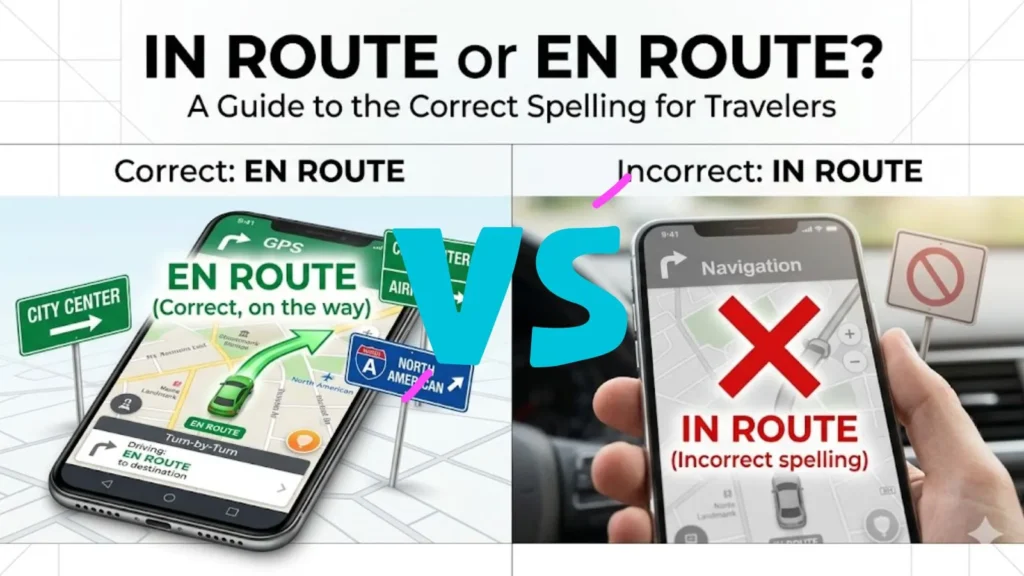
The correct phrase is en route, not in route. En route is a French expression meaning “on the way” or “along the route.” Many people write in route because it sounds similar, but standard English prefers en route in both formal and casual writing. If you mean someone is traveling somewhere, choose en route.
|RELATED: Either or Neither: What’s the Difference and When to Use Each?
Meaning
En route means currently traveling toward a destination. It often describes movement, progress, or something happening during travel.
Examples:
- The package is en route to your house.
- She is en route to the meeting.
- Help is en route after the emergency call.
It can describe people, deliveries, services, or abstract progress.
Why People Misspell
Many writers use in route because it sounds like en route when spoken quickly. English often confuses spelling and sound.
Words like address and success also cause mistakes because of doubled letters or unusual patterns. In this case, the issue is borrowed spelling from French. Fast typing, autocorrect, and hearing the phrase instead of reading it often create the error in route.
Origin & Etymology
The phrase en route comes from French. En means “on” or “in,” and route means road or way.
English adopted en route in the 18th century. Over time, it became common in travel, military, shipping, and everyday speech. Even though it is French in origin, it is now a standard English phrase used worldwide.
British vs American English
Both British and American English use en route. The spelling stays the same in both dialects.
| Meaning | British English | American English |
|---|---|---|
| On the way | en route | en route |
| Incorrect variant | in route | in route |
So no matter where you write, en route is the accepted form.
When to Use
Use en route in many situations:
- Essays: Supplies were en route to the city.
- Emails: I am en route now.
- Work reports: Materials are en route to the warehouse.
- Legal documents: Evidence was en route when delayed.
- Casual writing: Pizza is en route!
It works in both formal and informal settings.
Common Mistakes
| Incorrect | Correct |
|---|---|
| I am in route. | I am en route. |
| Package is in route. | Package is en route. |
| We were inroute. | We were en route. |
| She is on enroute. | She is en route. |
Always keep it as two words: en route.
Everyday Examples
Emails:
- I am en route and should arrive in ten minutes.
Social Media:
Coffee is ordered and I’m en route ☕
Professional Writing:
The shipment is en route to the distribution center.
School Assignments:
The explorers were en route to new lands.
Usage Comparison Table
| Situation | Correct Usage | Incorrect Usage |
|---|---|---|
| Delivery | Your parcel is en route. | Your parcel is in route. |
| Travel | We are en route home. | We are in route home. |
| Emergency | Police are en route. | Police are in route. |
| Daily Speech | I’m en route now. | I’m in route now. |
| Business | Goods are en route overseas. | Goods are in route overseas. |
FAQs
1. Is it in route or en route?
The correct phrase is en route.
2. What does en route mean?
It means “on the way” or traveling toward a place.
3. Is in route ever correct?
It appears in informal use, but standard English prefers en route.
4. Is en route formal?
Yes, but it is also common in casual speech.
5. How do I remember the spelling?
Think of it as a French phrase borrowed into English: en route.
6. Is en route one word?
No, it is two separate words.
7. Can I use en route in emails?
Yes, it is widely accepted in emails and messages.
Conclusion
When choosing in route or en route, always use en route. It is the correct and accepted phrase in British and American English. It means someone or something is on the way.
To remember it, think of travel signs, package tracking, or emergency updates that say en route. Keep it as two words, and you will never go wrong.

Hi, I’m Lily Brown, the voice behind Grammar Meaning! I make grammar simple and easy for everyone. I create helpful content on basicsgrammar.com.