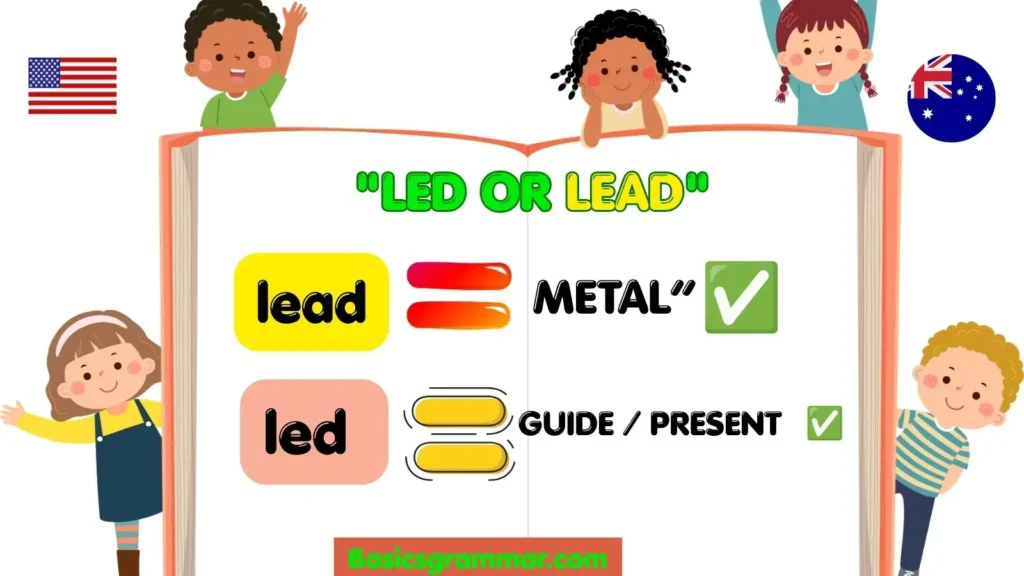
Led or lead is a common English word confusion because these two words can look almost identical while having different meanings and pronunciations. Both are correct words, but choosing the right one depends on the meaning and tense of the sentence.
Lead can function as a verb, noun, or adjective, while led is usually the past tense and past participle of the verb lead. The confusion becomes even greater because lead has two different pronunciations: one rhymes with “need,” while the other rhymes with “red.”
You’ll learn the difference between led and lead, their meanings, pronunciations, synonyms, antonyms, common mistakes, and easy examples. By the end, you’ll know exactly which word to use in your writing.
Led or Lead: Quick Answer
The correct word depends on your sentence.
Lead is the present-tense form of the verb when it means to guide, direct, or be in charge.
Led is the past-tense and past-participle form of lead.
Examples:
- ✅ I lead the team every Monday.
- ✅ She led the team yesterday.
- ❌ She lead the team yesterday.
- ❌ I led the team every Monday. (if you mean present tense)
A simple rule is:
Lead = present
Led = past
However, lead also has other meanings, so context matters.
What Does Lead Mean?
The word lead has several meanings in English.
As a verb, lead means to guide someone, direct a group, or take responsibility for something.
Example:
She will lead the project next month.
Here, lead means guide or manage.
The word can also describe being ahead in a competition:
Our team leads the tournament.
As a noun, lead can mean the position of being ahead.
Our team has a five-point lead.
Synonyms of Lead
Depending on the context, synonyms for lead include:
- guide
- direct
- manage
- control
- command
- supervise
- head
- conduct
These words are not always exact replacements, but they share similar meanings in many situations.
Antonyms of Lead
Possible antonyms include:
- follow
- trail
- obey
- retreat
- surrender
Example:
“She leads the group.”
The opposite idea would be:
“She follows the group.”
What Does Led Mean?
Led is the past tense and past participle of lead when lead means to guide or direct.
For example:
He led the team to victory.
This means he guided or directed the team in the past.
Another example is:
The teacher led the students into the classroom.
The action happened in the past, so led is correct.
More Examples of Led
- She led the meeting yesterday.
- The captain led the players onto the field.
- He led the company for ten years.
- Their coach led them to victory.
- The guide led us through the forest.
In every example, led describes an action that already happened.
Lead vs. Led: Main Difference
The easiest way to understand the difference is to look at tense.
| Word | Meaning | Tense | Example |
|---|---|---|---|
| Lead | Guide or direct | Present | I lead the team. |
| Led | Guided or directed | Past | I led the team yesterday. |
| Lead | Being ahead | Present | Our team leads the game. |
| Lead | A metal | Noun | The pipe contains lead. |
Therefore, lead and led are not interchangeable when you are talking about the verb meaning “to guide.”
Lead as a Verb
When lead functions as a verb, it usually means to guide, direct, or manage.
Examples:
- I lead the marketing team.
- She leads the discussion.
- They lead the organization.
- He will lead the project.
- Our captain leads the team.
Notice that lead can be used in the present tense with different subjects.
For example:
I lead the team.
She leads the team.
They lead the team.
The form changes to leads with third-person singular subjects such as he, she, and it.
Led as a Past-Tense Verb
When the action happened in the past, use led.
Examples:
- She led the meeting yesterday.
- He led the group last year.
- The captain led his team to victory.
- They led the campaign successfully.
- The guide led us to the village.
Using lead instead of led in these sentences would be a common grammatical mistake.
Incorrect:
She lead the meeting yesterday.
Correct:
She led the meeting yesterday.
The word yesterday makes the past tense especially clear.
Why Is Lead So Confusing?
One reason lead causes confusion is that it has two different pronunciations.
When lead means guide or direct, it is pronounced like “leed.”
Example:
I will lead the team.
However, lead can also refer to a chemical element, written lead, and that word is pronounced like “led.”
Example:
The old paint contained lead.
This creates an unusual situation in English because the spelling stays the same while the pronunciation changes.
Lead Meaning the Metal
Lead is also the name of a chemical element. Its chemical symbol is Pb.
In this meaning, lead is pronounced like “led.”
Example:
The pipes were made with lead.
This meaning has nothing to do with the verb lead, even though the spelling is identical.
Examples:
- The scientist tested the sample for lead.
- Old paint may contain lead.
- The workers removed the lead pipes.
- Lead exposure can be dangerous.
Therefore, always consider the context before deciding how to pronounce lead.
Lead or Led in Everyday Sentences
Here are some simple examples that show the difference.
Present:
I lead the team.
The action happens now or regularly.
Past:
I led the team last year.
The action happened in the past.
Future:
I will lead the team tomorrow.
The word returns to lead after “will.”
Perfect tense:
I have led the team before.
Here, led is used as the past participle.
This pattern is useful:
Present: lead
Past: led
Past participle: led
Common Mistakes With Led and Lead
Mistake 1: Using Lead for the Past
❌ She lead the team yesterday.
✅ She led the team yesterday.
Because the action happened yesterday, led is required.
Mistake 2: Using Led for the Present
❌ I led the team every week.
✅ I lead the team every week.
If you are describing a current or regular responsibility, use lead.
Mistake 3: Confusing Lead With Led
❌ He will led the project.
✅ He will lead the project.
After will, use the base form lead, not led.
Mistake 4: Confusing the Metal With the Verb
The manager lead the group.
This sentence may be incorrect depending on the tense.
But:
The pipe contains lead.
Here, lead is the name of the metal.
Easy Trick to Remember Led or Lead
Here is a simple memory trick:
Lead = present
Led = past
You can also remember:
Today I lead. Yesterday I led.
For example:
Today: I lead the team.
Yesterday: I led the team.
This short pattern makes the difference much easier to remember.
Led or Lead: Synonyms and Antonyms
Understanding related words can also strengthen your vocabulary.
Synonyms for Lead
When lead means guide:
- guide
- direct
- manage
- command
- supervise
- head
- control
- conduct
Antonyms for Lead
Depending on context:
- follow
- trail
- obey
- submit
- retreat
Synonyms Related to Led
Because led is the past form of lead, its synonyms depend on the original meaning.
For example:
Led the group → guided the group
Led the company → managed the company
Led the team → directed the team
Led the campaign → headed the campaign
Frequently Asked Questions
Is “led” the past tense of “lead”?
Yes. Led is the past tense and past participle of lead when the verb means to guide or direct.
Is it “lead” or “led” in the past tense?
Use led for the past tense.
Example: She led the team last year.
Is “lead” pronounced like “leed” or “led”?
When it means “guide,” lead is pronounced like “leed.” When it refers to the metal, lead is pronounced like “led.”
What is the difference between lead and led?
Lead is normally the present form of the verb, while led is its past and past-participle form.
Can lead be a noun?
Yes. Lead can be a noun meaning guidance, advantage, or the chemical element lead, depending on context.
What is the past participle of lead?
The past participle of lead is led.
For example:
She has led the company for five years.
Conclusion
The difference between led and lead becomes simple once you understand their grammatical roles. Lead is the present form of the verb meaning to guide, direct, or manage, while led is its past-tense and past-participle form.
Remember the easiest rule: today I lead, but yesterday I led. Also keep in mind that lead can refer to a metal, and that meaning has a different pronunciation.
Whether you are writing an email, article, school assignment, or professional report, choosing lead and led correctly will make your writing clearer and more polished.

Hi, I’m Mark Cole, the voice behind Grammar Meaning! I explain tricky grammar rules in simple ways. I write useful guides on basicsgrammar.com.