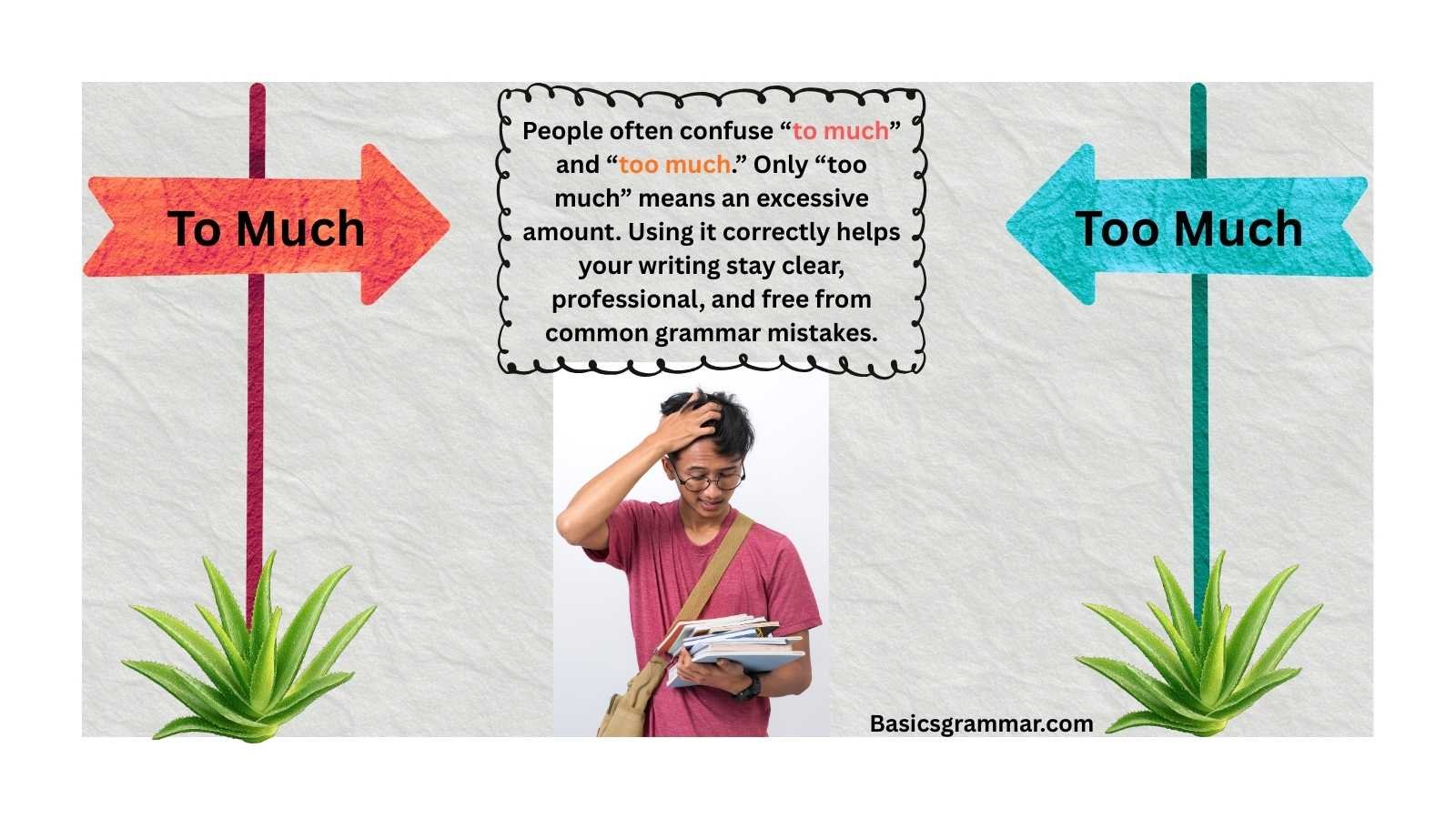
Many people struggle with the difference between “to much” and “too much”. This confusion pops up in everyday writing, emails, social media posts, and even in formal work documents. People often wonder which one is correct and when to use it. The good news? There’s a simple rule to remember. Understanding this distinction will improve your grammar and make your writing clearer.
The confusion arises because “to” and “too” sound exactly the same, but they have different functions. “Too” is an adverb that means excessively or also, while “to” is a preposition that shows direction or purpose. Many searches for “to much or too much” are from students, writers, and professionals who want to avoid embarrassing mistakes. This article explains the difference, gives clear examples, and provides advice for using the correct form in all situations.
To Much or Too Much – Quick Answer
Correct usage: “too much” is correct when you want to say an excessive amount.
- ✅ I ate too much cake.
- ✅ She spends too much time on her phone.
Incorrect usage: “to much” is almost always wrong unless it’s part of a larger structure with “to.”
- ❌ I ate to much cake.
- ❌ He gave the book to much detail. (Correct: “in too much detail”)
Rule: If you are talking about excess, always use “too much”.
The Origin of To Much or Too Much
The word “too” comes from Old English tō meaning in addition or excessively. Over time, it became the standard adverb used to indicate more than necessary.
On the other hand, “to” is a preposition used to indicate direction, recipient, or purpose. The confusion happens because they sound identical (homophones), but their meanings are completely different.
British English vs American English Spelling
Interestingly, the difference between “to much” and “too much” is the same in both British and American English. Both follow the same rule: use “too much” for excess.
| Feature | British English | American English |
|---|---|---|
| Excessive amount | too much | too much |
| Direction / purpose | to the store | to the store |
| Sound | Identical | Identical |
✅ Note: There is no spelling difference here, only the correct context matters.
Which Spelling Should You Use?
- US and UK English: Always use “too much” when describing excess.
- Global English / Commonwealth countries: The rule is the same. Using “to much” in place of “too much” is considered incorrect everywhere.
- Tip: If in doubt, replace “too” with “excessively.” If the sentence still makes sense, you have the right choice.
Common Mistakes with To Much or Too Much
- ❌ I have to much homework. → ✅ I have too much homework.
- Wrong She is to much funny. → ✅ She is too funny.
- ❌ He drinks to much coffee. → ✅ He drinks too much coffee.
- ❌ I want to much chocolate. → ✅ I want too much chocolate.
Tip: Remember: “to” = direction/purpose, “too” = excess.
To Much or Too Much in Everyday Examples
- Email: “I hope I’m not asking for too much help.”
- News headline: “Government spends too much on unnecessary projects.”
- Social media post: “This song is too much fire! 🔥”
- Formal writing: “Providing too much information can overwhelm the reader.”
To Much or Too Much – Google Trends & Usage Data
Search trends show that “too much” is far more popular than “to much”, which is often flagged as a mistake. Countries like the US, UK, Canada, and Australia frequently search this topic, especially among students and ESL learners.
Keyword Variations Comparison Table
| Variation | Correct? | Example |
|---|---|---|
| too much | ✅ Correct | “I have too much work.” |
| to much | ❌ Incorrect | “I have to much work.” |
| to many | ❌ Incorrect | “There are to many people.” |
| too many | ✅ Correct | “There are too many people.” |
FAQs
1. Can I ever use “to much”?
Only if “to” is part of another grammatical structure, like “to a much greater extent.” Otherwise, it’s incorrect.
2. Is “too much” used in both formal and informal writing?
Yes, it’s correct everywhere when referring to excess.
3. How do I remember the difference?
“Too” = excess. “To” = direction or purpose. If you can replace “too” with “excessively,” it’s correct.
4. Is “too much” the same in British and American English?
Yes, the usage rule is identical.
5. Are there similar confusing words?
Yes, like “its vs it’s,” “your vs you’re,” and “then vs than.”
6. Can I use “too much” in social media captions?
Absolutely, it’s common and correct.
7. Does “too much” have a negative connotation?
Not necessarily. It just indicates excess, which can be positive, negative, or neutral depending on context.
Conclusion
Understanding the difference between “to much” and “too much” is simple once you remember the key rule: “too much” always refers to an excessive amount. This applies in American, British, and global English. Mistakes like “to much” are common but easily avoidable with this simple tip: if it shows excess, use too.
Correct usage improves writing in emails, social media, formal documents, and even casual conversations. Remember, direction uses to, excess uses too. Keeping this distinction clear ensures your grammar is professional and your sentences are easy to read.