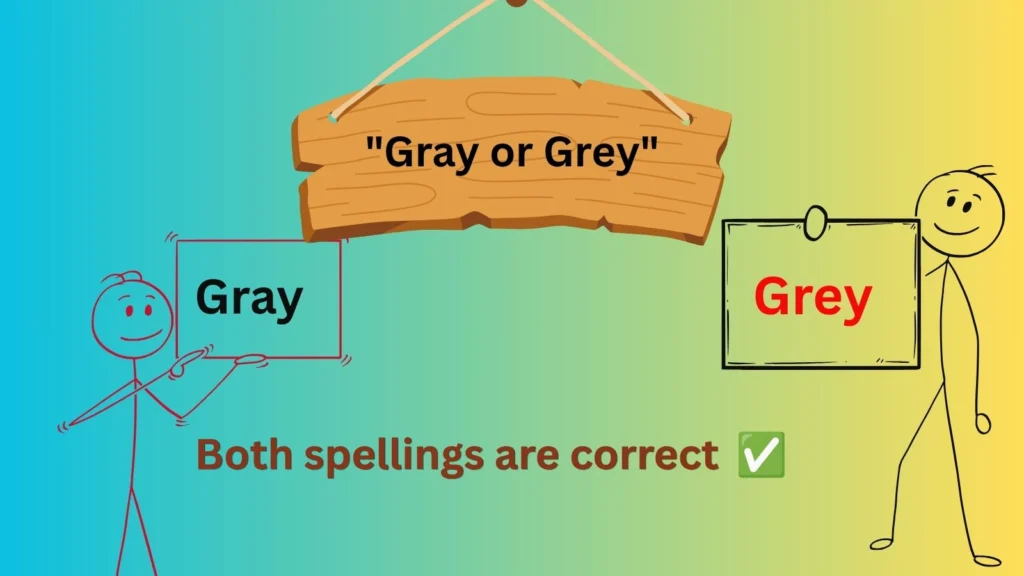
Choosing between The Color Gray or Grey can be confusing, especially when both spellings appear in books, websites, and dictionaries. The good news is that both spellings are correct. The only real difference is where they are commonly used. Understanding this simple rule will help you write with confidence, whether you’re working on an essay, email, business report, or social media post.
Quick Answer – The Color Gray or Grey
The Color Gray or Grey is one of those English spelling differences that depends on the variety of English you’re using.
- ✅ Gray is the preferred spelling in American English.
- ✅ Grey is the preferred spelling in British English and most other English-speaking countries.
Both words describe the same color, so neither spelling is wrong.
Meaning of The Color Gray or Grey
The Color Gray or Grey refers to a neutral color that sits between black and white. It often symbolizes balance, maturity, calmness, uncertainty, or sophistication depending on the context.
Simple examples:
- The sky turned gray before the storm.
- She painted her living room grey for a modern look.
- His gray hair showed years of experience.
- The old stone castle had grey walls.
Although the spelling changes, the meaning never does.
Why People Misspell The Color Gray or Grey
Many writers become confused because they see both gray and grey used online. Unlike spelling mistakes such as adress instead of address or sucess instead of success, gray and grey are both correct spellings.
Common reasons for confusion include:
- Switching between British and American English.
- Reading books from different countries.
- Auto-correct changing the spelling.
- Typing quickly without checking language settings.
The important thing is to stay consistent throughout your writing.
Origin of The Color Gray or Grey
The word comes from the Old English word grǣg, which described the color between black and white. It also shares roots with similar Germanic languages. Linguists connect it to the Proto-Germanic root grēwaz, meaning gray-colored.
Unlike many English words that came from Latin, gray/grey is primarily of Germanic origin rather than Latin. Over time, different English-speaking regions adopted different spellings:
- Gray became standard in America.
- Grey remained standard in Britain and many Commonwealth countries.
British vs American English
The spelling depends on the English style you’re using.
| English Version | Preferred Spelling |
|---|---|
| American English | Gray ✅ |
| British English | Grey ✅ |
| Canadian English | Mostly Grey |
| Australian English | Grey |
| New Zealand English | Grey |
Tip: Stay consistent. Don’t switch between gray and grey in the same document unless you’re quoting someone.
When to Use The Color Gray or Grey
Use the spelling that matches your audience.
| Writing Situation | Recommended Spelling |
|---|---|
| School essays (US) | Gray |
| School essays (UK) | Grey |
| Business reports | Match company style |
| Emails | Use your regional spelling |
| Legal documents | Stay consistent |
| Casual writing | Either, but don’t mix both |
Consistency always looks more professional than switching spellings.
Common Mistakes
Here are mistakes writers often make.
| Incorrect | Correct |
|---|---|
| Mixing gray and grey in one article | Pick one spelling |
| Thinking one spelling is wrong | Both are correct |
| Letting spellcheck randomly change words | Set your language first |
| Using US spelling in UK documents without reason | Match your audience |
Examples
❌ The walls were gray, and the grey sofa matched perfectly.
✅ The walls were gray, and the gray sofa matched perfectly.
✅ The walls were grey, and the grey sofa matched perfectly.
Everyday Examples
Here are common situations where you’ll use The Color Gray or Grey.
Emails
- We selected a gray background for the presentation.
- Please order the grey office chairs.
Social Media
- Loving this gray winter outfit.
- My cat has beautiful grey eyes.
Professional Writing
- The product comes in gray.
- The company offers grey packaging in Europe.
School Assignments
- The elephant’s skin is gray. (US)
- The elephant’s skin is grey. (UK)
Usage Comparison Table
| Situation | Correct | Incorrect |
|---|---|---|
| American report | The car is gray. | The car is grey (if following US style) |
| British report | The car is grey. | The car is gray (if following UK style) |
| Product description | Available in gray or grey depending on region. | Mixing both randomly |
| Daily conversation | Either spelling works in informal writing. | Saying one is always wrong |
Tips to Remember
- Gray = America (both contain the letter A).
- Grey = England (both contain the letter E).
- Choose one spelling and use it consistently.
- Check your document’s language settings before writing.
This simple memory trick helps most people remember the difference.
Frequently Asked Questions
Is gray or grey correct?
Yes. Both spellings are correct. Gray is American English, while grey is British English.
Which spelling is used in the United States?
Americans almost always write gray.
Which spelling is used in Britain?
British English normally uses grey.
Is one spelling more formal?
No. Both are equally formal within their own language variety.
How can I remember the difference?
Remember: Gray has A for America. Grey has E for England.
Can I use both in the same article?
It’s better to choose one spelling and stay consistent.
Does pronunciation change?
No. Both spellings are pronounced exactly the same.
Conclusion
Understanding The Color Gray or Grey is much easier than many English spelling differences. Both spellings describe the same neutral color, but their usage depends on your audience. Gray is standard in American English, while grey is preferred in British English and many Commonwealth countries. The key is consistency. Whether you’re writing school assignments, business emails, legal documents, or social media posts, choose the spelling that matches your readers and use it throughout your work. A simple memory trick—A for America, E for England—can help you remember the difference every time.

Hi, I’m Alex Reed, the voice behind Grammar Meaning! I simplify English grammar into easy lessons. I write for basicsgrammar.com to help you improve daily writing.