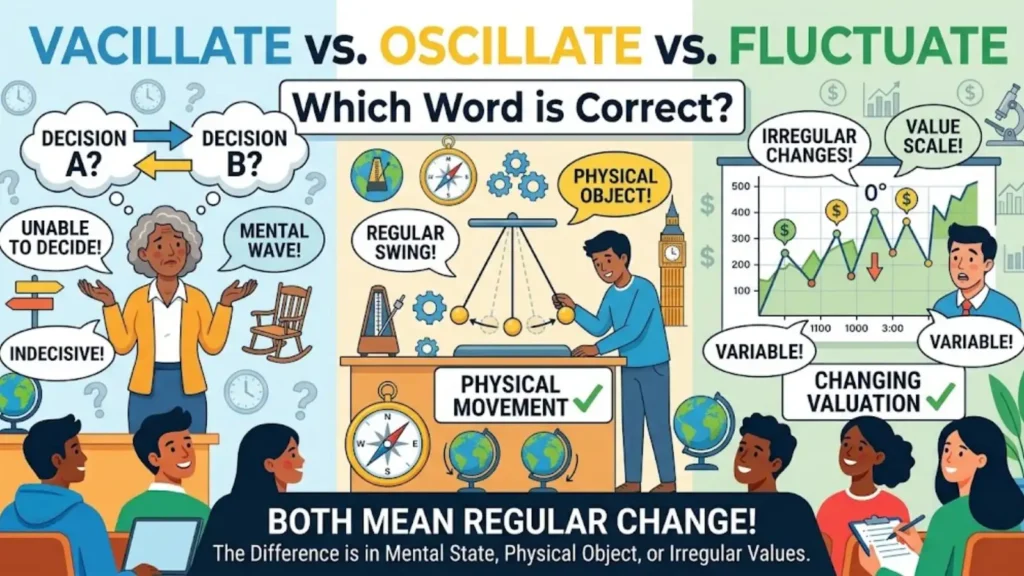
Quick answer: Vacillate means to keep changing your mind, oscillate means to move or switch between two points, and fluctuate means to rise and fall or change often.
Have you ever changed your mind several times before making a simple choice? Maybe you wanted tea, then coffee, and then went back to tea. You were vacillating about your choice. Now imagine a fan moving from left to right again and again. That fan oscillates. If the price of a product goes up one day and falls the next, it fluctuates.
The difference between vacillate vs oscillate vs fluctuate can seem small. All three words describe change, but they describe different kinds of change. Vacillate usually relates to thoughts, choices, or decisions. Oscillate often describes movement between two points or states. Fluctuate describes repeated changes, especially changes in levels, amounts, prices, or numbers.
Related: Sapphire or Saphire – Which Spelling Is Correct and Why It Matters
Pronunciation
Here are the common US and UK pronunciations:
| Word | US Pronunciation | UK Pronunciation |
|---|---|---|
| Vacillate | /ˈvæsəleɪt/ | /ˈvæsɪleɪt/ |
| Oscillate | /ˈɑːsəleɪt/ | /ˈɒsɪleɪt/ |
| Fluctuate | /ˈflʌktʃueɪt/ | /ˈflʌktʃueɪt/ |
The first syllable usually receives the main stress in all three words.
Now let us look at the key differences in simple terms.
Difference Between Vacillate vs Oscillate vs Fluctuate
1. Basic Meaning
Vacillate means to change your mind or decision.
- She vacillated before accepting the job.
- He vacillated between staying and leaving.
Oscillate means to move or switch between two points or states.
- The fan oscillates from side to side.
- Her mood oscillated between calm and anger.
Fluctuate means to change up and down or vary over time.
- Gas prices fluctuate every week.
- His weight fluctuated during the year.
2. Main Idea
The main idea behind vacillate is indecision.
And the main idea behind oscillate is back-and-forth movement.
The main idea behind fluctuate is variation.
For example:
- I vacillated over the decision.
- The pendulum oscillated.
- The temperature fluctuated.
3. Connection With Decisions
Vacillate is strongly connected with choices.
- She vacillated about buying the car.
- He vacillated between two colleges.
Oscillate can describe changing opinions, but movement is more common.
- His opinion oscillated between two views.
- Her support oscillated between the two plans.
Fluctuate is less natural for personal decisions.
- Incorrect: I fluctuated about whether to go.
- Better: I vacillated about whether to go.
4. Connection With Physical Movement
Oscillate is the strongest choice for repeated physical movement.
- The pendulum oscillated steadily.
- The machine oscillates during operation.
Vacillate normally does not describe physical movement.
- Incorrect: The fan vacillated from left to right.
- Better: The fan oscillated from left to right.
Fluctuate can describe physical levels but not usually regular movement from one point to another.
- The water level fluctuated.
- The machine’s speed fluctuated.
5. Connection With Numbers
Fluctuate is very common with numbers.
- Sales fluctuated throughout the year.
- The temperature fluctuated between 10 and 20 degrees.
Oscillate can describe numerical changes when they move between two levels.
- The rate oscillated between 4% and 6%.
- The signal oscillated between two values.
Vacillate is rarely used for numbers.
- Incorrect: The price vacillated.
- Better: The price fluctuated.
6. Emotional Meaning
Vacillate can show uncertainty.
- She vacillated because she felt unsure.
- He vacillated before making a choice.
Oscillate can describe movement between emotional states.
- His mood oscillated between hope and fear.
- She oscillated between excitement and worry.
Fluctuate can describe changing emotional levels.
- His confidence fluctuated during the competition.
- Her energy fluctuated throughout the day.
7. Regularity
Oscillate often suggests a repeated or regular movement.
- The pendulum oscillates back and forth.
- The fan oscillates from side to side.
Fluctuate does not require a regular pattern.
- Food prices fluctuate.
- The weather fluctuated during the week.
Vacillate can happen repeatedly, but the focus remains on indecision.
- He vacillated between the two options.
- She vacillated before giving an answer.
8. Direction of Change
Fluctuate often suggests movement both upward and downward.
- The stock price fluctuated all day.
- The temperature fluctuated between hot and cold.
Oscillate often suggests movement between two positions.
- The signal oscillated between high and low.
- The pendulum oscillated from left to right.
Vacillate often suggests movement between opinions or choices.
- He vacillated between yes and no.
- She vacillated between two careers.
9. Common Subjects
Common subjects for vacillate include:
- people
- voters
- decision-makers
- opinions
- choices
The common subjects for oscillate include:
- fans
- pendulums
- signals
- machines
- opinions
- moods
Common subjects for fluctuate include:
- prices
- temperatures
- rates
- numbers
- income
- demand
10. The Easiest Memory Trick
Remember these three simple ideas:
Vacillate = mind changes.
Oscillate = moves back and forth.
Fluctuate = level changes.
For example:
I vacillated about the job.
The fan oscillated across the room.
The salary fluctuated from month to month.
Nature and Behaviour of Vacillate, Oscillate, and Fluctuate
Vacillate
Vacillate describes uncertainty. A person may have two or more choices but cannot settle on one.
The word often has a slightly negative tone because it can suggest hesitation or a lack of firm decision-making.
For example:
The manager vacillated before choosing a plan.
Oscillate
Oscillate describes movement between two points, positions, conditions, or ideas.
The movement can be physical or abstract. A fan can oscillate physically, while someone’s opinion can oscillate mentally.
For example:
The machine oscillated between two settings.
Fluctuate
Fluctuate describes variation. Something becomes higher, lower, stronger, weaker, or different over time.
It does not always imply a fixed two-point pattern.
For example:
Electricity prices fluctuate during the year.
Why People Get Confused About Vacillate, Oscillate, and Fluctuate
People confuse these words because all three involve change.
They can also describe abstract ideas such as opinions, moods, confidence, and support. This overlap makes them difficult for English learners.
Consider these sentences:
His opinion vacillated between two choices.
His opinion oscillated between two views.
His confidence fluctuated during the contest.
All three sentences describe change, but the focus changes.
Vacillate focuses on uncertainty.
Oscillate focuses on movement between states.
Fluctuate focuses on variation.
Comparison Table
| Feature | Vacillate | Oscillate | Fluctuate |
|---|---|---|---|
| Main meaning | Change one’s mind | Move back and forth | Change or vary |
| Main focus | Indecision | Repeated movement | Variation |
| Physical movement | Rare | Very common | Sometimes |
| Decisions | Very common | Possible | Uncommon |
| Prices | Uncommon | Possible | Very common |
| Numbers | Rare | Possible | Very common |
| Moods | Possible | Common | Common |
| Opinions | Common | Common | Possible |
| Regular movement | Not required | Often | Not required |
| Up-and-down change | Not usually | Sometimes | Very common |
The Origin of Vacillate, Oscillate, and Fluctuate
These three words have Latin roots.
Vacillate comes from the Latin vacillare, meaning to sway, waver, or stagger. Over time, English developed the modern sense of being uncertain or unable to make a firm decision.
Oscillate comes from the Latin oscillare, connected with swinging or moving back and forth. The modern word keeps this basic idea of repeated movement between positions.
Fluctuate comes from the Latin fluctuare, meaning to move like waves or rise and fall. This history fits its modern meaning very well because fluctuating things often move up and down.
Their origins help explain their modern meanings:
- Vacillate → waver
- Oscillate → swing
- Fluctuate → rise and fall
British vs American English
There is little difference between American and British English in the basic meanings of these three words.
The spelling is also the same.
| Word | American English | British English |
|---|---|---|
| Vacillate | vacillate | vacillate |
| Oscillate | oscillate | oscillate |
| Fluctuate | fluctuate | fluctuate |
The main difference is often pronunciation rather than spelling.
For example:
- US: oscillate commonly begins with an “ah” sound.
- UK: oscillate commonly begins with an “o” sound.
However, the meanings remain essentially the same in both forms of English.
Which One Should You Use?
- Use vacillate when someone cannot decide.
She vacillated about accepting the offer.
2. Use oscillate when something moves repeatedly between two points or states.
The fan oscillated from side to side.
3. Use fluctuate when something changes in amount, level, value, or intensity.
The price fluctuated throughout the day.
For US, UK, and global English, these basic distinctions work well. You do not need a different word simply because your audience uses American or British English.
Common Mistakes
Mistake 1: Using “vacillate” for prices
Incorrect:
Food prices vacillate every month.
Correct:
Food prices fluctuate every month.
Mistake 2: Using “fluctuate” for indecision
Incorrect:
She fluctuated about her choice.
Correct:
She vacillated about her choice.
Mistake 3: Using “vacillate” for machine movement
Incorrect:
The fan vacillated from left to right.
Correct:
The fan oscillated from left to right.
Mistake 4: Using “oscillate” for every change
Incorrect:
My salary oscillated after the company changed its policy.
Better:
My salary fluctuated after the company changed its policy.
Mistake 5: Treating all three words as exact synonyms
They are related, but they are not interchangeable in every sentence.
Everyday Usage Examples
In Emails
We are still vacillating between the two plans.
Energy costs may fluctuate this month.
On Social Media
My mood fluctuates when I do not sleep well.
I keep vacillating between two outfits.
In News
Oil prices fluctuated during the week.
The machine’s output oscillated between two levels.
In Formal Writing
The committee vacillated before reaching a decision.
The system oscillated between two operating states.
Demand fluctuated throughout the study period.
Usage Trends
The three words appear in different types of writing.
Fluctuate is common in business, economics, science, finance, weather reports, and everyday discussions about changing levels.
Oscillate is common in science, engineering, technology, and descriptions of physical movement. It can also describe opinions and emotions.
Vacillate is more closely connected with human decisions, uncertainty, and changing opinions.
Therefore, the subject of your sentence often tells you which word you need.
Metaphors and Similes
These words can also create useful figurative images.
Vacillate
He vacillated like a person standing at two open doors.
This suggests that he cannot decide which path to take.
Oscillate
Her feelings oscillated like a pendulum.
This shows repeated movement between two emotional states.
Fluctuate
Prices fluctuated like waves on the sea.
This creates an image of constant rises and falls.
Connotative Meaning
Vacillate
Vacillate often has a slightly negative meaning. It can suggest that someone is unsure or slow to decide.
The leader vacillated over the proposal.
Oscillate
Oscillate is usually neutral. It describes movement without necessarily judging it.
The signal oscillated between two values.
Fluctuate
Fluctuate is also usually neutral.
Temperatures fluctuated during the week.
The emotional meaning depends on the context.
Idioms and Proverbs
There are no major common English idioms built directly around all three words.
However, several familiar expressions communicate similar ideas.
“Change one’s mind” is close to vacillate.
She kept changing her mind about the trip.
“Back and forth” is close to oscillate.
They went back and forth over the issue.
“Ups and downs” is close to fluctuate.
The business had many ups and downs this year.
These expressions can help learners remember the basic differences.
Literature and Movies
Writers often use ideas related to vacillation, oscillation, and fluctuation when they describe changing choices, repeated movement, or unstable conditions.
In literature, vacillation often appears in stories about difficult choices. Shakespeare’s Hamlet, first performed around 1600, is a famous example of a literary work centered on hesitation, doubt, and difficult decisions.
Oscillation is also useful in scientific and technical writing. Writers may use it to describe waves, pendulums, sound, light, and mechanical systems.
In movies, characters may vacillate before making major choices, while visual scenes may show oscillating movement or fluctuating conditions. These ideas appear across many genres, including drama, science fiction, and documentaries.
Why This Difference Matters
Knowing the difference between these words helps English learners communicate more clearly.
Imagine saying:
The price vacillated.
A reader may wonder whether the price was unable to make a decision. That sounds strange because prices do not normally make choices.
Now compare:
The price fluctuated.
The meaning is immediately clear.
Likewise:
The fan oscillated.
This clearly describes movement from one side to another.
Choosing the right word makes writing more precise. It also helps readers understand your intended meaning without guessing.
Usefulness in Daily Life
These words are useful in many everyday situations.
You can use vacillate when talking about:
- choosing a job
- selecting a school
- making a purchase
- changing your opinion
- making a difficult decision
You can use oscillate when talking about:
- fans
- machines
- signals
- waves
- movement
- changing between two states
Fluctuate when talking about:
- prices
- weather
- income
- demand
- energy levels
- temperatures
- interest rates
A simple way to remember them is:
Decision → vacillate
Back and forth → oscillate
Rise and fall → fluctuate
Situational Preference
Choose vacillate when a person cannot settle on a choice or opinion. When choose oscillate when something repeatedly moves between two points, positions, or states. Choose fluctuate when a value, level, amount, or condition changes over time. For example, a student may vacillate between two courses. A fan may oscillate from side to side. A student’s energy may fluctuate during a long day. These choices apply in both American and British English. When you focus on the exact type of change, the correct word becomes easier to select.
FAQs
Is vacillate the same as fluctuate?
No. Vacillate usually means changing your mind or being unable to decide. Fluctuate means changing or varying in level, amount, or condition.
Is oscillate the same as fluctuate?
They can overlap, but they are not always interchangeable. Oscillate often suggests repeated movement between two points, while fluctuate usually means changing or varying over time.
Can a person vacillate?
Yes. A person can vacillate when they cannot make a firm decision.
He vacillated about accepting the offer.
Can prices oscillate?
Yes. Oscillate can describe prices when they repeatedly move between particular levels. However, fluctuate is more common for general price changes.
Can emotions fluctuate?
Yes. Emotions, moods, confidence, and energy can fluctuate.
Her confidence fluctuated throughout the competition.
What is the easiest way to remember the three words?
Remember:
Vacillate = uncertain choice.
Oscillate = back and forth.
Fluctuate = change up and down.
Are these words different in British and American English?
Their meanings and spellings are essentially the same in British and American English. Some pronunciation differences exist.
Conclusion
Understanding vacillate vs oscillate vs fluctuate becomes easier when you focus on the type of change.
Vacillate describes uncertainty. A person may vacillate between two choices because they cannot decide. Oscillate describes repeated movement between points or states. A fan, signal, mood, or opinion can oscillate. Fluctuate describes variation, especially when a level, amount, price, or condition rises and falls.
These words share the general idea of change, but their focus is different. Vacillate is about an uncertain mind. Oscillate is about back-and-forth movement. Fluctuate is about variation over time.
You can use these distinctions in both American and British English. When you learn the common subjects and sentence patterns for each word, choosing the right one becomes much easier.
The simplest rule is worth remembering: vacillate for decisions, oscillate for back-and-forth movement, and fluctuate for changing levels or amounts.

Hi, I’m Alex Reed, the voice behind Grammar Meaning! I simplify English grammar into easy lessons. I write for basicsgrammar.com to help you improve daily writing.