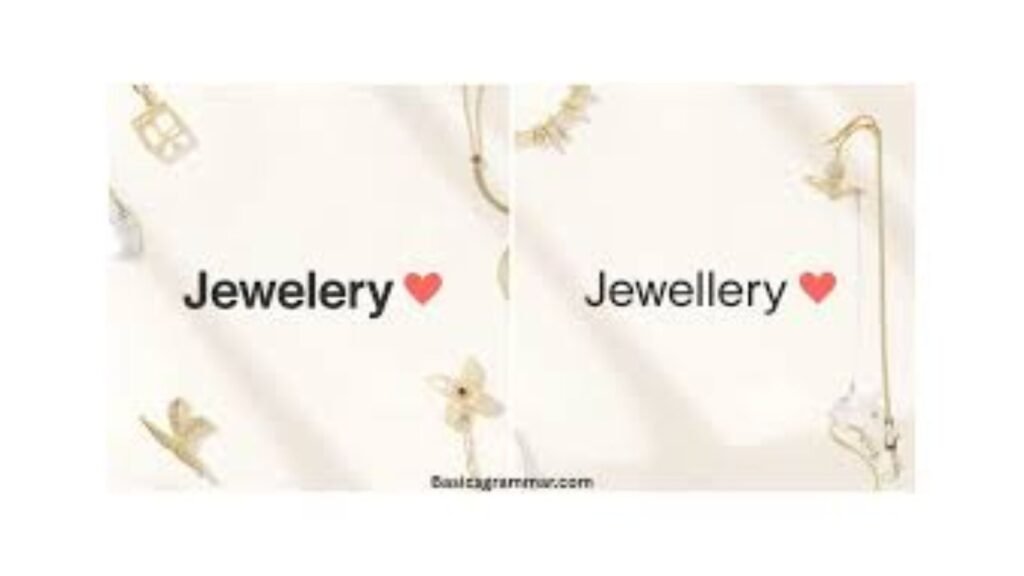
Quick answer: “Jewellery” is the correct spelling in British English, while “jewelery” is incorrect; the American English spelling is “jewelry.”
Your spell checker highlights the word “jewelery” in red when you type it. This word has several regional variations in spelling, which makes it difficult for many people to understand. Additionally, the pronunciation sounds identical, which further facilitates confusion.
|Learn more about: Axe or Ax: Which Spelling Is Correct?
What is the Difference Between Jewelery and Jewellery?
The difference is simple:
- Jewellery → Correct spelling in British English
- Jewelery → Incorrect spelling (common mistake)
There is also another correct version:
- Jewelry → Correct spelling in American English
So, if you’re writing for a British or international audience, use “jewellery.” If your audience is American, use “jewelry.” The spelling “jewelery” is not correct in standard English.
Jewelery vs Jewellery – Quick Answer
Correct spelling: Jewellery
Incorrect spelling: Jewelery
“Jewellery” is the correct form in British English.
“Jewelry” (note: different spelling) is correct in American English.
Examples:
- ✅ She bought beautiful jewellery in London.
- ✅ He sells gold jewelry in New York.
- ❌ She bought expensive jewelery (incorrect spelling).
When to Use Jewellery
Jewellery refers to decorative items people wear, such as rings, necklaces, bracelets, and earrings. These items are usually made from precious metals like gold or silver and may include gemstones.
It is the standard spelling in British English and is widely used in countries like the UK, Pakistan, India, and Australia.
Examples:
- She bought beautiful jewellery for her wedding.
- This shop sells handmade jewellery.
- He gifted her a piece of gold jewellery.
- Traditional jewellery is popular at cultural events.
Origin:
The word comes from the Old French word “jouel,” meaning plaything or ornament. Over time, it evolved into “jewel,” and then “jewellery” in British English.
When to Use Jewelery
“Jewelery” is not a correct spelling.
People often use it by mistake because:
- It looks like a simpler version of the word
- The pronunciation does not clearly show the double “l”
- Typing habits or lack of awareness
However, in formal writing, exams, blogs, or professional content, you should avoid this spelling.
The Origin of Jewelery vs Jewellery
The word comes from the Old French word jouel, meaning “plaything” or “ornament.” Over time, it entered English as “jewel.”
Later, different regions changed the spelling:
- British English added extra letters, forming jewellery
- American English simplified it to jewelry
However, “jewelery” is not part of this evolution. It is simply a common spelling mistake caused by confusion.
British English vs American English Spelling
English spelling often changes by region. This is the case here too.
| Version | Correct Spelling | Region | Example Sentence |
|---|---|---|---|
| British English | Jewellery | UK, Pakistan, India | She designs handmade jewellery. |
| American English | Jewelry | USA | He owns a jewelry store. |
| Incorrect Form | Jewelery | None | ❌ Not correct |
Key rule:
- Use jewellery in British-style writing
- Use jewelry in American-style writing
Pronunciation Guide
Jewellery pronunciation:
👉 joo-uhl-ree
Common mistakes:
- Saying it too fast and skipping the middle sound
- Pronouncing it as “jool-ree”
Take your time and clearly say all parts: joo + uhl + ree
Trick to Remember the Difference
Tip:
👉 “Jewellery has double ‘l’ and double ‘e’ – just like it has many small pieces.”
Another trick:
Think of British words like “travelling” (double “l”).
So, “jewellery” follows the same British pattern.
FAQs
1. Is “jewelery” correct?
No, “jewelery” is a misspelling and not accepted in standard English.
2. Is “jewellery” correct?
Yes, it is the correct British English spelling.
3. Why do people confuse them?
Because of pronunciation and different English spelling rules (British vs American).
4. How do you remember the correct spelling?
Remember that British English often uses double letters, like in “jewellery.”
5. Can both be used in English?
Only “jewellery” (British) and “jewelry” (American) are correct. “Jewelery” is not correct.
|RELATED: Everyday vs Every Day: Simple Guide to Use Them Correctly
Summary
The correct spelling in British English is “jewellery.”
It means decorative items like rings, necklaces, and bracelets.
The spelling “jewelery” is incorrect and should be avoided.
American English uses “jewelry,” which is also correct in its region.