Have you ever seen “Yeah or nay” and wondered whether it is correct? You are not alone. The phrase looks simple, but it can create confusion because yeah, yea, yay, and nay sound similar while having different meanings.
People often search for “Yeah or Nay” when they want to know whether they should write yeah or nay, yea or nay, or simply yes or no. The confusion becomes even greater in emails, social media posts, voting discussions, and informal conversations.
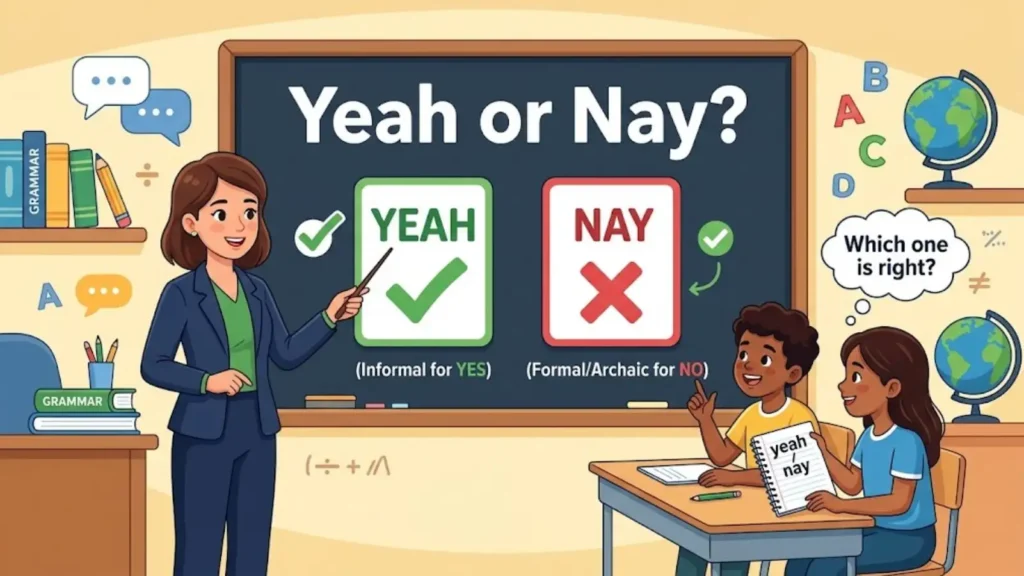
The key point is simple: “yea or nay” is the traditional expression meaning “yes or no.” Here, yea means an affirmative answer or vote, while nay means a negative answer or vote. “Yeah” is different. It is an informal form of yes and is common in everyday speech.
Understanding this small difference can help you choose the right expression for your audience and situation.
Yeah or Nay – Quick Answer
If you mean “yes or no,” the standard phrase is “yea or nay,” not “yeah or nay.”
- Yea = yes, agreement, or an affirmative vote
- Nay = no, disagreement, or a negative vote
- Yeah = informal yes
- Yay = an expression of happiness or excitement
Example:
“The committee must decide yea or nay.”
This means:
“The committee must decide yes or no.”
In modern English, yea and nay are especially associated with voting, formal decisions, and traditional language.
However, yeah or nay may appear informally when someone uses yeah as a casual version of yes. If you are specifically using the established expression, yea or nay is the conventional form.
Quick comparison
| Word | Meaning | Example |
|---|---|---|
| Yea | Yes; affirmative vote | “I vote yea.” |
| Nay | No; negative vote | “I vote nay.” |
| Yeah | Informal yes | “Yeah, I agree.” |
| Yay | Excitement or happiness | “Yay! We won!” |
| Yes | Standard affirmative answer | “Yes, I agree.” |
| No | Standard negative answer | “No, I disagree.” |
The Origin of Yeah or Nay
The history becomes clearer when we separate yeah from yea.
Where Does “Yea” Come From?
Yea is an old English word meaning yes or indeed. Its history goes back to Old English gēa and related Germanic forms. Merriam-Webster and other dictionary sources record yea as a very old English word.
Over time, yea became strongly connected with formal agreement and voting.
For example:
“The members voted yea.”
This means that the members voted in favor.
The noun form is also common in voting:
“There were 35 yeas and 12 nays.”
Where Does “Nay” Come From?
Nay is also an old word. It developed through Middle English from older Germanic forms and became a word meaning no or not. Its historical development is different from yea, although the two words eventually became a familiar pair.
Today, nay is much less common in ordinary conversation than no.
Where Does “Yeah” Come From?
Yeah developed as an informal spoken form of yes. It is now extremely common in casual English.
For example:
“Yeah, I’ll call you later.”
This is completely natural in conversation.
But it does not replace yea in traditional voting terminology.
Why Do the Spellings Cause Confusion?
The main problem is pronunciation.
Yea and yay are pronounced alike, while yeah sounds very similar in many accents. Yet their meanings are different.
Think of them this way:
Yea = yes
Yeah = casual yes
Yay = excitement
Nay = no
That simple distinction prevents most mistakes.
British English vs American English Spelling
There is no major British-versus-American spelling difference between yea and nay. Both varieties of English recognize these traditional forms.
The bigger difference is frequency and context.
In American English, yea and nay are strongly associated with formal voting, including legislative votes. In British English, the words are also understood and can appear in formal, historical, literary, or voting contexts.
Neither variety changes yea into a different spelling such as yeeh or yeah when referring specifically to an affirmative vote.
| Feature | British English | American English |
|---|---|---|
| Yea | Used in formal/traditional contexts | Used especially in formal voting |
| Nay | Used in formal/traditional contexts | Used especially in formal voting |
| Yeah | Informal “yes” | Informal “yes” |
| Yay | Excitement or celebration | Excitement or celebration |
| Yes or no | Most natural general choice | Most natural general choice |
| Yea or nay | Formal or traditional | Formal or voting-related |
So, this is not really a British-versus-American spelling issue. The important difference is the meaning and tone of each word.
Which Spelling Should You Use?
Your choice depends more on context than on nationality.
For a US Audience
Use yea or nay when discussing:
- Formal voting
- Government decisions
- Committee decisions
- Motions
- Legislative proceedings
- Traditional voting language
Example:
“The proposal received 48 yeas and 17 nays.”
For everyday American English, yes or no is usually more natural.
For UK and Commonwealth Audiences
The same principle applies.
Use yea or nay when the formal or traditional tone fits the context.
For ordinary communication, use:
“Please give me a yes or no answer.”
For a Global Audience
If your readers include people who are learning English, yes or no is usually the clearest choice.
For example:
“Please tell us yes or no.”
This is easier to understand than:
“Please give us a yea or nay.”
Use yea or nay when the phrase itself is relevant or when you want a formal, traditional tone.
Common Mistakes with Yeah or Nay
1. Writing “Yeah or Nay” for Formal Voting
Less precise:
“The council voted yeah or nay.”
Better:
“The council voted yea or nay.”
Yeah means informal yes, while yea is the traditional affirmative voting term.
2. Confusing “Yea” With “Yay”
These words sound the same but mean different things.
Yea:
“She voted yea.”
Yay:
“Yay! We finished the project!”
The first expresses agreement. The second expresses excitement.
3. Using “Yea” Instead of “Yeah” in Casual Speech
This can sound old-fashioned.
Unusual:
“Yea, I’ll meet you at seven.”
Natural:
“Yeah, I’ll meet you at seven.”
Use yeah when you are representing casual speech.
4. Assuming “Nay” Means “Never”
Nay usually means no, especially in older or formal language.
It is not simply another spelling of never.
5. Writing “Ye or Nay”
Historical texts may contain older forms, but yea or nay is the standard modern expression when you mean yes or no.
Yeah or Nay in Everyday Examples
The expression can appear in several types of writing, but its tone changes depending on the setting.
In Emails
Formal:
“Please let me know with a simple yea or nay.”
More natural for most business emails:
“Please let me know with a simple yes or no.”
The second version is clearer and more modern.
In News Writing
News reports about votes may use yeas and nays:
“The measure passed with 62 yeas and 38 nays.”
This works well because the words identify affirmative and negative votes.
In Social Media
People sometimes use the phrase playfully:
“New design idea: yea or nay?”
This is understandable and gives the post a slightly dramatic or humorous tone.
A more casual version would be:
“New design: yes or no?”
In Formal Writing
In a formal voting context:
“Members were asked to vote yea or nay on the motion.”
Here, yea or nay fits naturally.
In Everyday Conversation
Most people would simply say:
“Do you want to go, yes or no?”
or:
“Are you coming or not?”
Using yea or nay in casual conversation can sound deliberately formal, old-fashioned, or humorous.
Yeah or Nay – Google Trends & Usage Data
Search interest around “Yeah or Nay” is difficult to interpret as a simple spelling contest because the phrase overlaps with several different searches.
People may search for:
- “yea or nay meaning”
- “yeah or nay meaning”
- “yea vs yeah”
- “yea or nay”
- “yay or nay”
- “yea vs yay”
- “yes or no”
The important distinction is that search popularity does not automatically show which form is grammatically correct.
Modern English overwhelmingly uses yes and no in ordinary communication. Yea and nay survive mainly in formal voting, traditional language, historical writing, and playful uses. Dictionary sources likewise identify yea as an old or formal affirmative term and nay as its negative counterpart.
There is also no meaningful British-versus-American spelling split for yea and nay. Their usage differences are mainly related to context and register, rather than spelling rules.
Usage comparison
| Form | Main context | Modern frequency |
|---|---|---|
| Yes or no | Everyday English | Very common |
| Yeah | Casual conversation | Very common |
| Yea or nay | Voting/formal language | Less common |
| Yea | Formal vote | Less common |
| Nay | Formal vote/traditional language | Less common |
| Yay | Excitement | Common |
Because Google Trends can change by date, country, and search wording, individual search queries should be interpreted carefully rather than treated as direct evidence of grammatical correctness.
Comparison Table: Yeah, Yea, Yay, and Nay
| Word/Phrase | Meaning | Correct Use | Example |
|---|---|---|---|
| Yeah | Informal yes | Casual speech | “Yeah, that’s fine.” |
| Yea | Yes; affirmative vote | Formal/traditional voting | “I vote yea.” |
| Yay | Excitement | Celebration | “Yay! We won!” |
| Nay | No; negative vote | Formal/traditional voting | “I vote nay.” |
| Yea or nay | Yes or no | Decisions/voting | “Yea or nay?” |
| Yes or no | Affirmative or negative | General English | “Yes or no?” |
The easiest memory trick is:
Yea = yes
Nay = no
Yay = excitement
Yeah = casual yes
FAQs About Yeah or Nay
1. Is “yeah or nay” correct?
It can be understood, especially as an informal combination of yeah and nay. However, the established expression meaning yes or no is “yea or nay.”
2. What does “yea or nay” mean?
Yea or nay means yes or no. It is especially associated with voting, formal decisions, and traditional language.
3. Is “yea” the same as “yeah”?
No. Yea is traditionally an affirmative response or vote. Yeah is an informal form of yes used in ordinary conversation.
4. Is “yea” the same as “yay”?
No. Yea means yes or an affirmative vote. Yay expresses happiness, excitement, or celebration.
5. Is “nay” the opposite of “yea”?
Yes. In voting language, yea means an affirmative vote, while nay means a negative vote.
6. Should I use “yea or nay” in an email?
You can use it when discussing a formal decision or when a traditional tone fits. For most modern business emails, “yes or no” is clearer.
7. Is “yea or nay” British or American English?
It is used in both British and American English. It is not a special spelling difference between the two varieties.
Conclusion
The phrase “Yeah or Nay” causes confusion because several English words sound alike but serve different purposes. The most important distinction is between yeah and yea.
Yeah is an informal way to say yes. You will commonly hear it in conversations, text messages, and casual writing. Yea, on the other hand, is an older and more formal word meaning yes, especially an affirmative vote. Nay means no or a negative vote. Together, yea or nay means yes or no.
For formal voting, committees, legislative discussions, and traditional writing, yea or nay is the established expression. For everyday communication, yes or no is usually clearer. If you want to show excitement, use yay, not yea.
So, remember the simple rule: yea means yes, nay means no, yeah means casual yes, and yay expresses excitement. Choosing the right form makes your writing clearer and helps you avoid one of English’s most common sound-alike confusions.

Hi, I’m Mark Cole, the voice behind Grammar Meaning! I explain tricky grammar rules in simple ways. I write useful guides on basicsgrammar.com.