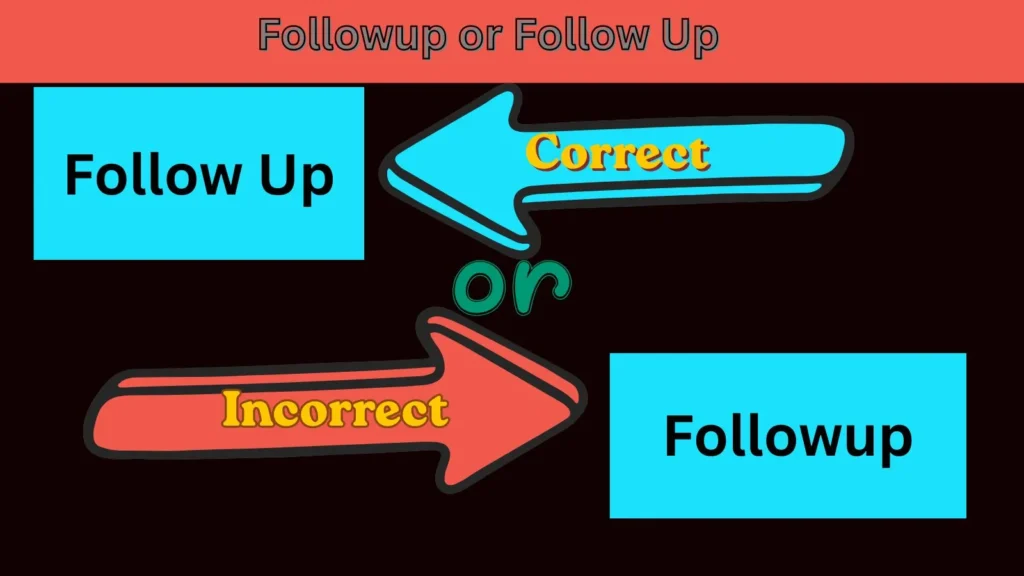
I remember stopping mid-sentence and wondering, “Is it followup or follow up?” It looked like a small detail, but something about it didn’t feel right. A quick grammar check cleared the confusion and saved the sentence.
If you’re searching for followup or follow up, you’re definitely not alone. These forms look similar, but they are used differently in writing. “Follow up” is usually a verb or phrase, while “follow-up” is often used as a noun or adjective.
This small distinction matters more than it seems. Using the wrong form can make your writing look less polished or professional. In this guide, I’ll break down the correct usage so you can write with clarity and confidence every time.
|RELATED: Donut or Doughnut: Is It Donut or Doughnut?
Followup or Follow Up – Quick Answer
✘ Followup → incorrect in formal writing
✅ Follow up → verb (an action)
✔ Follow-up → noun or adjective (a thing or description)
Follow up is used as a verb or phrase when talking about taking action again or checking something later, while follow-up is commonly used as a noun or adjective.
Examples:
- ✅ I will follow up with the client tomorrow.
- ❌ I will followup with the client tomorrow.
- ✅ This is a follow-up meeting after the interview.
- ❌ This is a followup meeting after the interview.
Rule of Thumb: If you can replace it with “check” or “pursue,” use follow up. If it is naming the action itself, use followup.
The Origin of Follow up
The term follow up comes from the English verb “follow,” meaning to pursue or continue, combined with “up,” emphasizing completion. Over time, in professional writing, the noun form followup evolved to describe the act or event of following up.
The one-word form started appearing in business, medical, and educational contexts in the 20th century. The two-word form remains the standard verb structure, while the single word became widely accepted in official documents, emails, and reports.
British English vs American English Spelling
| Form | Usage | Region | Example |
|---|---|---|---|
| Follow up | Verb | UK & US | I will follow up on your application. |
| Followup | Noun/Adj | US (common in business), UK (less formal) | Schedule a followup call. |
| Follow-up | Hyphenated | UK (preferred for noun/adjective) | The team had a follow-up meeting. |
Key Difference:
US English often prefers followup for nouns and adjectives.
British English commonly uses follow-up for clarity.
The verb form follow up is universal.
Which Spelling Should You Use?
You should use “follow up” or “follow-up” depending on how it is used in a sentence. In most cases, “follow up” is used as a verb, while “follow-up” is used as a noun or adjective.
Using the correct form improves clarity and makes your writing look more professional and grammatically accurate. The single-word form “followup” is generally not correct in standard English writing.
Examples:
- I will follow up with you tomorrow.
- This is a follow-up email after the interview.
- Please follow up on the report today.
Common Mistakes with Followup
Writing followup as a verb
❌ Wrong: I will followup the email.
✅ Correct: I will follow up the email.
Using follow up as a noun without context
❌ Wrong: Schedule a follow up tomorrow.
✅ Correct: Schedule a follow-up tomorrow.
Forgetting the hyphen in British English noun usage
❌ Wrong: The doctor asked for a followup.
✅ Correct: The doctor asked for a follow-up.
Followup in Everyday Examples
Emails:
- Verb: Please follow up on the client’s request.
- Noun: Let’s schedule a followup meeting next week.
|See also: Then or Than – What’s the Difference
News & Articles:
- Verb: The reporter will follow up on the story.
- Noun: A follow-up report will be published tomorrow.
Social Media:
- Verb: Don’t forget to follow up with comments.
- Noun: The follow-up thread provides extra tips.
Formal Writing:
- Verb: We will follow up with additional data.
- Noun: The follow-up procedure ensures compliance.
Followup – Google Trends & Usage Data
According to Google Trends:
- Follow up is searched more often than followup, especially in the US and UK.
- Noun form followup gains popularity in professional and medical contexts.
- Usage spikes in job application and business communication periods.
Keyword Variations Comparison Table
| Form | Part of Speech | Example | Region |
|---|---|---|---|
| Follow up | Verb | I will follow up with HR. | US/UK |
| Followup | Noun/Adjective | Schedule a followup session. | US |
| Follow-up | Noun/Adjective | The doctor requested a follow-up appointment. | UK |
FAQs
1. Can I use “followup” as a verb?
No. Use follow up for verbs. Example: I will follow up on your message.
2. Is “follow-up” correct in American English?
Yes, it is correct but less common. US style prefers followup for nouns/adjectives.
3. How do I remember the difference?
Think: Verb → two words. Noun/Adjective → one word (US) or hyphenated (UK).
4. Can “follow up” start a sentence?
Yes. Example: Follow up promptly to avoid delays.
5. Should I hyphenate “follow-up” in professional emails?
Yes, especially in UK English, for clarity when using it as a noun/adjective.
6. Is “follow-up meeting” correct?
Yes. Hyphenate for British English or US formal writing.
7. Are “follow-up” and “followup” interchangeable?
Mostly, yes, but follow your regional style guide for consistency.
Conclusion
Knowing whether to write followup or follow up improves clarity in emails, reports, and social media. Remember the simple rule: verbs are always follow up (two words). Nouns and adjectives can be followup in American English and follow-up in British English. Use the correct form depending on your audience to appear professional and avoid confusion.
With practice, spotting the difference becomes intuitive, ensuring your communication is polished and error-free. Always proofread, and when writing globally, default to follow up for verbs and follow-up for nouns/adjectives.

Hi, I’m John Miles, the voice behind Grammar Meaning! I share clear and practical grammar tips. You’ll find my work on basicsgrammar.com.