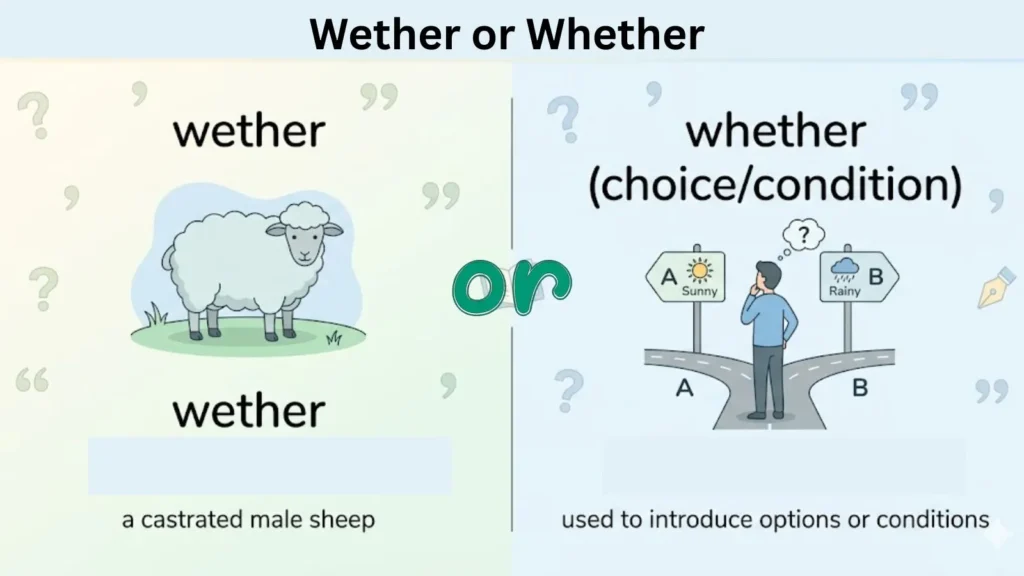
Wether or whether is a common spelling confusion in English writing. Many learners and writers mix these words because they sound similar but have different meanings.
Understanding the correct usage improves grammar accuracy and communication clarity.
|See also: Spicey or Spicy – Which Spelling Is Correct?
Wether or Whether – Quick Answer
Correct in writing: whether✅
Incorrect: wether❌
Examples:
- ✅ I don’t know whether it will rain today.
- ❌ I don’t know wether it will rain today.
According to standard English grammar rules and dictionary definitions, “whether” is the correct form when expressing a choice or condition.
|RELATED: One in the Same or One and the Same: Which is Correct?
Tip:
If you’re talking about choices or possibilities, always use whether.
The Origin of Wether or Whether
The word whether comes from Old English hwæðer, meaning “which of two.” It has been used for centuries in English writing to indicate choice or doubt.
Wether, on the other hand, comes from Old English wether, specifically referring to a castrated male sheep. The similarity in pronunciation has caused confusion over time, but their meanings have always been very different.
British English vs American English Spelling
Interestingly, “whether” is the same in both British and American English
Similarly, “wether” remains unchanged across English varieties, but it is rarely used except in farming or livestock contexts.
| Word | Meaning | British English | American English | Usage Frequency |
|---|---|---|---|---|
| whether | Expressing alternatives/choices | ✓ | ✓ | Very High |
| wether | Castrated male sheep | ✓ | ✓ | Rare |
Tip:
Confusion mostly occurs due to typing errors or autocorrect, not regional spelling differences.
Which Spelling Should You Use?
You should always use “whether” when talking about choices, conditions, or possibilities in English writing. It is the standard and correct form accepted in both British and American English. Using the correct spelling improves clarity and professionalism in your content.
Examples:
- I am not sure whether I should join the meeting today.
- She asked whether he would come to the party.
- Tell me whether you like tea or coffee.
Global advice: For UK, US, and Commonwealth countries, stick with whether in non-agricultural writing.
Common Mistakes with Wether or Whether
❌Incorrect: “I’m not sure wether I can come.”
✅Correct: “I’m not sure whether I can come.”
Confusing wether with weather: “Check the wether forecast.” → should be weather.
Using whether for sheep contexts: “The whether ran in the field.” → should be wether.
Tip: If it’s about choice, possibility, or condition → whether.
Wether or Whether in Everyday Examples
Email:
“Please let me know whether you can attend the meeting.”
News:
“It’s unclear whether the policy will pass.”
Social Media:
“I can’t decide whether to try the new app.”
Formal Writing:
“The study examined whether the new method improved results.”
Example of wether: “The farm had ten wethers grazing in the pasture.”
Wether or Whether – Google Trends & Usage Data
- Searches for whether are consistently higher than wether, showing widespread confusion or interest.
- Top countries searching for whether include the US, UK, India, and Canada.
- Wether searches spike mostly in agricultural contexts or educational queries about spelling.
Insight:
Most users search to clarify correct spelling in writing, not farming.
Comparison Table
| Feature | Whether | Wether |
|---|---|---|
| Meaning | Choice, alternative, possibility | Castrated male sheep |
| Pronunciation | /ˈwɛðər/ | /ˈwɛðər/ |
| Usage Frequency | Very High | Rare |
| Context | Writing, speaking, formal | Farming, agricultural |
| Correct in Emails | ✅ | ❌ |
FAQs
1. Can I use “wether” instead of “whether”?
No, unless you are literally referring to a male sheep.
|See also: Spicey or Spicy – Which Spelling Is Correct?
2. Is “whether or not” correct?
Yes, it is correct and commonly used to indicate two possibilities.
3. Why do people confuse wether and whether?
They sound identical but have very different meanings; pronunciation causes typing errors.
4. Is this confusion common in American or British English?
It is common in both; the difference is universal, not regional.
5. Can “wether” ever mean something else?
No, it specifically refers to a castrated male sheep.
6. How can I remember the difference?
Think: whether = choice/possibility, wether = sheep.
7. Is “whether” formal or informal?
It is suitable for all types of writing, including formal, professional, and academic contexts.
Conclusion
Understanding wether or whether is simple once you know the difference. Whether deals with choices, alternatives, or possibilities, and is the correct choice in almost all writing situations. Wether refers only to a castrated male sheep and is rarely used outside farming.
Remembering the difference will make your writing more professional and reduce embarrassing mistakes. When in doubt, ask yourself: am I talking about a choice or a sheep? If it’s a choice → whether. Following this guide will ensure your writing is accurate, clear, and suitable for both British and American audiences.