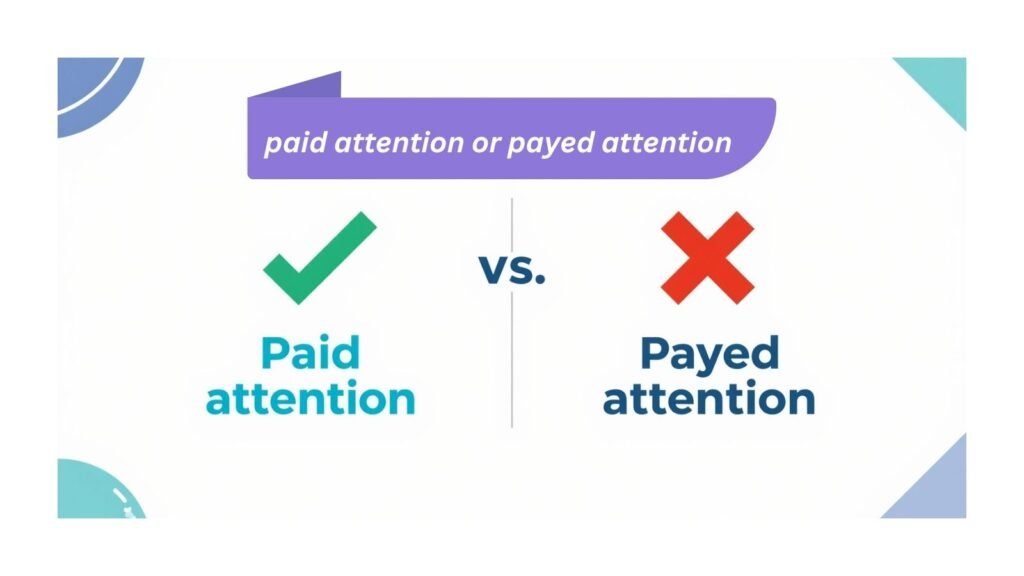
Many writers confuse paid attention or payed attention because both forms appear similar. Understanding past tense verbs, English grammar rules, irregular verbs, correct word usage, and common writing mistakes helps you choose the proper expression.
Using the correct phrase improves clarity, strengthens professional communication, and ensures your writing follows standard English conventions.
What Does “Paid Attention” Mean?
The expression paid attention means carefully noticing, listening to, or focusing on something.
Examples
- She paid attention during the lecture.
- The driver paid attention to the road signs.
- Students who paid attention understood the lesson better.
In normal English, payed attention is incorrect.
Paid Attention vs Payed Attention
Correct: Paid Attention ✅
Use paid as the past tense of pay when talking about money, effort, respect, or attention.
- I paid attention to the instructions.
- They paid the bill on time.
- He paid close attention to every detail.
Rare Exception: Payed ⚓
The word payed is a specialized nautical term meaning to let out rope, cable, or line.
SEE LEARN MORE: Bleached or unbleached flour
Example:
- The sailors payed out the anchor rope.
Outside maritime contexts, paid is the correct spelling.
British English vs American English
Unlike words such as colour/color or organise/organize, there is no regional difference between paid and payed.
| American English | British English |
|---|---|
| paid attention ✅ | paid attention ✅ |
| payed attention ❌ | payed attention ❌ |
Both varieties of English use paid attention.
How Spell Checkers Handle the Phrase
Most spell checkers recognize both paid and payed because payed is technically a valid word.
However:
- When writing about focus or concentration, grammar tools usually recommend paid attention.
- If your sentence discusses ships or ropes, payed may be accepted.
Always review context rather than relying only on automatic corrections.
Similar Spelling Variations
English contains many spelling differences and regional preferences, including:
- organise / organize
- realise / realize
- recognise / recognize
- apologise / apologize
These examples differ by dialect, but paid attention is universally accepted in both American and British English.
Why Correct Spelling Matters
Choosing paid attention instead of payed attention demonstrates:
- Strong grammar skills
- Professional writing ability
- Attention to detail
- Better readability
- Greater credibility with readers
Even small spelling mistakes can reduce trust in academic papers, business reports, or published content.
Common Mistakes
Incorrect
❌ She payed attention during class.
Correct
✅ She paid attention during class.
Incorrect
❌ I payed attention to the warning signs.
Correct
✅ I paid attention to the warning signs.
Practical Examples
- The teacher appreciated students who paid attention.
- Drivers should always pay attention to traffic signals.
- We paid close attention during the safety briefing.
- The audience paid careful attention to the speaker.
Tips to Remember
- Paid = money, attention, respect, effort
- Payed = ships, ropes, nautical terminology
If you mean focus or concentration, always choose paid attention.
Frequently Asked Questions
Which is correct, paid or payed?
Paid is the correct past tense of pay in everyday English. Payed is used only in rare nautical contexts.
What is the meaning of “paid attention”?
Paid attention means giving careful focus, listening closely, or noticing something important.
What does “pay attention to” mean?
It means to concentrate on, watch carefully, or listen closely to someone or something.
Why is it paid, not payed?
Because pay is an irregular verb, its standard past tense is paid. Payed is reserved for specialized maritime uses involving ropes or ships.
Conclusion
Choosing paid attention instead of payed attention improves English grammar, correct verb forms, writing accuracy, professional communication, and language clarity.
Remember that paid is the standard past tense for everyday use, while payed belongs mainly to nautical contexts. Using the correct form helps readers understand your message with confidence.

Hi, I’m Lily Brown, the voice behind Grammar Meaning! I make grammar simple and easy for everyone. I create helpful content on basicsgrammar.com.