Many writers wonder whether to use email or e-mail because both forms appear in digital communication. Understanding electronic mail, modern spelling, style guide preferences, business writing, and professional communication helps you choose the correct version.
Using the right spelling improves clarity, maintains consistency, and ensures your content matches current English language standards.
|See also: One in the same or one and the same
Email or E-mail – Quick Answer
The preferred modern spelling is email.
- ✅ Email is the standard form used in most professional and digital writing.
- ✅ E-mail is an older variant that remains acceptable but is less common.
Examples:
- Please send me an email tomorrow.
- The company announced the update by e-mail. (Older style)
The Origin of Email or E-mail
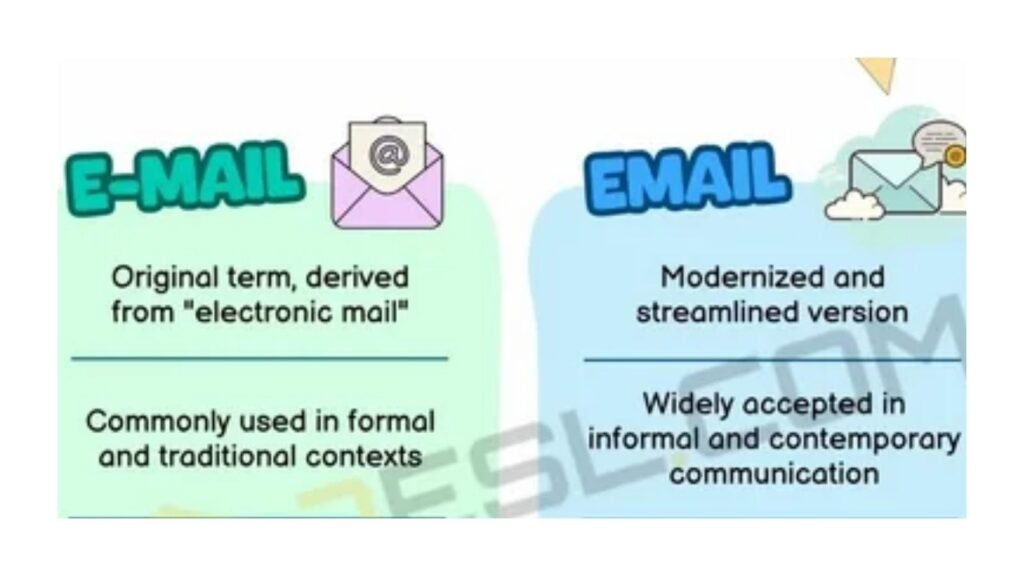
The term comes from electronic mail, which was shortened to e-mail in the early days of the internet. The hyphen highlighted the connection between “electronic” and “mail.”
As digital communication became mainstream, many publishers and dictionaries simplified the spelling to email, following the same pattern as words like online and website, which also lost their hyphens over time.
Today, email is the dominant form in everyday writing.
British English vs American English Spelling
Unlike many spelling differences, both British and American English generally prefer email today.
| Feature | American English | British English |
|---|---|---|
| Modern preferred spelling | ||
| Older acceptable variant | ||
| Common business usage |
Example Sentences
| Style | Example |
|---|---|
| Modern | Please check your email inbox. |
| Traditional | I received your e-mail yesterday. |
Which Spelling Should You Use?
Choose your spelling based on audience and style guide.
- US readers: Use email.
- UK readers: Use email.
- Business writing: Prefer email.
- Academic or legacy publications: Follow the required style guide if it specifies e-mail.
- Global websites: Email is the safest and most widely recognized choice.
Consistency matters more than preference.
Common Mistakes with Email or E-mail
Mixing styles
❌ Please send an email, then reply by e-mail.
✅ Use one spelling consistently throughout the document.
Assuming e-mail is incorrect
It is not wrong, but it is less common in modern usage.
Using unnecessary capitalization
Write email, not Email, unless it begins a sentence.
Email or E-mail in Everyday Examples
|See learn more: Spicey or spicy
Business Communication
Please send the signed contract by email.
News
The company notified customers through email.
Social Media
Check your email for the verification code.
Formal Writing
Applicants must submit supporting documents by email before the deadline.
Email or E-mail – Google Trends & Usage Data
Search data and publishing trends show that email overwhelmingly dominates modern English usage.
- Most searches use email without a hyphen.
- Technology companies and software interfaces almost always display email.
- Major style guides have increasingly adopted the unhyphenated form.
- E-mail still appears in older publications and archived content but continues to decline in popularity.
Comparison Table
| Feature | ||
|---|---|---|
| Meaning | Electronic mail | Electronic mail |
| Modern usage | Very common | Less common |
| Professional writing | Preferred | Acceptable but dated |
| US English | Preferred | Older style |
| UK English | Preferred | Older style |
| SEO recommendation | Best choice | Usually unnecessary |
Frequently Asked Questions
Is it email or e-mail in British English?
In modern British English, email is the preferred spelling, although e-mail is still occasionally used. Does email have a capital E?
No. Write email with a lowercase e, unless it appears at the beginning of a sentence. When did e-mail become email?
As digital communication became widespread in the late 1990s and early 2000s, most style guides and publishers gradually adopted email without the hyphen.
Conclusion
Choosing between email or e-mail depends on style preferences, but modern usage strongly favors email. Following digital communication standards, writing consistency, professional language, grammar best practices, and SEO-friendly spelling helps create polished content. Use one form consistently to improve readability and communicate clearly with your audience.

Hi, I’m John Miles, the voice behind Grammar Meaning! I share clear and practical grammar tips. You’ll find my work on basicsgrammar.com.