

Many people often confuse the words peek and peak, especially when writing or speaking quickly. Both sound alike but have very different meanings and uses. People search for peek or peak to clarify which spelling to use in different contexts, avoid embarrassing mistakes, and improve their English vocabulary. This article will clear up the confusion, explain the origins, usage, and provide clear examples to help you master these commonly mixed-up homophones.
Choosing the Right Word: When to Use Peek vs Peak
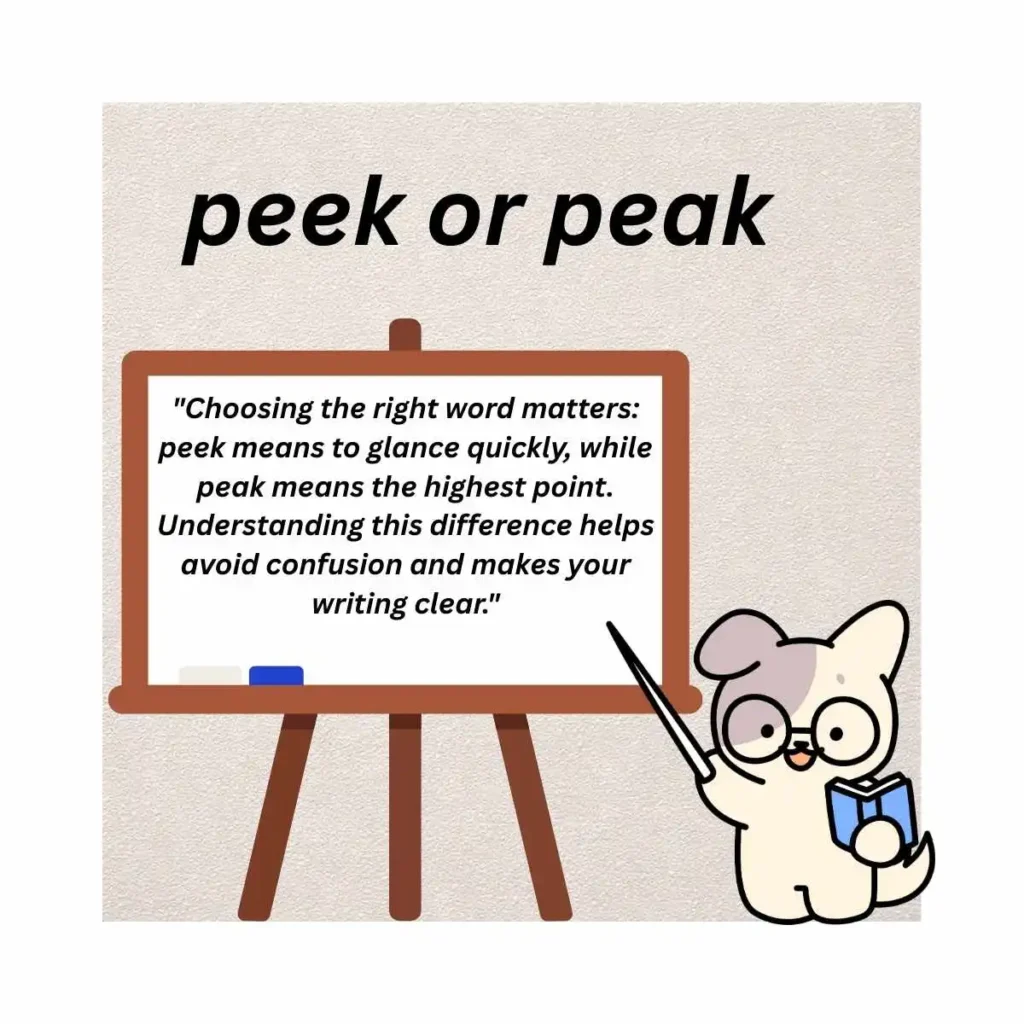
Selecting between peek and peak depends entirely on their meanings and the context in which they are used. Peek is a verb that means to take a quick or secretive glance at something, often implying curiosity or a brief look. For example, “She took a peek at the surprise gift.” In contrast, peak is primarily a noun referring to the highest point of something, such as a mountain or performance level, or a verb meaning to reach the highest point. For instance, “The climbers reached the peak at dawn.” Understanding these distinctions ensures your writing is precise and conveys the intended message clearly. Using the wrong word can confuse readers and reduce the professionalism of your communication.
Practical Examples of Peek and Peak in Writing
Incorporating peek and peak correctly in your writing enhances clarity and style. For example, in informal contexts or narrative storytelling, peek is often used to describe quick glances: “He peeked through the curtains to see who was outside.” Meanwhile, peak appears in discussions about limits or extremes, such as “The athlete’s performance peaked during the championship.” These examples highlight how each word functions differently across sentences. Writers should pay attention to their specific meanings and grammatical roles to avoid common mistakes and to create vivid, accurate descriptions in both formal and casual writing.
Peek or Peak: Clear Definitions and Key Differences
Peek and peak are homophones — words that sound alike but differ in spelling and meaning. Peek refers to a brief, often secretive look, functioning mostly as a verb. Peak generally denotes the highest or most intense point of something, and it can be a noun or a verb. This fundamental difference makes it essential to distinguish between the two, especially in professional writing, to prevent ambiguity. Misusing peek for peak or vice versa can disrupt the reader’s understanding and weaken your message. By mastering their definitions and applications, you can enhance your language precision and avoid common pitfalls.
Quick Quiz: Test Your Understanding of Peek vs. Peak
Try these quick questions to check if you can correctly distinguish between peek and peak:
- Which word means “to take a quick or secretive look”?
a) Peak
b) Peek - Which word refers to “the highest point of a mountain or performance”?
a) Peek
b) Peak - Choose the correct word: “She took a ___ at the birthday presents before the party started.”
- Fill in the blank: “The mountain climbers finally reached the ___ after a long ascent.”
- True or False: “Peek” can be used as a noun to describe the highest point.
Answers:
- b) Peek
- b) Peak
- Peek
- Peak
- False
Peek or Peak – Quick Answer
Peek means to take a quick or secretive look at something. For example: “She took a peek through the window.”
Peak means the highest point or top of something, often a mountain or figurative highest level. For example: “They climbed to the mountain’s peak.”
Remember: peek = quick glance, peak = highest point.
The Origin of Peek and Peak
Both words come from Old and Middle English but have different roots.
- Peek evolved from the Middle English piken, meaning “to look quickly.”
- Peak originated from Old English pīc, meaning “pointed top or summit.”
The different origins explain why their meanings and uses are distinct despite their similar sounds.
British English vs American English Spelling
The spelling of peek and peak is the same in both British and American English. There is no variation between the two dialects. Both follow the same rules:
| Word | Meaning | Example (UK) | Example (US) |
|---|---|---|---|
| Peek | Quick glance | “Take a peek through the door.” | “Take a peek through the door.” |
| Peak | Highest point/summit | “The peak of the mountain.” | “The peak of the mountain.” |
Which Spelling Should You Use?
Use peek when referring to a quick look, and peak when talking about the highest point or figurative high level (like peak performance). This rule applies universally—whether you are writing for a US, UK, or global audience.
Common Mistakes with Peek or Peak
- Writing peak when meaning a quick glance, e.g., “Take a peak at this.” (Incorrect)
- Writing peek when referring to a summit, e.g., “They reached the peek of the hill.” (Incorrect)
Always double-check the meaning to ensure you use the correct homophone.
Peek or Peak in Everyday Examples
- Email: “I just wanted to give you a quick peek at the draft.”
- News headline: “Tourists reached the peak of Mount Everest.”
- Social media post: “Take a peek at my new photos!”
- Formal writing: “The company reached its peak performance last quarter.”
Peek or Peak – Google Trends & Usage Data
Google Trends shows that peak is searched more frequently than peek due to its use in broader contexts like geography, sports, and business. However, searches for peek spike in contexts related to curiosity, sneak peeks, or previews. Both words enjoy steady interest globally, with a slight higher usage of peak in English-speaking mountainous regions.
Comparison Table: Peek vs Peak
| Feature | Peek | Peak |
|---|---|---|
| Meaning | Quick glance | Highest point or summit |
| Part of Speech | Verb (mostly) | Noun and verb |
| Example sentence | “She took a peek inside.” | “The peak of the mountain.” |
| Usage context | Informal, casual, secretive | Formal, geographic, figurative |
| Pronunciation | /piːk/ | /piːk/ |
FAQs About Peek or Peak
What does peak and peek mean?
Peak means the highest point; peek means a quick or secret look.
Is it peak or peek interest?
The correct phrase is “pique interest,” not peak or peek.
Can I take a peek meaning?
It means to take a quick, often secretive look.
What does peak at mean?
It means to reach the highest point at something.
What does peek at mean?
It means to glance quickly or secretly at something.
Is it a peak or a peek?
Use “peak” for a high point; “peek” for a quick look.
Is peek an English word?
Yes, peek is a correct English verb and noun.
What is a peek around?
It means to look quickly or cautiously around a place.
Why do kids say peak?
Kids often confuse “peek” with “peak” due to similar pronunciation.
Conclusion
Understanding the difference between peek and peak is essential for clear and correct English communication. Remember, peek is about a quick or secretive look, while peak refers to the highest point or top level. Using these words correctly avoids confusion and improves your writing quality, whether in emails, articles, or casual conversation. With practice and awareness of their distinct meanings, you can confidently choose the right word every time.