Quick Answer
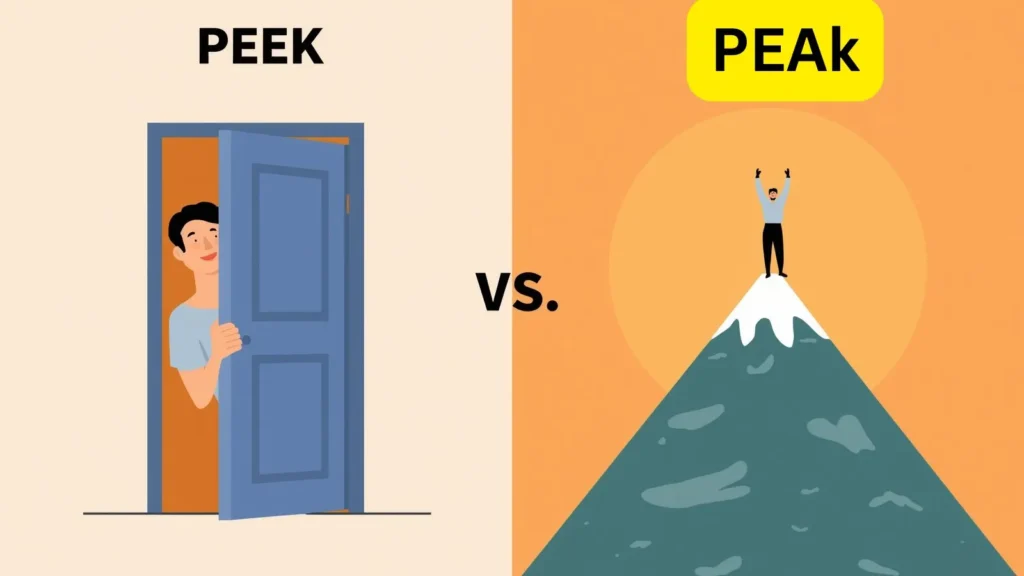
The difference between peek or peak is simple: peek means to glance secretly or quickly, while peak refers to the top, highest point, or maximum.
Emaples:
- “I took a quick peek at the surprise gift.”
- “We climbed to the mountain peak at sunrise.”
Meaning of Peek and Peak
Peek – To look quickly or secretly. Example: She took a peek inside the box.
Peak – The top or highest point of something, like a mountain, performance, or skill. Example: His productivity is at its peak in the morning.
Both words reflect control and timing: peeking shows a fleeting action, while reaching a peak shows mastery or maximum level.
Why People Misspell Peek or Peak
Many confuse peek or peaks due to English double letters. Words like address and success often trip writers. Typing quickly or relying on sound alone leads to errors:
- Incorrect: He reached his peack.
- Correct: He reached his peak.
The double “e” in peek signals a quick glance, while peak has a single “a” denoting height.
Origin of Peek and Peak
Peek originates from Middle English piken, meaning “to look quickly.”
Peak traces back to Old French pique and Latin piccare, meaning “pointed top.”
Both words have evolved over centuries, maintaining their distinct meanings in modern English.
British vs American English
Good news: spelling for peeks or peak is the same in British and American English.
| Word | British English | American English |
|---|---|---|
| Peek | peek | peek |
| Peak | peak | peak |
No regional differences exist, so you can confidently use them in essays, emails, or professional reports.
When to Use Peek or Peak
Use peek in casual or professional writing for a quick glance:
- Emails: Take a peek at the draft.
- Social media: A peek behind the scenes!
Use peak for formal, technical, or descriptive contexts:
- Essays: The athlete reached her peak performance.
- Reports: Profits hit a peak in Q4.
Common Mistakes
| Mistake Type | Incorrect | Correct |
|---|---|---|
| Single vs Double Letters | He took a pek at the results. | He took a peek at the results. |
| Confusing Peak/Peek | We peeked the mountain. | We reached the mountain peak. |
| Typing too fast | Peak at the message! | Take a peek at the message! |
Pay attention to context: peeks = glance, peak = top.
Possess in Everyday Examples
- Emails: “Here’s a peek at the quarterly report.”
- Social Media: “A quick peek behind the scenes of our launch!”
- Professional Writing: “Sales reached their peak last month.”
- School Assignments: “The peak of the Roman Empire was in 117 AD.”
Usage Comparison Table
| Context | Correct | Incorrect |
|---|---|---|
| Object/Thing | She took a peek at the gift. | She took a peak at the gift. |
| Skills/Performance | His energy is at its peak. | His energy is at its peek. |
| Legal/Business | Profits reached a peak this quarter. | Profits reached a peek this quarter. |
| Casual Speech | Take a quick peek at this! | Take a quick peak at this! |
FAQs About Peek or Peak
- How to remember the spelling?
- Peek has double “e” for “eyes,” peak has “a” like “mountain top.”
- Can I use peek in essays?
- Yes, when describing a brief glance, not height.
- Is peak always a noun?
- Mostly, but it can also be a verb: The business will peak next year.
- Do Americans spell it differently?
- No, spelling is consistent across English dialects.
- What’s a common typing mistake?
- Using “peek” instead of “peak” for heights or vice versa.
- Is peek informal?
- Yes, generally casual or descriptive; peak is more formal.
- Any tricks to remember?
- Think: peek = peek through eyes, peak = peak of a mountain.
Conclusion
Remember: peeks or peak are easy to confuse but simple to master. Use peeks for a quick glance, peak for height, performance, or maximum levels. Watch out for double letters, typing errors, and context. With these tips, your writing will be precise, polished, and free from common mistakes.

Hi, I’m Mark Cole, the voice behind Grammar Meaning! I explain tricky grammar rules in simple ways. I write useful guides on basicsgrammar.com.