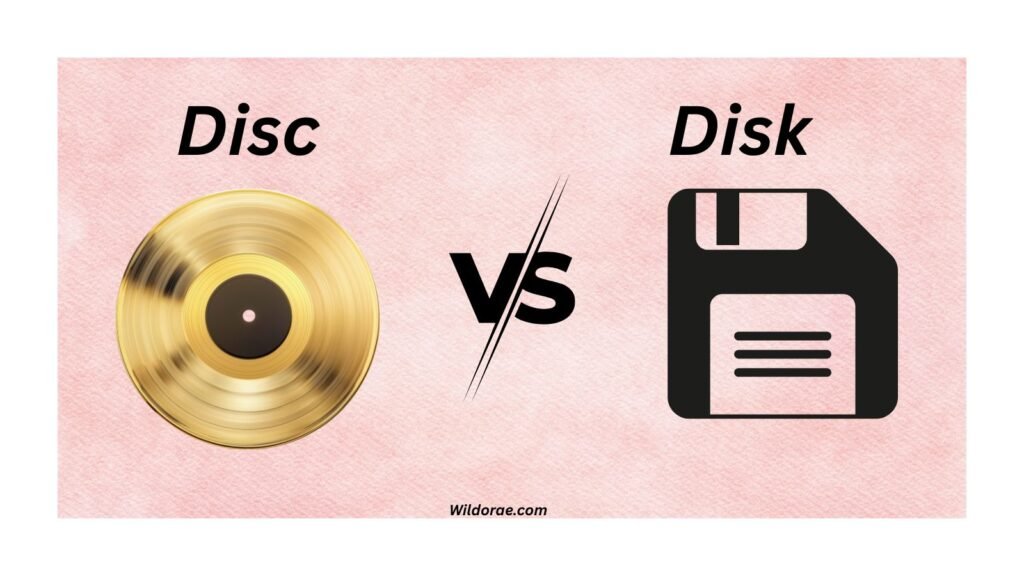
Have you ever typed disc or disk and stopped, unsure which one is right? You are not alone. Many people search this keyword because both spellings appear correct—and confusingly, they are.
You might see “hard disk” on your computer but “compact disc” on a CD. So which one should you use?
|RELATED: Envision vs Vision: Clear Meaning, Key Differences
Disc or Disk – Quick Answer
Both “disc” and “disk” are correct but used in different contexts.
Disc → Used for optical media
Examples:
- Compact disc, Blu-ray disc
Disk → Used for computers and storage
Examples:
- Hard disk, disk drive
👉 Easy rule:
- Laser = Disc
- Computer = Disk
|See also: Cocoon vs Cacoon: Real Differences Explained
The Origin of Disc or Disk
The word comes from the Latin word “discus,” meaning a flat, round object.
Over time:
“Disc” became the traditional spelling in British English
“Disk” became common in American English
Technology shaped usage:
- Early computer makers in the US used “disk”
- Media companies like CDs and DVDs used “disc”
That is why both spellings exist today—and both are correct in different cases.
British English vs American English Spelling
Tip:
- British English prefers disc
- American English prefers disk
But technology breaks this rule.
Comparison Table
| Context | British English | American English | Example |
|---|---|---|---|
| General use | Disc | Disk | Round metal disc |
| Optical media | Disc | Disc | Compact disc |
| Computer storage | Disk | Disk | Hard disk drive |
👉 Note:
Even in the UK, “disk” is used for computers.
Which Spelling Should You Use?
It depends on your audience and topic.
- For US audience → Use disk
- For UK/Commonwealth → Use disc in general, but disk for computers
- For global audience → Follow industry standard:
- Tech → disk
- Media → disc
👉 Best tip: Match the context, not just the country.
Common Mistakes with Disc or Disk
Here are frequent errors people make:
❌ Wrong: I saved the file on a compact disk
✔ Correct: I saved the file on a compact disc
Wrong: My computer disk is full (referring to CD)❌
Correct: My disc is full✔
❌ Wrong: Insert the disk (CD player)
✔ Correct: Insert the disc
👉 Key mistake: Mixing tech and media terms.
Disc or Disk in Everyday Examples
Emails
- “Please save the file to your hard disk.”
- “Burn the video onto a disc.”
|See also: Cocoon vs Cacoon: Real Differences Explained
News
- “The company released a new Blu-ray disc.”
- “The system failed due to a damaged disk.”
Social Media
- “Just found my old music discs!”
- “My laptop disk is almost full 😩”
Formal Writing
- “Data is stored on a magnetic disk.”
- “The archive is available on optical disc.”
Disc or Disk – Google Trends & Usage Data
- “Disk” is more popular in the US
- “Disc” is more common in the UK and media-related searches
- Tech searches like “hard disk” dominate globally
👉 Key insight:
- People search “disk” for computers
- People search “disc” for CDs, DVDs, and media
Comparison Table: Disc vs Disk
| Feature | Disc | Disk |
|---|---|---|
| Main use | Optical media | Computer storage |
| Examples | CD, DVD, Blu-ray | Hard disk, floppy disk |
| Region | UK preferred | US preferred |
| Industry usage | Media | Technology |
| Shape meaning | Flat round object | Same |
FAQs
Q1. Is “disc” or “disk” correct?
Both are correct. Use disc for media and disk for computers.
Q2. Why do computers use “disk”?
Early American tech companies adopted “disk,” and it became the standard.
Q3. Is it “hard disc” or “hard disk”?
Correct term: hard disk.
Q4. Is it “compact disk” or “compact disc”?
Correct term: compact disc (CD).
Q5. Do British people use “disk”?
Yes, but mainly for computer-related terms.
Q6. Which spelling is more common?
“Disk” is more common globally due to tech usage.
Q7. Can I use them interchangeably?
No. Using the wrong one can sound incorrect in context.
Conclusion
The difference between disc or disk is simple once you know the rule. Both words mean the same thing—a flat, round object—but their usage depends on context. Over time, technology created a clear split: “disc” for optical media and “disk” for computer storage.
If you remember one thing, let it be this: match the word to the situation. Writing about CDs, DVDs, or Blu-rays? Use disc. Talking about computers, data, or storage? Use disk. This rule works worldwide, no matter your audience.

Hi, I’m Alex Reed, the voice behind Grammar Meaning! I simplify English grammar into easy lessons. I write for basicsgrammar.com to help you improve daily writing.