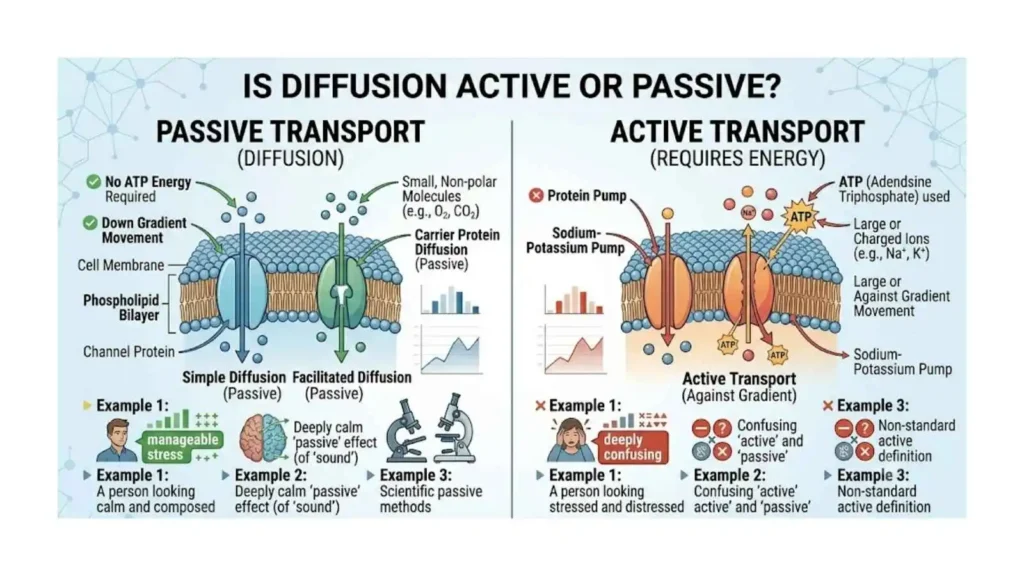
Many students ask, “is diffusion active or passive?” because they often confuse it with other cell transport processes. Understanding passive transport, cell membrane, concentration gradient, molecule movement, and active transport makes biology much easier.
Diffusion occurs naturally without using cellular energy, allowing substances to move from areas of high concentration to low concentration. Learning this basic concept helps explain respiration, nutrient exchange, and many essential functions inside living organisms.
|See also: someday or one day
Is Diffusion Active or Passive? – Quick Answer
Diffusion is passive transport. It moves molecules from a region of high concentration to a region of low concentration without using cellular energy (ATP).
Example:
- Oxygen diffuses from the lungs into the bloodstream.
- Carbon dioxide diffuses from cells into the blood to be exhaled.
What Is Diffusion?
Diffusion is the spontaneous movement of particles until they become evenly distributed.
Examples :
- Food coloring spreading through water
- The smell of fresh coffee filling a room
- Oxygen entering body tissues
Because molecules move naturally, diffusion requires no energy input.
Why Is Diffusion Considered Passive?
Passive transport relies on natural concentration gradients rather than cellular energy.
Characteristics of passive diffusion:
- No ATP required
- Moves from high concentration to low concentration
- Occurs naturally
- Helps maintain cellular balance
This makes diffusion one of the most fundamental passive transport mechanisms in living organisms.
Diffusion vs Active Transport
| Feature | Diffusion | Active Transport |
|---|---|---|
| Energy Required | No | Yes (ATP) |
| Direction | High → Low concentration | Low → High concentration |
| ATP Needed | No | Yes |
| Transport Type | Passive | Active |
| Example | Oxygen entering cells | Sodium-potassium pump |
Origin of the Term “Diffusion”
The word diffusion comes from the Latin diffundere, meaning “to spread out” or “pour apart.” Scientists adopted the term to describe the natural spreading of particles through gases, liquids, or biological membranes.
Common Mistakes About Diffusion
Many learners mistakenly believe:
|SEE LEARN MORE: Unphased or unfazed
- ❌ Diffusion requires energy.
- ✅ Diffusion occurs naturally without ATP.
- Diffusion moves particles against the concentration gradient.❌
- Diffusion moves particles down the concentration gradient.✅
- ❌ Diffusion and active transport are identical.
- ✅ They are different biological processes with different energy requirements.
Everyday Examples of Diffusion
Diffusion occurs around us every day:
- Perfume scent spreading across a room
- Tea dispersing in hot water
- Oxygen moving into blood vessels
- Carbon dioxide leaving body tissues
- Food coloring mixing into water
These examples illustrate passive movement without external energy.
Why Students Search “Is Diffusion Active or Passive”
This biology question appears frequently in classrooms and exams because students often compare diffusion with osmosis and active transport.
Common search intentions include:
- Understanding passive transport
- Preparing for biology tests
- Learning cell membrane functions
- Comparing diffusion with active transport
Tips to Remember
A simple memory trick:
Diffusion drifts downhill. Active transport climbs uphill.
If molecules move naturally from high to low concentration, the process is passive.
People also ask
Does diffusion use ATP?
No. Diffusion does not use ATP because it is a passive transport process that occurs naturally. Is diffusion a passive movement?
Yes. Diffusion is a passive movement in which molecules travel from an area of higher concentration to an area of lower concentration without energy. What makes diffusion passive?
Diffusion is passive because it moves substances down their concentration gradient and requires no cellular energy (ATP). What are the 4 types of passive transport?
The four common types of passive transport are simple diffusion, facilitated diffusion, osmosis, and filtration.
Summary
In summary, diffusion is a passive process that requires no ATP and follows a natural concentration gradient. By understanding passive diffusion, cell transport, active transport comparison, molecular movement, and biological processes, you can confidently answer exam questions and strengthen your science knowledge. Mastering these concepts makes learning biology simpler, clearer, and more accurate.

Hi, I’m Alex Reed, the voice behind Grammar Meaning! I simplify English grammar into easy lessons. I write for basicsgrammar.com to help you improve daily writing.