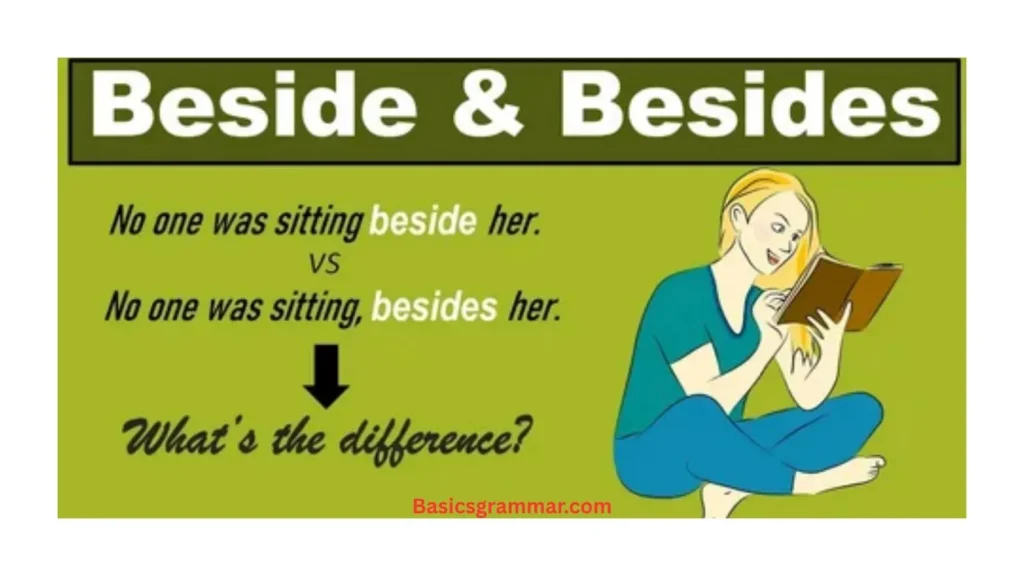
When choosing between beside and besides, many English language learners hesitate. Despite having nearly identical appearances, the words serve different purposes in a sentence. Using the incorrect one can confuse readers and give the impression that your writing is less professional. Fortunately, if you grasp the fundamentals, the distinction is simple to recall.
|See more: Contractor vs contracter
This tutorial illustrates the differences between beside and besides, emphasizes their grammatical functions, includes real-world examples, talks about regional usage, examines typical errors, and gives straightforward advice for always selecting the right word. Gaining proficiency with this combination will boost your confidence and clarity when writing emails, essays, blog posts, or business documents.
What Do “Beside” and “Besides” Mean?
Although they differ by only one letter, these words serve different purposes.
Beside
Beside is a preposition meaning next to, by the side of, or close to.
Examples:
- The chair is beside the window.
- She sat beside her best friend.
- A lamp stood beside the bed.
Besides
Besides usually means in addition to, apart from, or also.
Examples:
- Besides English, she speaks French.
- I have other plans besides work.
- Besides, we already finished the project.
Key Difference Between Beside and Besides
The easiest way to remember the distinction is:
|SEE LEARN MORE: Insuring vs ensuring
- Beside = next to
- Besides = in addition to
Quick Comparison
| Word | Meaning | Example |
|---|---|---|
| Beside | Next to | The dog slept beside the couch. |
| Besides | In addition to | Besides coffee, we also serve tea. |
Origin of the Words
Both words trace their roots to Old English.
- Beside developed from words meaning “by the side.”
- Besides evolved later by adding -s, expanding the meaning to include “in addition” or “moreover.”
Although closely related historically, their modern meanings differ significantly.
British English vs American English Usage
Unlike many spelling pairs, beside and besides do not differ between British and American English.
| British English | American English |
|---|---|
| beside | beside |
| besides | besides |
Both regions use the same spellings and meanings.
Spell Checkers and Language Settings
Modern spell checkers generally recognize both beside and besides as correct words. However, they cannot always determine whether you selected the correct one for your sentence.
Example:
- ❌ Besides the sofa sat a cat. (Incorrect if you mean “next to.”)
- ✅ Beside the sofa sat a cat.
Always proofread for meaning rather than relying entirely on automated tools.
Similar English Word Pairs
Many learners confuse similar-looking words. Examples include:
- organise / organize
- realise / realize
- recognise / recognize
- apologise / apologize
Unlike those regional spelling variations, beside and besides represent different meanings and grammatical uses.
Common Mistakes
Mistake 1
❌ I parked my car besides the building.
✅ I parked my car beside the building.
Mistake 2
❌ Beside math, I enjoy science.
✅ Besides math, I enjoy science.
Mistake 3
❌ She stood besides me during the ceremony.
✅ She stood beside me during the ceremony.
Why Correct Usage Matters
Choosing between beside and besides improves precision and professionalism.
Clear grammar helps:
- Build reader trust
- Improve academic writing
- Strengthen business communication
- Avoid misunderstandings
- Enhance overall writing quality
Even small word choices can significantly affect clarity.
Tips to Remember
Use this simple memory trick:
- Beside = Side → both relate to location.
- Besides = Plus → think “plus” or “in addition.”
If you can replace the word with “next to,” choose beside. If you can replace it with “also” or “in addition,” choose besides.
Everyday Examples
- Please sit beside me.
- Besides cooking, she enjoys painting.
- The bicycle remained beside the garage.
- Besides that issue, everything looks fine.
- He placed the keys beside the notebook.
Frequently Asked Questions
- Where do we use “besides”?
Use besides to mean “in addition to” or “also.” Example: Besides English, she speaks Spanish. - What is the difference between “beside” and “aside”?
Beside means “next to,” while aside means “to one side” or “separately from the main topic.” - Are there common mistakes in using “beside” and “besides”?
Yes. Many people mistakenly use besides when they mean next to, but beside is the correct choice for location. - What is the correct way to use “beside”?
Use beside to show that something is next to or by the side of something else. Example: The car is parked beside the house.
Conclusion
Knowing the difference between beside and besides helps you write more accurately and clearly. Despite the single letter difference between the two terms, alongside offers more details or concepts, whilst beside specifies a physical situation. Both variants may be accepted by spell checkers, but proper usage can only be ensured by meticulous proofreading.
You may steer clear of common errors and write confidently in academic, professional, and everyday contexts by practicing with examples and retaining their unique meanings.