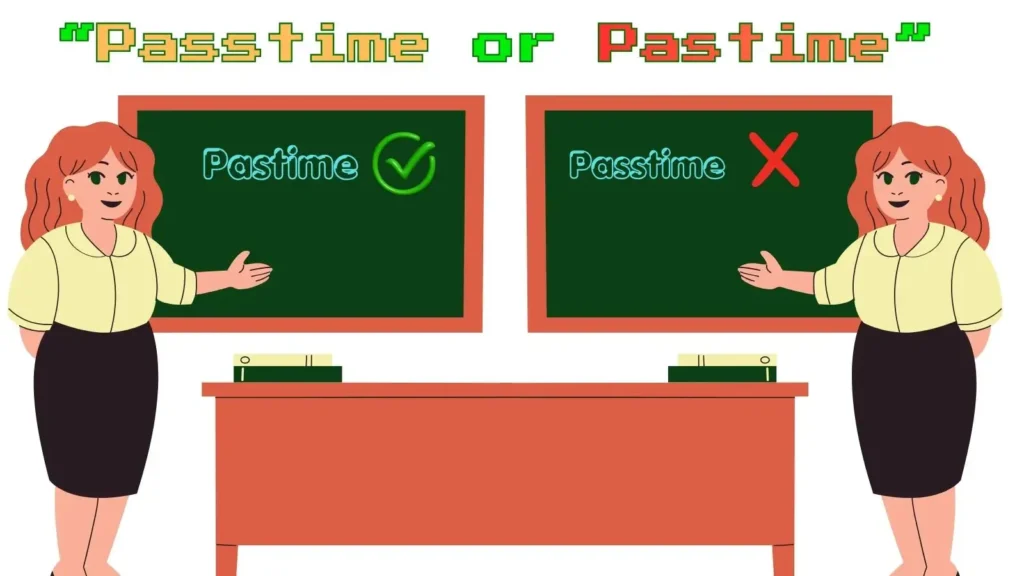
Have you ever typed “passtime or pastime” and stopped because both spellings look possible? You are not alone. This is a common spelling question because passtime seems logical at first glance. After all, the word combines the ideas of “pass” and “time.”
“However, English has one standard spelling for this word: pastime.”
A pastime is an activity that you enjoy during your free time. Reading, gardening, fishing, painting, and playing games can all be pastimes. Major English dictionaries list pastime as the correct form. Oxford defines it as something you enjoy doing when you are not working.
So, why does passtime appear so often online? The answer is simple. People often spell the word based on how it sounds or on the phrase “pass time.” This creates a natural spelling mistake.
You will learn the correct spelling, its history, common mistakes, regional usage, real-life examples, and simple rules to remember it.
RELATED: Break Metal or Brake Metal: Understanding the Correct Usage
Passtime or Pastime – Quick Answer
“Pastime is the correct spelling.”
Passtime is a common misspelling and should generally be avoided in standard English.
Correct:
- Reading is my favorite pastime.
- Fishing is a relaxing pastime.
- Watching movies is a popular pastime.
- Gardening is an enjoyable pastime.
Incorrect:
- Reading is my favorite passtime.
- Fishing is my favorite passtime.
The key point is easy to remember:
Correct: pastime
Incorrect: passtime
The word pastime means an activity that you do for pleasure during your free time. It is similar to hobby, recreation, leisure activity, or entertainment. Oxford notes that “pastime” is often used when discussing activities people enjoy generally.
Pastime in a sentence
Photography is a popular pastime among travelers.
Here, photography is an activity done for enjoyment, not as a job.
The Origin of Pastime
The spelling pastime has a long history.
Oxford traces the word to the late 15th century. It comes from the verb pass plus time and was influenced by the French expression passe-temps.
The basic idea was simple: to pass time by doing something enjoyable.
Over time, English developed the noun pastime as a single word. Therefore, although the expression pass time is still correct, the noun pastime has its own established spelling.
This difference explains much of the confusion.
Compare these examples:
- I pass time by reading.
- Reading is my favorite pastime.
The first example uses a verb phrase. The second uses a noun.
That small difference matters.
Why do people write “passtime”?
The spelling passtime probably looks natural because English speakers already know the phrase pass time.
Example:
“I read books to pass time.”
It is easy to assume that the noun should be written passtime. However, standard English uses pastime.
English contains many words whose spelling cannot always be predicted from their individual parts. That is why checking the established dictionary form is often safer than creating a spelling from logic alone.
British English vs American English Spelling
There is no major British-versus-American spelling difference for this word.
Both British and American English use:
pastime
Oxford lists pastime in both its general British English dictionary and American English dictionary.
The same spelling is also used in other major varieties of English.
| Variety of English | Correct Spelling | Example |
|---|---|---|
| British English | pastime | Reading is a popular pastime. |
| American English | pastime | Baseball is a popular pastime. |
| Canadian English | pastime | Hiking is an enjoyable pastime. |
| Australian English | pastime | Fishing is a common pastime. |
| New Zealand English | pastime | Gardening is a relaxing pastime. |
| International English | pastime | Music can be a wonderful pastime. |
Therefore, you do not need to change the spelling based on your audience.
Some English words have regional differences, such as favourite/favorite and colour/color. Pastime is not one of them.
Pastime vs. Pass Time
This is another important distinction.
| Form | Type | Meaning | Example |
|---|---|---|---|
| pastime | Noun | A leisure activity | Reading is my pastime. |
| pass time | Verb phrase | Spend time doing something | I read to pass time. |
| passtime | Nonstandard spelling | Usually a misspelling of pastime | Avoid this form. |
This distinction solves many spelling problems.
Which Spelling Should You Use?
If you are writing an article, email, school assignment, business document, or social media post, use pastime.
There is no need to choose between British and American spelling here because both varieties use the same form.
For US readers
Use:
Baseball is a favorite American pastime.
Notice that favorite uses the American spelling, but pastime stays the same.
For UK readers
Use:
Gardening is a popular British pastime.
The word remains pastime.
For Commonwealth readers
Writers in countries such as Canada, Australia, and New Zealand should also use pastime.
For global audiences
Pastime is the safest choice because it is the standard English spelling across major English varieties.
If you remember only one rule, remember this:
Use “pastime” when you mean a leisure activity.
Common Mistakes with Pastime
Several mistakes appear because people connect the noun with the phrase pass time.
1. Writing “passtime”
❌ Reading is my favorite passtime.
✅ Reading is my favorite pastime.
The extra s does not belong in the noun.
2. Confusing “pastime” with “pass time”
❌ Football is something I pass time.
✅ Football is a popular pastime.
Or:
✅ I watch football to pass time.
The noun and verb phrase have different grammatical roles.
3. Using “past time”
Another possible mistake is writing the two words separately.
Usually, past time does not mean a hobby or leisure activity.
For example:
It is past time to leave.
Here, “past time” relates to something being overdue. It does not mean a hobby.
4. Assuming “passtime” is a British spelling
It is not.
British English uses pastime, just like American English.
5. Adding unnecessary hyphens
❌ past-time
✅ pastime
The standard noun is written as one word.
Pastime in Everyday Examples
The word pastime works in many types of writing.
In everyday conversation
Reading is a quiet pastime.
What is your favorite pastime?
Gardening became her favorite pastime after retirement.
emails
Photography has become a relaxing pastime for me.
My favorite pastime is hiking with friends.
news writing
Cricket remains a popular pastime for millions of fans.
Fishing has long been a favorite pastime in the region.
On social media
Weekend pastime: hiking and taking photos!
What is your favorite pastime?
Books, coffee, and a quiet afternoon. Perfect pastime.
In formal writing
Outdoor recreation can provide a healthy and enjoyable pastime.
The study examined how leisure activities influence people’s choice of pastime.
The word can sound slightly more formal than hobby, but it is still common and natural.
Pastime vs. Hobby
Pastime and hobby are close in meaning, but they are not always used in exactly the same way.
A hobby usually describes an activity that someone regularly enjoys.
A pastime can describe any enjoyable way of spending free time.
Example:
“My hobby is painting.”
“Watching television is a common pastime.”
Oxford explains that hobby often describes an activity a person actively pursues, while pastime is often used more generally for activities people enjoy.
Both words are correct. The best choice depends on context.
Comparison of common variations
| Word or Phrase | Correct? | Meaning | Example |
|---|---|---|---|
| pastime | ✅ Yes | Leisure activity | Reading is my pastime. |
| passtime | ❌ No | Common misspelling | Avoid this spelling. |
| pass time | ✅ Yes | Spend time | I read to pass time. |
| past time | ⚠️ Context-dependent | Time that has passed/overdue | It is past time to go. |
| past-time | ❌ Usually no | Nonstandard form for this meaning | Use pastime instead. |
| hobby | ✅ Yes | Regular leisure activity | Painting is my hobby. |
| recreation | ✅ Yes | Activity for pleasure | Walking is good recreation. |
Passtime or Pastime – Google Trends & Usage Data
People often search Google for “passtime or pastime” because spelling questions usually arise when a word sounds correct but looks uncertain in writing.
Google Trends measures search interest on a relative scale rather than giving an exact number of searches. It allows users to compare terms by location, time period, and search category.
For this keyword, search behavior is especially useful because people may search for several forms:
- passtime or pastime
- pastime or passtime
- is passtime a word
- pastime meaning
- passtime meaning
- past time vs pastime
The important usage pattern is that pastime is the established dictionary spelling, while passtime is generally a spelling error.
Search interest can also vary by country. English-speaking regions may produce searches related to spelling, grammar, or vocabulary. Students, English learners, editors, and writers are especially likely to search for this type of comparison.
However, Google Trends should not be treated as a dictionary or proof of correct spelling. A misspelled word can receive many searches simply because people are unsure about it.
That is why dictionary evidence and standard usage matter more than search volume when deciding which spelling is correct.
How to Remember the Correct Spelling
A simple memory trick can help.
Think of:
past + time = pastime
The word has only one s between pa and time:
pas + time = pastime
Do not add another s.
You can also connect the noun with this sentence:
A pastime helps you pass time.
Notice the difference:
- You pass time.
- A pastime helps you do it.
This trick makes the spelling easier to remember.
When Should You Use “Pastime”?
Use pastime when you are talking about an enjoyable activity done during free time.
Good examples include:
- Reading
- Fishing
- Gardening
- Painting
- Hiking
- Cooking
- Photography
- Watching movies
- Playing games
- Collecting stamps
Example:
“Gardening is a peaceful pastime.”
The word does not require the activity to be serious, expensive, or productive. A pastime can be almost anything people enjoy during their free time.
FAQs About Passtime or Pastime
1. Is “passtime” a correct word?
No. Pastime is the standard spelling for an activity that you enjoy during your free time. Passtime is generally considered a misspelling.
2. Is it “pastime” or “passtime”?
The correct spelling is pastime. It contains one s before “time.”
3. Is “pastime” one word?
Yes. Pastime is normally written as one word.
4. What does pastime mean?
A pastime is an activity that you enjoy during your free time. For example, reading, fishing, and gardening can all be pastimes.
5. Is “pass time” different from “pastime”?
Yes. Pass time is a verb phrase meaning to spend time doing something. Pastime is a noun meaning a leisure activity.
I read books to pass time.
Reading is my favorite pastime.
6. Is “pastime” used in American English?
Yes. American English uses pastime. Oxford’s American English dictionary lists the same spelling.
7. What is another word for pastime?
Common alternatives include hobby, recreation, leisure activity, interest, and amusement. The best synonym depends on the sentence.
Conclusion
When choosing between passtime or pastime, the answer is clear: pastime is the correct spelling. It is the standard noun for an activity that someone enjoys during free time.
The confusion comes from the phrase pass time, which has a different grammatical function. You can pass time by reading, but reading can be your pastime. Once you understand this difference, the spelling becomes much easier.
There is also no British-versus-American spelling issue here. Both major varieties use pastime. The same form works well in professional writing, school assignments, emails, articles, news stories, and everyday conversation.
So, avoid passtime when you mean a leisure activity. Instead, remember the simple pattern: pass time is a verb phrase, while pastime is a noun.
If you are ever unsure, choose pastime. It is the standard, professional, and widely accepted spelling.